Should You Upgrade Your Camera or Maximize What You Have?
The decision to upgrade your camera hinges less on whether you’re using 20% or 100% of its capabilities and more on what your needs, aspirations, and limitations are as a photographer. Cameras today, particularly DSLRs and mirrorless models, pack an extraordinary amount of features, many of which are designed for niche use cases or highly specific scenarios. The truth is, most photographers—casual and even professional—rarely tap into the full potential of their cameras. This isn’t a failing; it’s a matter of focusing on the tools that serve your style and creative goals.
If you’re contemplating an upgrade, start by evaluating your current camera. Are there technical limitations holding you back? Perhaps you’re frequently shooting in low light and struggling with noise, or you find that your camera’s autofocus is too slow for action shots. Maybe the resolution isn’t sufficient for large prints, or you’re intrigued by cutting-edge features like in-body stabilization, improved dynamic range, or enhanced video capabilities. If your creative pursuits demand these improvements and your current camera is holding you back, an upgrade might be worth considering.
However, if you’re simply lured by newer models or feeling a bit of gear envy, it’s worth pausing to assess whether a new camera will truly elevate your photography. Often, investing time in understanding and mastering your current equipment yields far more significant results than jumping to a newer model. A deep dive into your camera’s manual, experimenting with its advanced features, or even taking a photography workshop can dramatically improve your output without spending a cent on new gear.
Sometimes, the desire for an upgrade stems not from the camera itself but from ancillary aspects like lenses or accessories. In fact, upgrading your lens can have a more profound impact on your work than upgrading the body. A high-quality prime or a specialized lens might open up new creative doors that a new camera body cannot.
Ask yourself: What do you truly need? If you’re satisfied with your current results and feel your limitations are more about technique than technology, hold off. If your gear is preventing you from achieving your vision, it’s time to consider what an upgrade might offer.
What often gets overlooked in this whole upgrade-versus-mastery debate is how dramatically photography changes when you stop thinking in terms of gear and start thinking in terms of problems. Every camera you own is essentially a problem-solving machine, and once you frame your frustration as a concrete limitation rather than a vague sense of “this could be better,” the path forward becomes clearer. If the problem is missed focus, that’s technique, settings, or lens choice. If it’s motion blur, that’s shutter discipline or light management. If it’s flat images, that’s usually light, timing, or perspective, not silicon. When you identify problems this way, you often discover that your current camera is far more capable than you gave it credit for, and that the real upgrade is in how deliberately you use it, how patiently you wait for light, how intentionally you choose where to stand.
There’s also the psychological side, and it’s a sneaky one. New gear can temporarily make you shoot more, walk farther, look harder, simply because it feels new and exciting. But that motivation fades, while skill compounds. A camera you know deeply becomes an extension of your hands; you stop thinking about menus and start reacting instinctively. That familiarity is worth more than a spec bump, especially in moments that matter—street scenes that last two seconds, expressions that vanish, light that only works once. Ironically, photographers who upgrade less often tend to make stronger work because they’re not constantly recalibrating their muscle memory or chasing novelty instead of vision.
And yet, upgrades are not the enemy. They’re just misunderstood. The best upgrades usually arrive after you’ve hit the ceiling of your current system so many times that the limitations are no longer theoretical—they’re felt in your bones. You know exactly why you need better high-ISO, or faster autofocus, or lighter gear for travel, because you’ve lost images without them. At that point, upgrading isn’t indulgence; it’s efficiency. It removes friction from your process and lets you focus on seeing rather than fighting your tools. The danger is upgrading before you’ve reached that stage, when the camera becomes a distraction instead of a solution.
So the real question isn’t whether to upgrade or not. It’s whether you’ve extracted enough from what you already own to know precisely what you’re upgrading for. When that answer is clear, the decision becomes almost boringly obvious. Until then, squeezing every last drop out of your current camera is not restraint—it’s training. And training, inconvenient as it sounds, is still the most powerful upgrade available.
Take a very specific, very real-world combo like the Canon R100 paired with a TTArtisan 50mm f/1.2, and the whole “upgrade or master” question stops being abstract and turns into a hands-on, slightly chaotic, incredibly instructive exercise. On paper, it’s almost a weird pairing: an entry-level RF-mount body that keeps things simple, and a fully manual, ultra-fast, character-heavy lens that basically refuses to do anything for you. But that’s exactly why it’s such a good teacher. The R100’s APS-C sensor turns that 50mm into an 80mm full-frame equivalent field of view, so you’re living in short-telephoto territory—portraits, details, compressed street scenes, museum fragments, that kind of thing—and f/1.2 on APS-C gives you a look that can feel surprisingly “big camera,” even though, technically speaking, depth of field behaves more like about f/1.9 in full-frame equivalence for framing and subject distance. Still, it’s shallow enough that you’ll miss focus a lot at first, and yes, that’s part of the point.
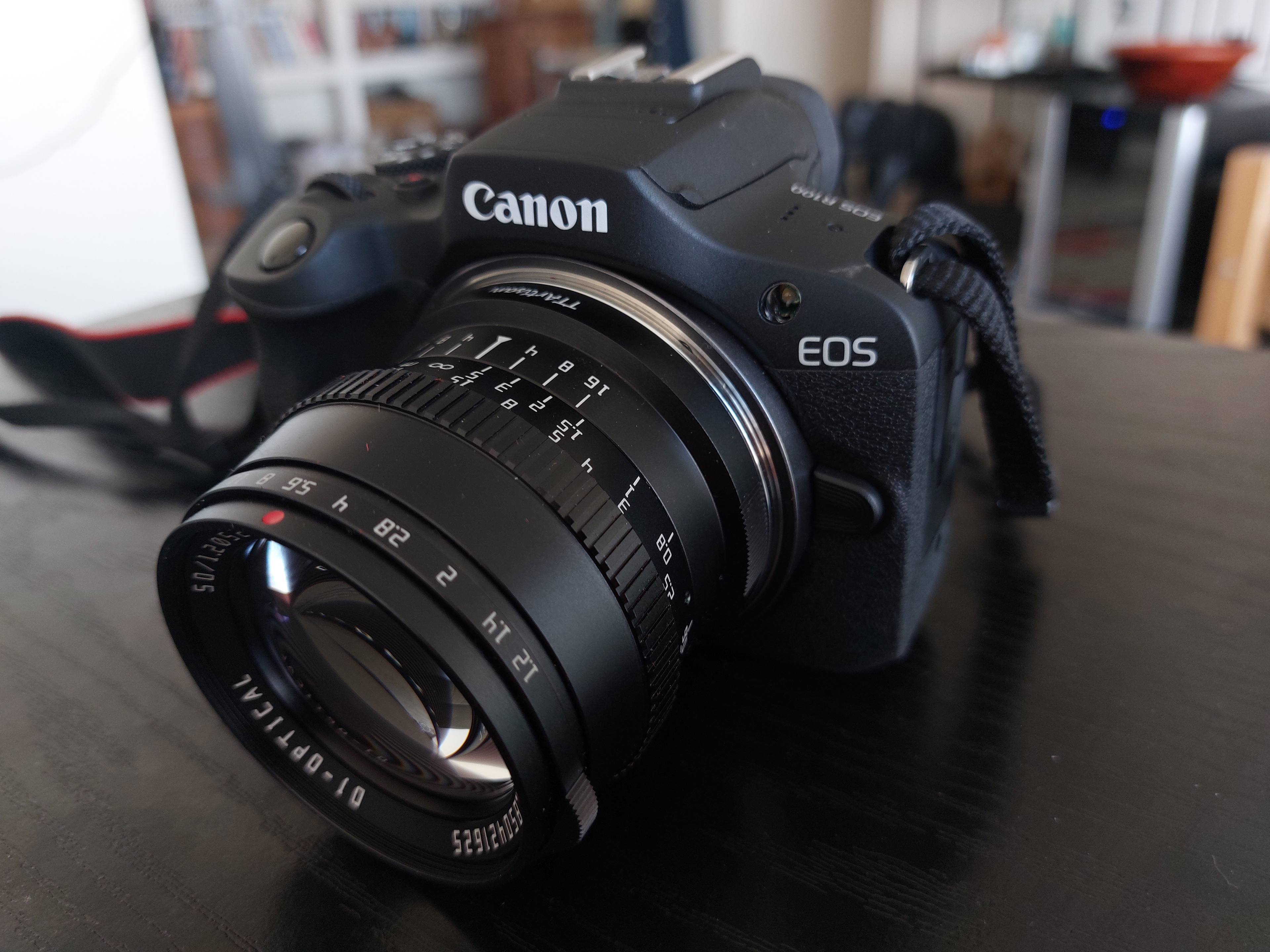
Here’s the technical reality that decides whether you’ll love this setup or hate it: you’re manual focus only, and at an 80mm equivalent angle of view, your margin for error is thin. At close portrait distances, depth of field at f/1.2 is the kind of thin where eyelashes can be sharp and the iris can drift soft if you breathe wrong. The R100 doesn’t have in-body stabilization, and that matters more than people admit when you’re using an 80mm equivalent lens. The old “1 over focal length” rule becomes “1 over 80” as a baseline, and in practice you’ll want 1/160 or even 1/250 if your subject is alive (and they usually are). Without stabilization, your keeper rate is going to be dictated by shutter speed discipline, not just how steady you feel. The funny thing is, this combo pushes you into better habits fast: you start respecting shutter speed the way you respect gravity.
Metering and exposure behavior also become part of the learning curve. With a manual lens like the TTArtisan 50mm f/1.2, you’re using the lens’ physical aperture ring, so the camera is effectively working in stop-down metering. In bright conditions, it’s easy: set ISO 100, pick a shutter speed that protects against shake (say 1/500 for street portraits), and then ride the aperture ring for the look you want. In lower light, you’ll find yourself making a three-way trade: open to f/1.2 to keep ISO reasonable, but then fight the razor-thin focus plane; stop down to f/2 or f/2.8 to get more depth of field, but then your shutter speed drops unless you raise ISO. The R100’s sensor is perfectly usable, but it’s not a magical “shoot in darkness for free” machine, so you’ll feel that ISO climb. If you want a practical rule of thumb that actually works: for handheld indoor portraits, start around 1/200, f/1.2–f/2, and let ISO float, but keep a personal ceiling you can live with (for many people, ISO 3200 is a comfortable line; ISO 6400 can be fine depending on exposure and how you process). The key detail is exposure: slightly underexposed high-ISO files look rougher than correctly exposed ones. Nail exposure first, then worry about noise. Noise is annoying; underexposure is cruel.
Focusing is the main event, so you need a focusing method that matches the R100’s strengths. The most reliable approach is to use focus magnification in live view when you can, especially for static subjects—architecture details, product shots, portraits where the subject can hold still for half a second (rare, but it happens). Magnify, focus on the eye, take the shot, and don’t rush. For street and moving subjects, magnification is too slow, so you shift to a more classic technique: stop down a bit and use zone focusing. At f/4 or f/5.6, your depth of field grows enough that you can pre-focus to a distance—say 2.5 meters—and capture people moving through that plane without the constant “focus, recompose, panic” cycle. This is where the R100 actually becomes a surprisingly good partner: it’s simple, it gets out of your way, and you can set it up like a little purposeful machine. Manual lens, predictable exposure, pre-focus distance, decisive timing. It’s almost… calming. Almost.
Optically, the TTArtisan 50mm f/1.2 is not a clinical lens, and that’s not a defect, it’s a personality trait. Wide open, you’ll often see lower contrast, some glow, and a kind of soft-edged sharpness that makes highlights bloom a bit—especially in backlight or high-contrast scenes. Stop it down to f/2 and you usually get a noticeable jump in bite and contrast. By f/2.8 and f/4 it can look quite crisp in the center, with corners improving progressively. On APS-C you’re also cropping away the worst of the edges compared to full frame, which helps a lot, and that’s one of the underrated benefits here: you get more “usable character” and less “why are the corners melting.” If you shoot portraits, you’ll probably like it most between f/1.2 and f/2 for mood, and between f/2 and f/2.8 for reliability. Also, pay attention to chromatic aberration: fast lenses often show purple/green fringing on high-contrast edges, like hair against bright windows. It’s fixable in post, but it’s better to anticipate it by avoiding extreme contrast at f/1.2 when you want a clean look.
Then there’s the question that quietly decides whether you’re upgrading because you need to, or because you want to: what is this setup preventing you from doing? If you’re shooting fast-paced events, kids running, unpredictable movement, or anything where autofocus is basically your safety net, then yes, this combo is going to feel like riding a bicycle in a snowstorm. You can do it, but you’ll work for it. On the other hand, if your photography is about intention—portraits, street scenes where you can pre-visualize, travel details, slow observation—this pairing is a masterclass in control. It forces you to understand exposure as a system, not a guess. It forces you to understand depth of field as geometry, not vibes. It forces you to accept that “sharp” is not a default setting, it’s something you earn.
And here’s the twist: after a few weeks with the Canon R100 and the TTArtisan 50mm f/1.2, you may discover you don’t need a new camera body as much as you thought. What you actually needed was a constraint that made you pay attention. Or, you might discover the opposite: you love the focal length and the look, but you’re losing too many frames to missed focus and motion blur, and what you really need is a body with stabilization, better viewfinder handling, and stronger manual focus aids. Either outcome is a win, because now the upgrade decision is based on evidence, not temptation. That’s the whole point, honestly. You don’t upgrade to become better—you upgrade once you’ve become good enough to know exactly what you’re buying.