Travel Photography, Cartier-Bresson Style, With a Canon R100 and a TTArtisan 50mm f/1.2
Most people don’t think of a Canon R100 and a cheap Chinese manual 50mm as a setup worth discussing in the same breath as Henri Cartier-Bresson. But standing in front of this tiny camera, the absurdly fast TTArtisan lens flaring a little at the edges like a half-remembered summer glare, you suddenly realise something: Bresson didn’t care about gear the way the internet does. He cared about reaction time, about intent, about walking the streets ready to trip a shutter at the exact moment life blinked. And if anything, this little budget combo forces you closer to that mindset than a $4,000 mirrorless hypersensor ever will.
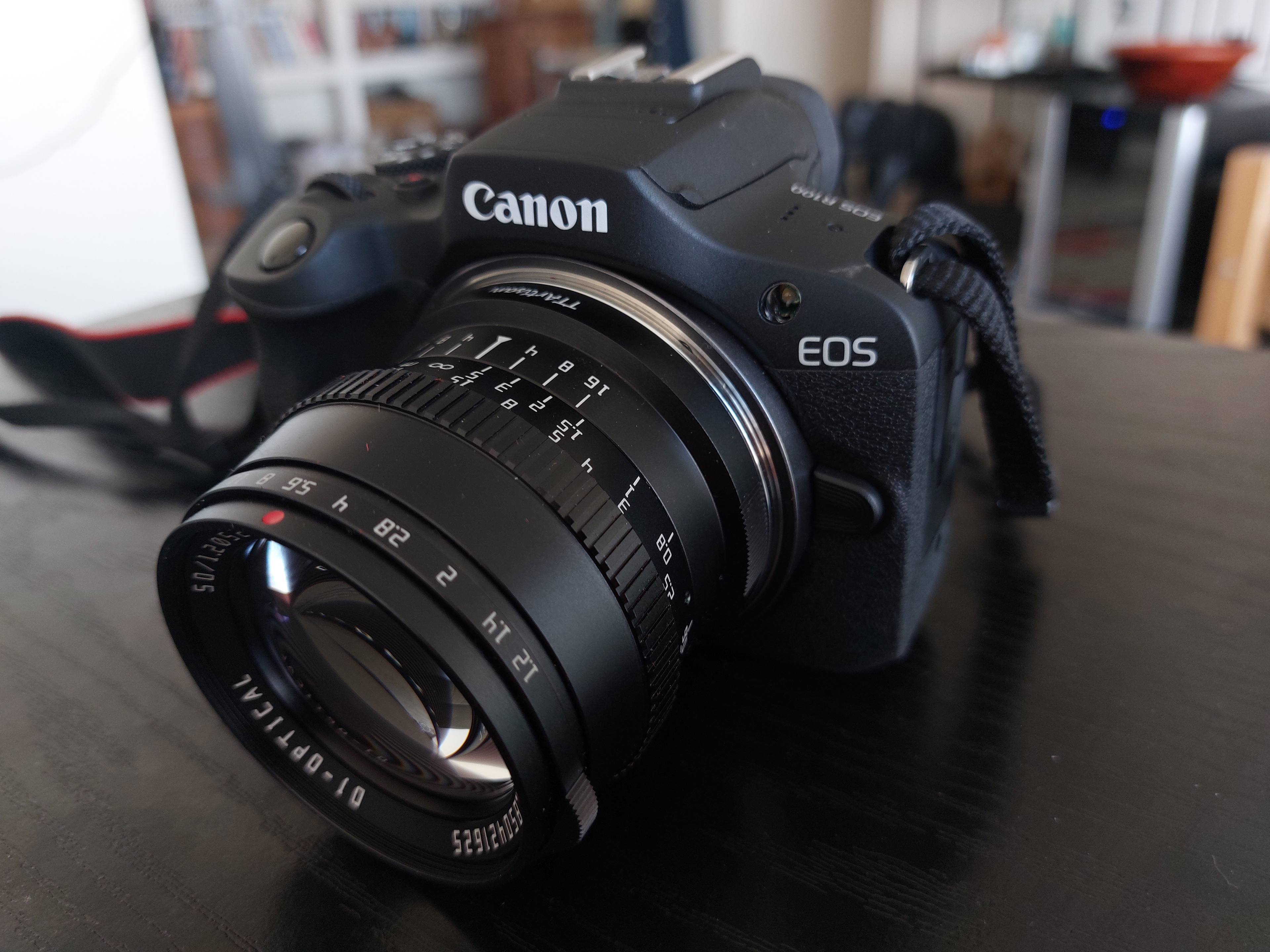
The image above says it clearly: this isn’t a luxury tool, it’s a willingness tool. The Canon EOS R100 is tiny, almost shy, like a camera that doesn’t fully believe in its own potential. The TTArtisan 50mm f/1.2 is the opposite—loud, imperfect, eager to bloom highlights and smear a bit of bokeh around the edges as if to remind you it wasn’t designed by a committee. Together they produce something unexpectedly alive. Slightly wrong. Slightly wonderful. The kind of wrong that makes you work for the frame the way photographers used to, before twenty-first-century autofocus taught us to expect the world to be sharp for us.
Here’s the quiet trick: shooting Cartier-Bresson with a modern autofocus camera often results in technically perfect images that feel emotionally sterile. But when you put a manual lens on an entry-level mirrorless body, the world slows down just enough to match the rhythm of Bresson’s philosophy. You start anticipating gestures again. You watch people’s feet instead of their faces. Your left hand learns the distance scale almost by muscle memory—one meter, two meters, three—while your right hand keeps the R100 balanced like a sketchbook rather than a machine.
People underestimate the R100 because it lacks IBIS, storms of autofocus points, and the usual spec-sheet intimidation. But the absence of stabilizers forces a firmer grip. The small viewfinder demands discipline. The limited buffer quietly insists that you stop machine-gunning and instead commit to single, deliberate frames. And with a manual 50mm, that discipline blossoms into actual vision. You’re not documenting—you’re waiting.
Cartier-Bresson talked about “the decisive moment” as if it were a butterfly you had to catch without disturbing the air around it. With this setup, you actually feel the analogy. At f/1.2, the depth of field is so thin that the world becomes a razor blade: either you’re in the groove, or you’re nowhere. It’s maddening at first. Then it becomes intoxicating. Suddenly the mistakes are the point. A sliver of sharpness cutting through a mess of blur feels more honest than a perfectly tracked 40fps burst. These frames aren’t about accuracy. They’re about the attempt.
On the road—train stations, back alleys, chaotic markets—the setup becomes almost invisible. The R100 looks like a tourist’s toy; the TTArtisan lens looks like a relic from the 1970s. People don’t pose for you. They don’t stiffen. They don’t retreat. Shooting street photography while appearing harmless is its own superpower. Bresson had a Leica. You have something smaller, lighter, quieter, and so forgettable it loops back into being perfect. You can shoot at chest level. Hip level. Through reflections. Over your shoulder. The camera becomes an extension of your attention rather than a billboard announcing your presence.
Technical quirks become strengths too. The TTArtisan’s wide-open glow turns overhead travel lighting into soft halos. The R100’s APS-C crop turns that 50mm into a tight 80mm-ish frame—almost too tight for classic street—but ideal for isolating gestures from chaotic backgrounds, Bresson-style. And if you stop down to f/2.8 or f/4, suddenly the lens behaves with surprising sharpness, giving you a beautifully retro-modern look that is half reportage, half dream.
Here’s the unconventional part: this combo teaches you to see before you raise the camera. You start recognizing micro-moments by sound: footsteps changing tempo, a bus door exhaling, the flutter of a coat in the wind. You start pre-focusing by habit—two meters for crowds, three for squares, five for cafés. You start framing without lifting the camera, because after a while your sense of 50mm becomes a muscle. You walk, you look, you predict, you move. And each time you nail one of those frames, it doesn’t feel like the camera helped you. It feels like you earned it.
If Cartier-Bresson were alive today, he probably wouldn’t care about megapixels. He wouldn’t worry about rolling shutter. He wouldn’t be scrolling YouTube for lens reviews. He would take the cheapest balanced tool he could find, stick a small fast lens on it, walk into the street, and listen for the world’s tiny fractures.
That’s why this little R100 + TTArtisan pairing works. Not because it’s good. But because it makes you good.
For a site like pho.tography.org, which lives on the conviction that photography is not the gear you buy but the way you see, this combo is an anchor—a reminder that the decisive moment has nothing to do with the size of your sensor, and everything to do with the size of your attention.
If this post becomes the landing point for new visitors arriving from your other domains, it will do what it needs to: stand out, stand apart, and signal clearly that this site isn’t another SEO-driven gear carousel. It’s a place for people who’d rather chase moments than specs.