The Telescopic Effect: How Canon’s Crop Mode Visually Extends Your Lens Reach
Canon’s crop mode is often introduced through numbers—crop factors, megapixels, percentages—but that framing misses what photographers actually feel when they flip it on. The defining experience is visual. The moment crop mode is engaged, the viewfinder tightens, distractions fall away, and the subject steps forward with a confidence that feels unmistakably telephoto. Nothing about the lens changes, no digital zoom is applied, yet the camera behaves as if the focal length itself has grown. That’s the telescopic effect. Your field of view narrows by 1.6×, and suddenly distant birds, players across a field, or compressed street details occupy the frame with intent rather than hope. You stop thinking “I’ll crop later” and start composing decisively, right there, while the moment is still alive.
What’s actually happening is brutally simple geometry. Canon’s APS-C crop uses a 1.6× reduction on both width and height, which means the sensor area in use shrinks by a factor of 2.56. That number explains the resolution shift precisely, without mystery or marketing gloss. On a high-resolution body like the Canon EOS R5, the full-frame 45-megapixel image becomes roughly 17.6 megapixels in crop mode. On a 24-megapixel body like the Canon EOS R8, crop mode delivers about 9.4 megapixels. The math is clean, predictable, and unavoidable. But treating this reduction as the headline completely misreads the point. The resolution loss is a side effect, not the purpose. The purpose is visible reach. You are choosing, in-camera, to spend all your pixels on the part of the scene that matters.
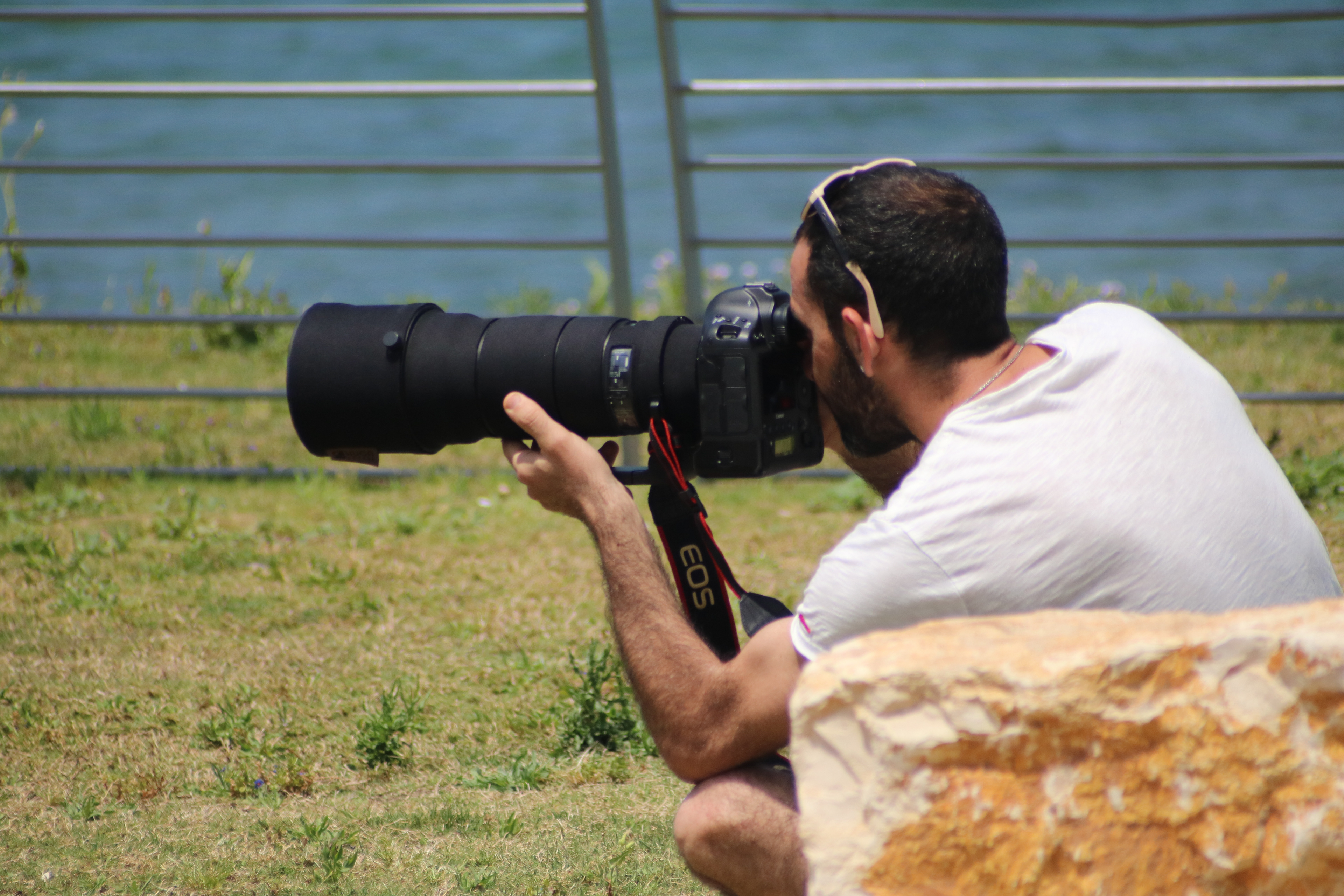
That’s exactly where crop mode earns its keep, because sometimes you really don’t want to be this guy. The image says it all: a photographer crouched low on the grass, body twisted slightly forward, both hands locked around an enormous black super-telephoto lens that dwarfs the camera body behind it. The lens barrel stretches outward like a small cannon, padded with a thick hood, heavy enough that his left hand has to cradle it from underneath just to keep the whole setup balanced. His posture looks tense, almost defensive, shoulders hunched, eye pressed hard into the viewfinder, sunglasses awkwardly pushed up on his head. Even at rest, the rig dominates the scene more than the person using it. This is the physical reality of chasing reach with glass alone—weight, attention, logistics, and a kind of visual loudness that turns photography into an endurance exercise. Crop mode is the quiet alternative. It gives you a large part of that framing power without the crouching, without the spectacle, without committing your entire shooting style to hauling a single oversized lens everywhere. Same moment, same intent, far less strain. And once you’ve experienced that freedom, standing lightly with a smaller setup while still seeing your subject “close,” the appeal of becoming this guy starts to fade pretty quickly.
The difference between cropping later and shooting in crop mode is not technical, it’s behavioral. Seeing the cropped frame live changes how you shoot. Autofocus becomes more assertive because the subject dominates the frame earlier. Background clutter disappears sooner. Your eye stops wandering. The camera encourages commitment instead of safety. This is why crop mode feels more powerful than its specifications suggest. You’re not just discarding outer pixels; you’re simplifying decision-making at the exact moment when hesitation costs shots. Full frame becomes exploratory, generous, forgiving. Crop mode becomes precise, selective, almost surgical. The lens hasn’t changed, but your relationship to distance has, and that shift alone can raise keeper rates more than any theoretical gain in resolution.
And yes, it’s worth saying plainly: the images coming out of crop mode are still more than sufficient for most real-world uses, especially online. A 17–18 megapixel file or even a 9–10 megapixel file still contains thousands of pixels on the long edge. Most websites, social platforms, newsletters, and editorial layouts never display images wider than 2000–2500 pixels anyway; anything larger is quietly downscaled. Even moderate prints hold up well when the pixels come from the sharp center of a modern sensor-lens combination. In practice, a clean, intentional 10-megapixel image often looks stronger than a loosely framed 24-megapixel file trimmed in a hurry later. The resolution number shrinks, but usability barely does.
To make the telescopic effect tangible, consider a 400 mm lens. Switch crop mode on and the framing you see is equivalent to a 640 mm lens on full frame. A bird that once felt marginal suddenly fills the frame with authority. Faces across a stadium stop being suggestions and start being subjects. The autofocus feels glued on, composition happens faster, and the shot feels earned rather than rescued. Depth of field, perspective, and light transmission remain unchanged—this is not optical magnification—but the focus reach absolutely increases. That’s why crop mode feels like gaining a longer lens without carrying one. It doesn’t replace true super-telephotos, but it reframes them as optional tools rather than mandatory upgrades.
Once that clicks, crop mode stops feeling like a compromise and starts feeling like a deliberate choice. You’re not losing pixels; you’re buying reach with intent. The math explains it, but the viewfinder sells it.