The Quiet Negotiation Between Light, Time, and a Staircase
Photography is often described as freezing a moment, but that’s a polite lie we tell ourselves to make the craft feel manageable. Nothing is frozen. Every photograph is a negotiation, sometimes gentle, sometimes tense, between light that has already left its source and time that is already slipping away. By the time the shutter closes, the moment is gone, slightly bent, slightly dishonest, and that is exactly why the image matters. A photograph is not proof of what happened; it’s proof that something aligned long enough to be noticed. This image, taken beneath a stone arcade that opens onto a grand staircase, feels like that alignment made visible.
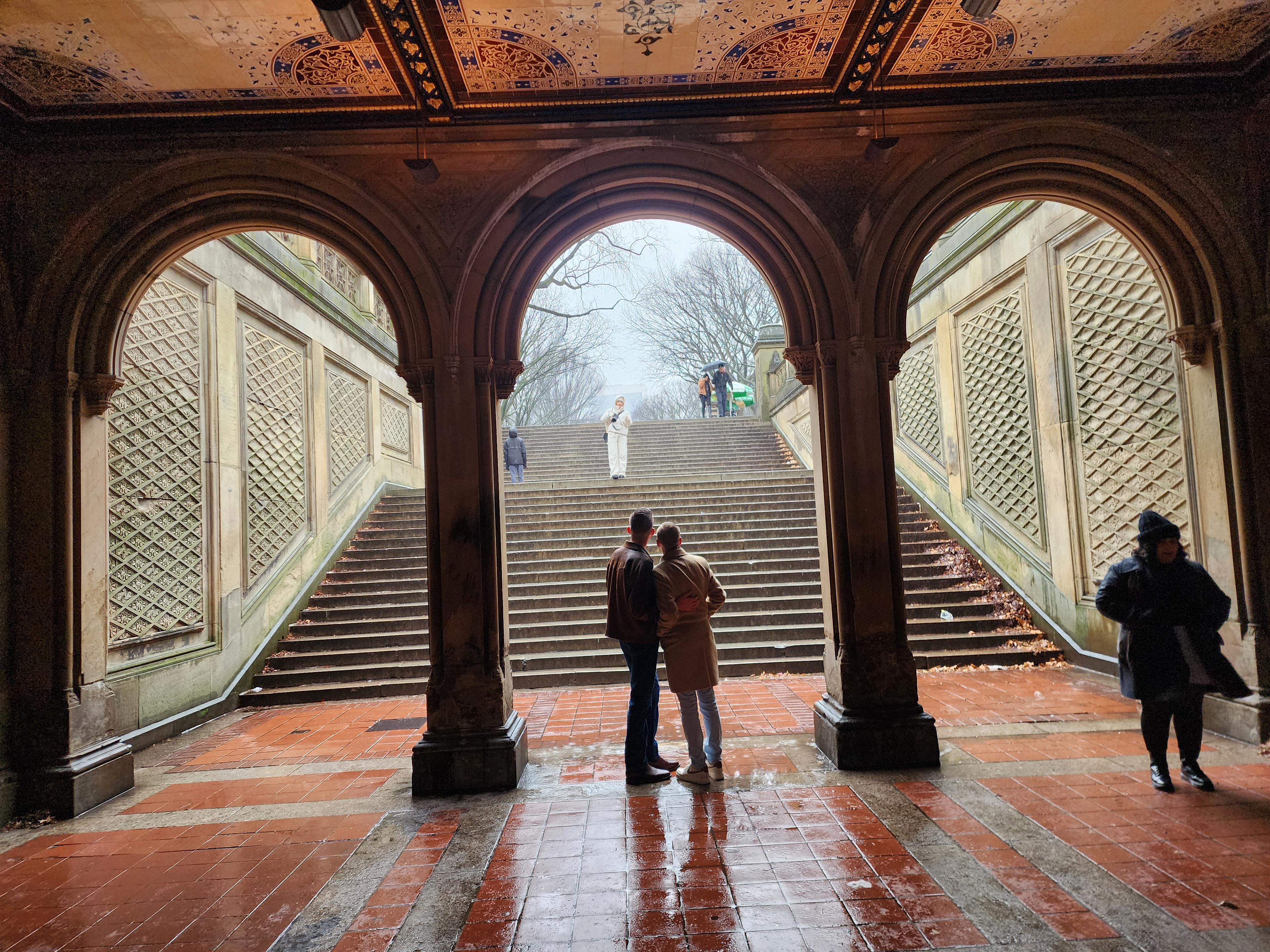
The scene begins in shadow, under three heavy arches that frame the world like a set of slow blinks. The ceiling above them is richly patterned, old-world ornate, warm colors pressed into stone, reminding you that this place was built to outlast attention spans. Below, the floor is wet, brick-red tiles reflecting the light in broken, imperfect patches, as if the ground itself is remembering the sky. The reflection is important. It already tells you this photograph is about doubling, about time folding back on itself. You’re standing in a space that holds echoes, and the camera is listening.
At the center, just before the staircase rises, a couple stands close together. One arm rests around the other’s back, not in a dramatic way, not for effect, but with the ease of something repeated a thousand times. They are looking upward, toward the stairs and the pale winter light beyond, sharing direction, intention, maybe even silence. They are not the subject in the traditional sense. They are an anchor. Without them, the image would still be beautiful, but it would not breathe. They introduce duration. They introduce the idea that time here is not just passing, it is being lived.
Beyond them, life continues without waiting. A figure in white descends the stairs, almost glowing against the gray stone, perfectly placed but completely unplanned. Higher up, small figures scatter in different rhythms, climbing, stopping, turning, leaving. On the right edge, a passerby moves through the foreground, half-blurred, already on the way out of the frame, a reminder that every photograph is a compromise between what stays and what escapes. This is where photography quietly stops being about composition and starts being about choreography. Nothing is arranged, yet everything is aligned. The camera didn’t impose order; it recognized it.
This is what photographers eventually learn, often the hard way. Sharpness, dynamic range, perfect exposure, the clean histogram, they’re all useful, but they don’t create meaning. Meaning arrives when something is unresolved. When the light isn’t perfect. When the subject doesn’t pose. When time leaves fingerprints on the scene and you decide not to wipe them away. In this image, time is layered: the building speaks in centuries, the couple in years, the passerby in seconds, the reflection on the floor in fractions of a second. All of it exists at once, stacked like transparent sheets. The camera doesn’t freeze it. It allows the overlap to be felt.
That’s why photographers slowly stop photographing things and start photographing transitions. A person about to move. A space just after rain. A staircase that is neither here nor there but in between. The arches hold the scene like cupped hands, the stairs lead forward without promising where, and the couple stands exactly at the threshold where a moment becomes a memory. Sometimes the photograph happens before you lift the camera. Sometimes all you do is notice it, and the noticing is enough.