Night photography really begins in that fragile momen
Night photography really begins in that fragile moment when the sun hasn’t fully left yet, and this image lives exactly there. The sky is still holding onto its last warmth, a deep gradient that slips from burning orange near the horizon into a bruised purple higher up, like the day is reluctant to let go. Below it, the sea is already darker, textured by soft, repetitive waves that catch just enough leftover light to shimmer faintly. The beach scene feels staged and accidental at the same time: rows of empty tables and folded umbrellas, waiting, while strings of lights stretch across the sand in long, confident arcs, red and cool white alternating like a pulse. Those lights don’t just illuminate the scene, they draw it, carving perspective lines that pull your eye toward the water and the small lifeguard tower standing quietly to the right, half-silhouette, half-witness.
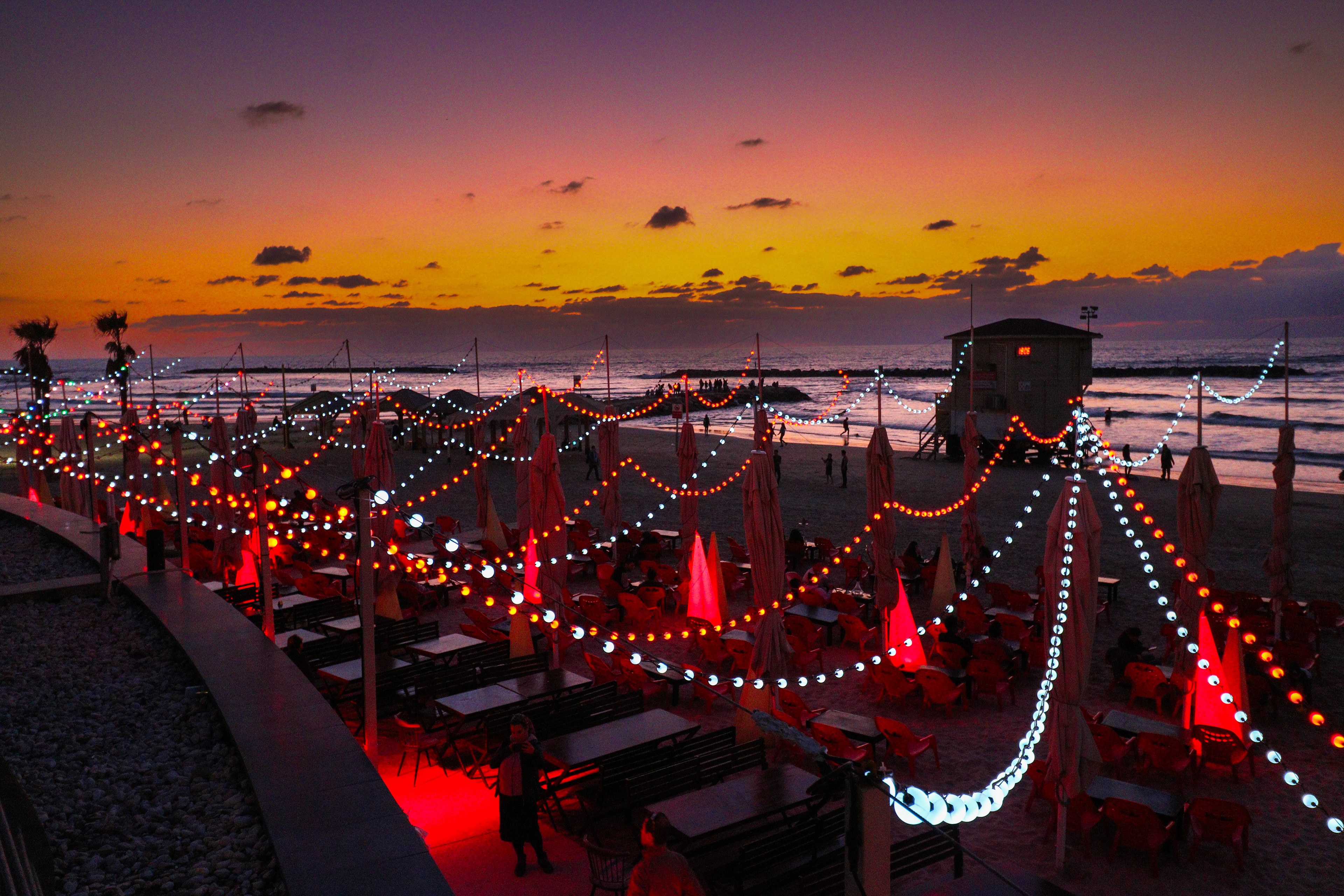
What makes this a night photograph rather than just a sunset is how the artificial light takes control of the narrative. The red glow spills onto the sand and furniture, tinting everything with a theatrical warmth that feels almost cinematic, while the white bulbs stay crisp and slightly harsher, defining structure and distance. You can sense the exposure balancing act here: long enough to let the sky breathe and the sea settle, but controlled so the lights don’t explode into chaos. The people become secondary, almost ghosts, small figures moving between tables or along the shoreline, their presence suggested more than described. That’s one of the quiet tricks of night photography I always come back to, letting motion soften into atmosphere instead of freezing it, allowing the place to feel lived-in rather than documented.
There’s also something emotionally honest about shooting a scene like this when most of the beach is technically “closed” for the day. The umbrellas are folded, chairs pushed in, the crowd thinned out, yet the lights are on, unapologetically bright, as if the night deserves its own audience. Night photography thrives on that contradiction: emptiness paired with invitation, silence wrapped in color. You’re not chasing detail anymore, you’re shaping mood, deciding which elements get to glow and which are allowed to fade. Standing there, camera in hand, you can almost feel the temperature drop and the sounds change, waves louder now, voices softer, the click of the shutter oddly loud in comparison. It’s never just about low light, it’s about choosing what the darkness gets to keep.
From a technical point of view, this kind of scene lives and dies by exposure discipline. You’re balancing three competing light sources: the fading ambient sky, the reflective surface of the sea, and strong point light sources that want to blow out instantly. An aperture in the f/4 to f/5.6 range keeps enough depth of field to hold the lights, tables, and horizon together without forcing ISO into noisy territory. Shutter speed is slow enough to let the sky’s color deepen and the water smooth slightly, but not so long that the people turn into full streaks, usually somewhere around 1/10 to 1/2 second depending on wind and wave movement. ISO sits in the moderate range, often 400–800, because pushing higher would flatten the subtle gradients in the sky and exaggerate color noise in the shadows. White balance matters more than usual here; auto tends to neutralize the scene and kill the mood, so a manual setting leaning slightly warm preserves the sunset tones while allowing the red lights to stay intentionally aggressive. Metering off the midtones of the sky rather than the lights themselves is a quiet trick that keeps highlights under control and lets the darkness fall naturally where it wants to. This is one of those moments where the histogram tells only part of the story, and trusting your eye, even if it means letting parts of the frame go very dark, is what makes the image breathe.