When APS-C Glass Pretends to Be Full Frame, A Little Optical Surprise
I took this photo on a quiet indoor afternoon, no plan behind it, just light falling nicely and an orchid doing its thing by the window. The flowers are pale pink with those fine purple veins that always look a bit unreal, like someone traced them with a pencil after the fact. The light comes from the right, soft and diffused, wrapping gently around the petals and letting the background fall away. You can still sense the room though — a wall, a light switch, the everyday stuff — nothing staged, nothing hidden. And then there’s the frame itself: darker corners, a circular shadow creeping in, subtle but unmistakable. That detail is the whole story.
This shot was taken with a TTArtisan 50mm f/1.2, officially an APS-C lens, mounted on a Canon R8, a full-frame body that normally plays by very strict rules. Canon is usually uncompromising here. Mount an RF-S lens and the camera instantly forces crop mode, no questions asked, full frame denied. But this lens is fully manual. No electronics, no communication, no metadata whispering “I’m APS-C, don’t trust me.” So the R8 stays in full-frame mode, blissfully unaware, and suddenly you’re seeing what the lens can actually project rather than what it’s allowed to.
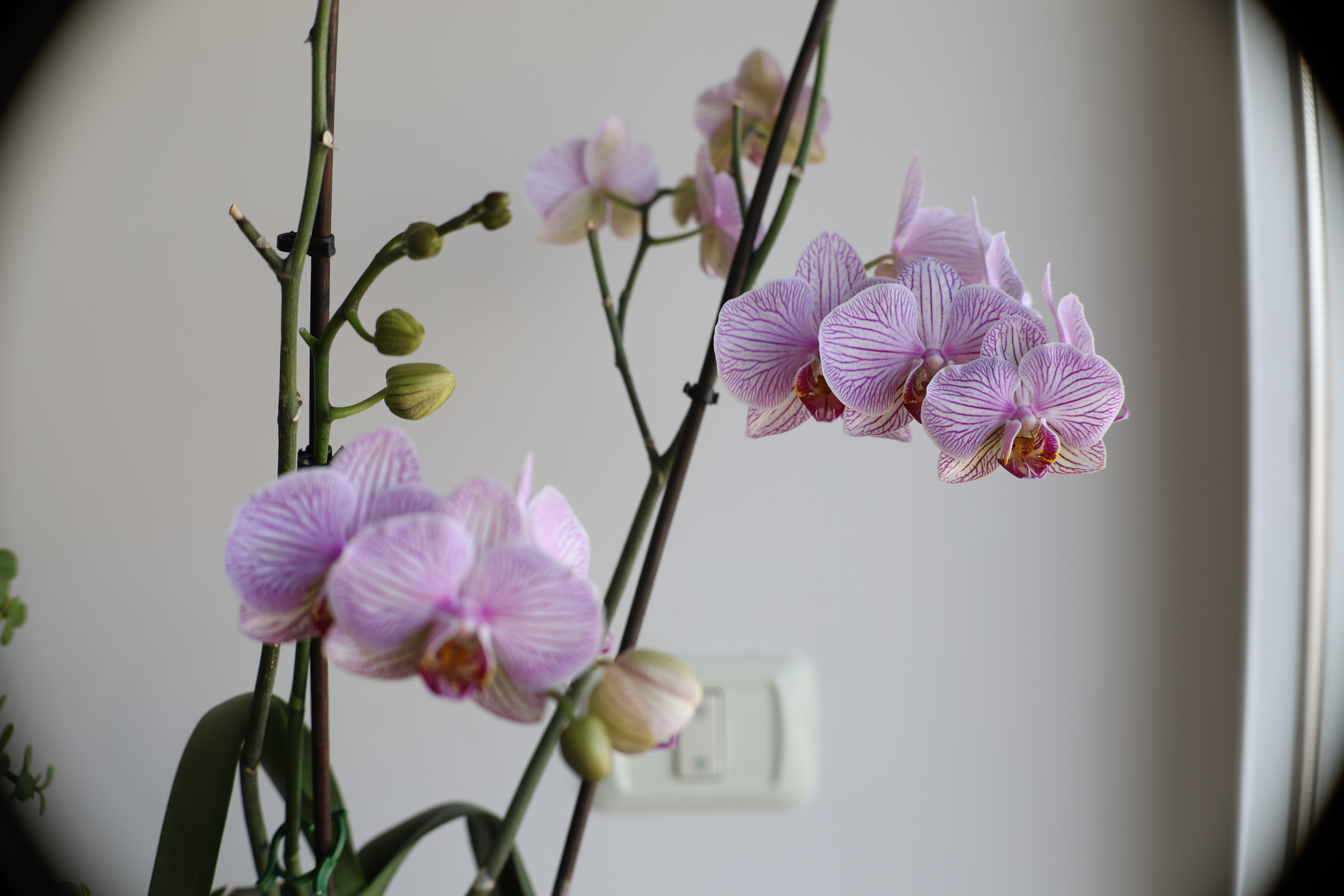
At 50mm, especially with a fast f/1.2 design, the image circle turns out to be much larger than the APS-C label suggests. It doesn’t perfectly cover the full sensor, but it comes close — close enough that instead of a hard cutoff you get vignetting. Real vignetting, optical vignetting, the kind that fades gradually rather than slamming the door shut. In the center and mid-frame, the image is calm and usable. The orchid petals hold their texture, the focus falloff feels natural, and the background dissolves into that slightly dreamy softness that fast manual lenses are good at. Toward the edges, things darken, and instead of fighting it, the frame starts working with it.
Wide open, that vignette becomes part of the composition. It pulls your eye inward, toward the flowers, toward the light. Stopped down a bit, it would ease off, but I actually like it here. It reminds me that I’m not shooting a perfectly corrected, overly polite lens. I’m shooting glass with character, glass that wasn’t designed to please a spec sheet but still manages to surprise. This is exactly where APS-C lenses can behave differently depending on focal length. Wide APS-C lenses usually collapse on full frame — heavy black corners, smeared edges, no mercy. Normal and short telephoto lenses, especially fast ones, often over-deliver. They were built generously, and sometimes that generosity shows up when you ignore the label.
What I enjoy most about this setup is that it feels like a small rebellion without trying to be one. Canon locks RF-S lenses into crop mode to protect consistency and image quality, and that makes sense. But manual lenses live outside that system. They don’t ask permission. They just project light. Sometimes that light almost fills the sensor, and “almost” turns out to be enough. You keep full-frame depth of field behavior, full resolution, and you accept imperfections as part of the look instead of something to correct away.
This orchid photo isn’t about proving a point. It’s about noticing what happens when you experiment quietly. An APS-C lens on a full-frame body, a bit of vignetting, a lot of character, and an image that feels more alive because it isn’t technically perfect. Specs say one thing. The photo says another. And as a photographer, I’m always going to trust the photo first.
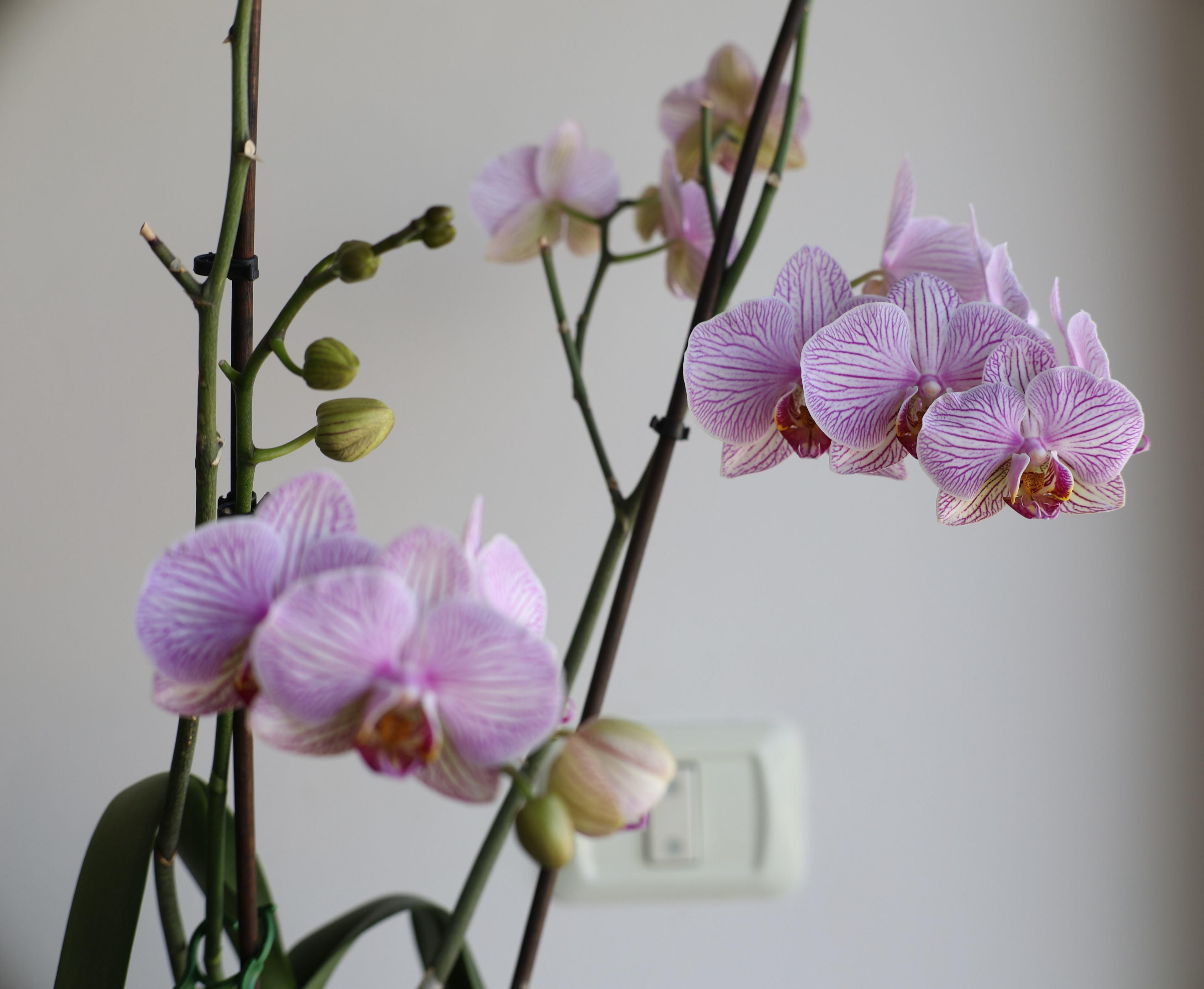
In post-processing, I ended up cropping this image just enough to clean up the vignetting while keeping the frame’s vertical integrity intact. The full height remains exactly as shot, which preserves the natural upward flow of the orchid stems and the sense of air around the flowers, but I trimmed some of the side margins where the dark falloff was most noticeable. The result is a frame that still feels spacious and balanced, without calling attention to the lens’s limits. Roughly speaking, the final image keeps about 80% of the original full-frame area, which is a compromise I’m more than comfortable with in exchange for using a fast f/1.2 lens and staying in full-frame mode. The crop doesn’t feel like a correction so much as a quiet refinement, letting the flowers, the soft window light, and the shallow depth of field carry the image without distraction.
Which APS-C Prime Lenses Come Closest to Full Frame Coverage, From a Photographer’s Point of View
If the goal is to squeeze as much usable full-frame coverage as possible out of an APS-C prime, the rule is surprisingly simple once you’ve seen it in practice: go longer, go faster, and don’t expect perfection. Image circle generosity increases with focal length, and fast primes tend to be designed with larger optical elements that accidentally project more than they strictly need to. That’s why wide APS-C primes almost always fail spectacularly on full frame, while normal and short telephoto primes can feel like they’re quietly getting away with something.
In real-world terms, the sweet spot starts around 50mm and gets safer as you move toward 85mm and beyond. APS-C 50mm f/1.2 and f/1.4 primes are often the best “almost full-frame” performers. Lenses like the TTArtisan 50mm f/1.2, 7Artisans 50mm f/1.2, and similar fully manual designs tend to cover most of the full-frame sensor with vignetting rather than hard cutoffs. Wide open, you’ll see dark corners. Stop down a bit or apply a light crop, and suddenly you’re working with 75–85% of the full-frame area while keeping full-frame depth of field behavior and resolution. That’s exactly the kind of compromise that makes sense for low-light, still life, portraits, or indoor shooting.
Move up to 56mm APS-C primes and coverage often improves further. Many 56mm f/1.4 or f/1.2 lenses were designed as “portrait equivalents” for crop sensors, which means their image circles are frequently generous. On full frame, these lenses often show mild to moderate vignetting rather than severe corner failure, especially when stopped down slightly. By the time you reach APS-C 85mm primes, coverage is usually very close to full frame, sometimes nearly complete. The trade-off, of course, is field of view. You’re no longer cheating wide angles, you’re leaning into compression and subject isolation instead.
What consistently matters more than brand is lens philosophy. Fully manual third-party primes are your friend here. They don’t communicate with the camera, so there’s no forced crop mode, and their optical designs are often simpler, less aggressively optimized for edge correction on a specific sensor size. That lack of correction is exactly what allows the image circle to spill over. Autofocus APS-C lenses designed tightly for modern systems are usually more precisely constrained and less forgiving when pushed outside their intended format.
The practical takeaway is this: if you want maximum full-frame coverage from an APS-C prime, look first at 50mm f/1.2 or f/1.4, then 56mm and 85mm equivalents, preferably manual, preferably fast. Expect vignetting, plan for light cropping, and treat the edges as optional rather than guaranteed. You won’t get a perfect full-frame lens, but you can absolutely get a usable, expressive one that covers most of the sensor and delivers speed and character at a fraction of the cost. And once you’ve shot with one long enough, the question stops being “does it cover full frame?” and turns into “does the image work?” which is usually the better question anyway.
Wide Angle APS-C on Full Frame, Where the Experiment Usually Falls Apart
Wide angle is where the optimism tends to die quickly, and that’s not opinion, it’s optics. APS-C wide-angle primes are the least likely category to meaningfully cover a full-frame sensor, no matter the brand or price. The shorter the focal length, the more aggressively the lens has to bend light to cover the intended frame, and APS-C designs are calculated very tightly around that smaller sensor. Unlike 50mm or 85mm lenses, there’s usually no “extra generosity” hiding in the image circle. When you mount an APS-C wide prime on a full-frame body and force it to shoot full frame, you don’t get gentle vignetting, you get a tunnel.
In practical terms, APS-C wides below about 24mm almost always produce hard mechanical cutoff on full frame. Dark, circular corners that don’t clean up when stopped down, because this isn’t light falloff, it’s simply no image being projected there at all. A 10mm, 12mm, 14mm, or even 16mm APS-C prime will typically leave you with a small bright circle floating in the middle of a black frame. Cropping that into something usable usually leaves you with less than APS-C coverage, which defeats the entire point of shooting full frame in the first place.
There are a few edge cases, but they’re limited and still compromised. APS-C primes in the 23mm to 24mm range sometimes project a slightly larger image circle, but even then, full-frame coverage is rare. What you usually get is heavy, uneven vignetting and very weak corners that don’t improve much when stopped down. You might salvage something by cropping to roughly APS-C dimensions, but you won’t get the “80% of full frame” experience you can achieve with normal or telephoto APS-C primes. In other words, wide angle is the one place where the trick stops being fun and starts being pointless.
There’s also a design reason why fast APS-C wides don’t help the way fast normals do. With a 50mm f/1.2, the large rear elements and longer optical path often create a naturally oversized image circle. With wide angles, even fast ones, the rear elements sit closer to the sensor and the image circle is controlled very tightly to avoid size, weight, and cost exploding. Lens designers don’t leave much extra coverage on the table here. What you see is what you get.
From a photographer’s point of view, the conclusion is pretty clear. If you’re experimenting with APS-C lenses on a full-frame body to gain speed or character at low cost, wide angle is the wrong place to try. The compromises are too severe, the crops too aggressive, and the results rarely justify the effort. If you need wide angle on full frame, even a modest full-frame lens will outperform any APS-C workaround instantly. APS-C wide primes are excellent at what they’re designed for, but full-frame cheating is not one of those things.
So while APS-C 50mm, 56mm, or even 85mm primes can surprise you by covering most of the sensor with manageable vignetting, wide angle APS-C lenses don’t play that game. They don’t bend the rules, they enforce them. And once you’ve seen that black tunnel appear in the viewfinder, you usually stop trying.