Turning Photographs into Posters: When a Scene Becomes Graphic
Some photographs naturally want to become something else. You take the shot thinking it’s a documentary image — a restaurant interior, a street corner, a crowded café — and then later, while looking at it on the screen, you notice something different. The shapes line up. The light falls in repeating patterns. The figures become silhouettes instead of individuals. At that moment the photograph stops behaving like a photograph and starts behaving like a poster.
The restaurant scene here is a good example of that transition. The original image captures a busy dining room during service: tables filled with guests, a waiter standing in the center writing down an order, lantern lights running down the ceiling like a visual spine guiding the eye through the room. In a traditional photographic treatment the emphasis would remain on tonal detail, textures, and the realism of the moment. But once the image is posterized, the scene transforms. Shadows collapse into solid shapes, highlights flatten into clean areas of color, and suddenly the composition becomes graphic rather than purely photographic.
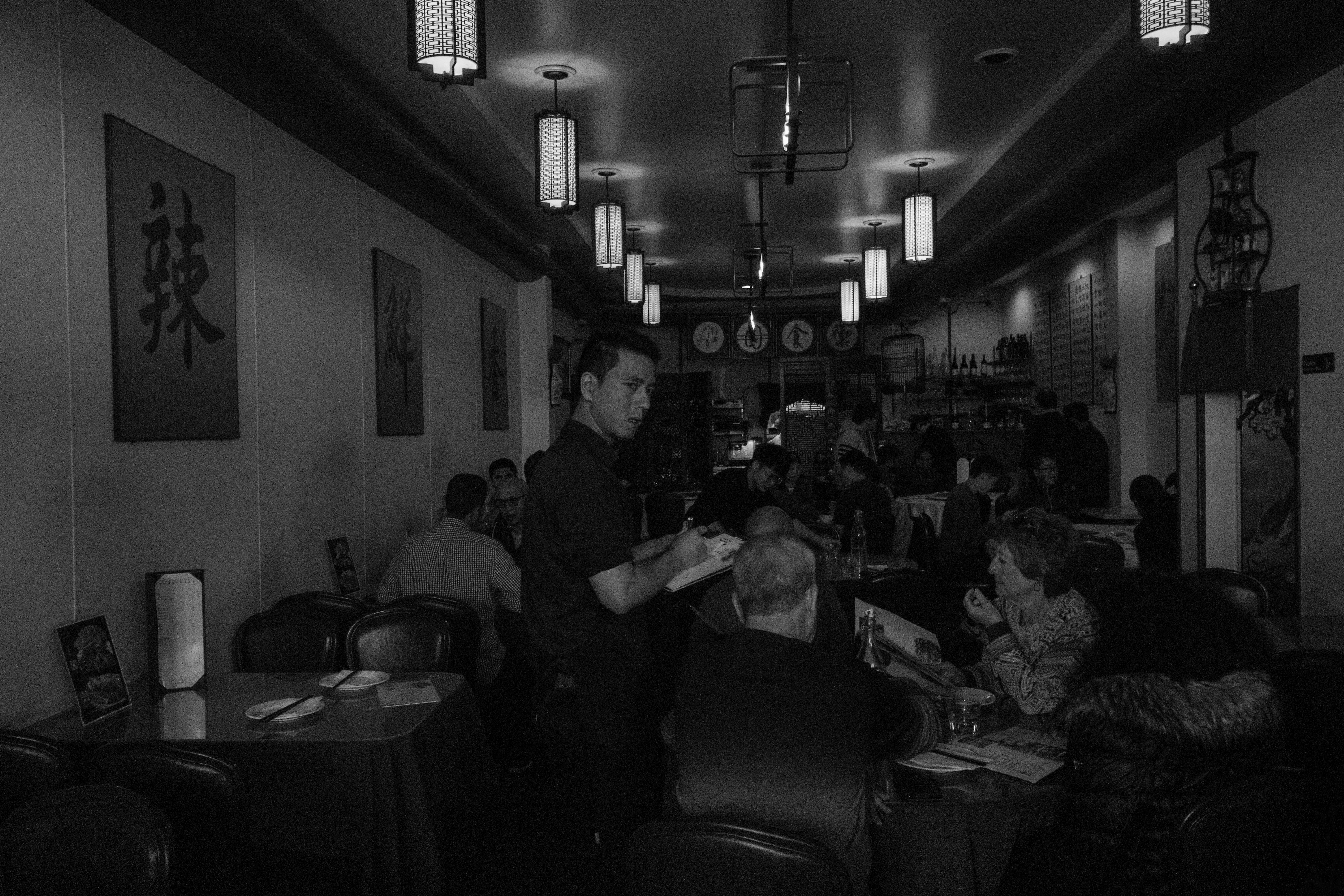
This transformation works especially well when a photograph already has strong structure. In this case the repeating lantern lights form a rhythm that pulls the viewer’s eye from the foreground into the depth of the restaurant. The waiter in the center acts as a natural focal point — his turned head and notepad give the image a small narrative anchor. Meanwhile the diners, chairs, coats, and tables become simplified silhouettes once the poster effect is applied. What used to be a complex scene of many small details turns into a set of bold visual blocks that are easier to read from a distance.
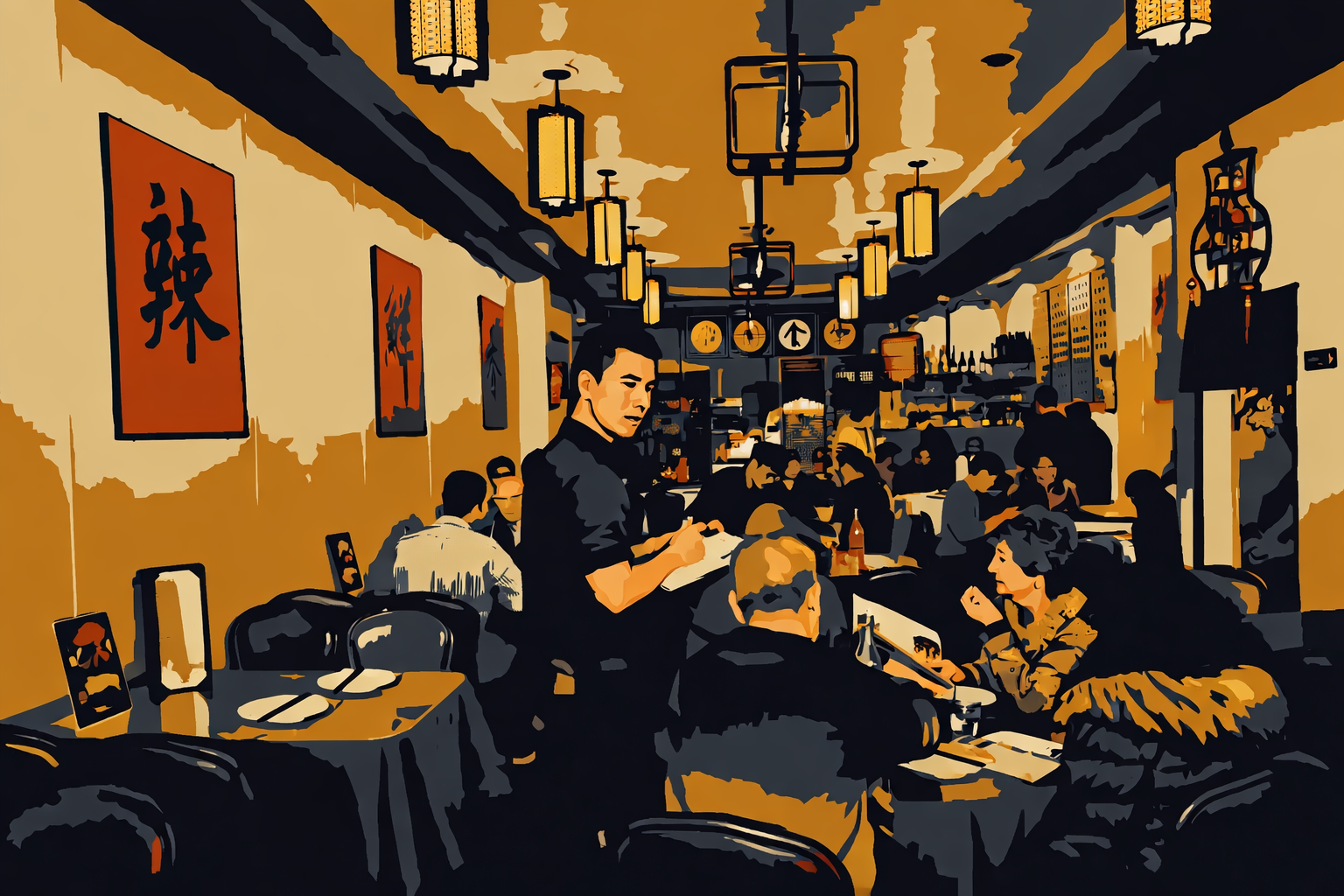
That readability is one of the main reasons photographers sometimes convert images into poster-style graphics. Posters are meant to be seen quickly and understood immediately. A viewer across a room should be able to grasp the scene without studying every detail. Posterization reduces the tonal range and simplifies the visual language, allowing the eye to process the image almost instantly. Instead of a thousand tiny textures, the viewer sees strong shapes and contrast.
Another reason is storytelling. Realistic photographs describe a moment exactly as it happened. Poster-like images, on the other hand, exaggerate the mood of the scene. The warm lantern lights in the restaurant become glowing geometric forms. Dark areas turn into deep graphic shadows. The overall feeling becomes slightly cinematic, almost like a still frame from a film or a vintage travel advertisement. The viewer begins to read the scene less as documentation and more as atmosphere.
There is also a practical creative reason photographers experiment with this technique. Some images simply have stronger visual impact when they move away from realism. Busy environments — restaurants, markets, street scenes — often contain too much visual information. Posterization removes that clutter. What remains is the underlying design of the image: lines, shapes, balance, and visual rhythm.
For photographers who enjoy experimenting with their images after the shot, poster-style treatments can reveal compositions that were not obvious at first. A photograph that looked ordinary in standard editing may suddenly become striking once reduced to a limited palette of tones. The scene starts to feel intentional, graphic, and sometimes even timeless.
In the end, turning a photograph into a poster is not about replacing photography with illustration. It’s about uncovering the design that was already hiding inside the frame. Some images tell their story best through detail and realism. Others — like this lively restaurant moment — come alive when they are simplified into bold shapes, strong contrast, and a visual language that feels closer to classic poster art than to a traditional photograph.