Street and Travel Photography with the Canon EF 28mm f/1.8 USM
A 28 mm lens has a very particular personality in street and travel photography. It sits in that interesting middle ground where the scene still feels natural and human, but the frame opens wide enough to capture context, architecture, and movement around the subject. The Canon EF 28 mm f/1.8 USM is one of those lenses that photographers often overlook today, partly because it belongs to the older EF generation, yet when used on modern mirrorless bodies it can deliver images that feel remarkably alive and immediate.
In the first photograph, the lens demonstrates exactly what makes 28 mm so effective for street work. The scene unfolds on a European sidewalk in front of a heavy stone building with classical detailing. Two ATMs are embedded into the wall behind iron bars painted deep red, giving the façade a slightly fortified appearance. The stone blocks are rough and pale, with years of weathering visible in their texture. A decorative dark iron doorway sits further to the right, framed by sculpted stone and an ornate arch.
Three women move through the frame, each caught in a slightly different moment of motion. On the left edge, one woman in a dark winter coat is mid-stride, slightly blurred by movement as she walks out of the frame. In the center, another woman with blonde hair strides confidently across the scene wearing a thick black puffer jacket, a red scarf peeking out from the collar, a short black skirt, sheer black tights, and ankle boots. Her forward motion gives the image energy, and the 28 mm perspective exaggerates the sense of movement slightly by stretching the foreground space.
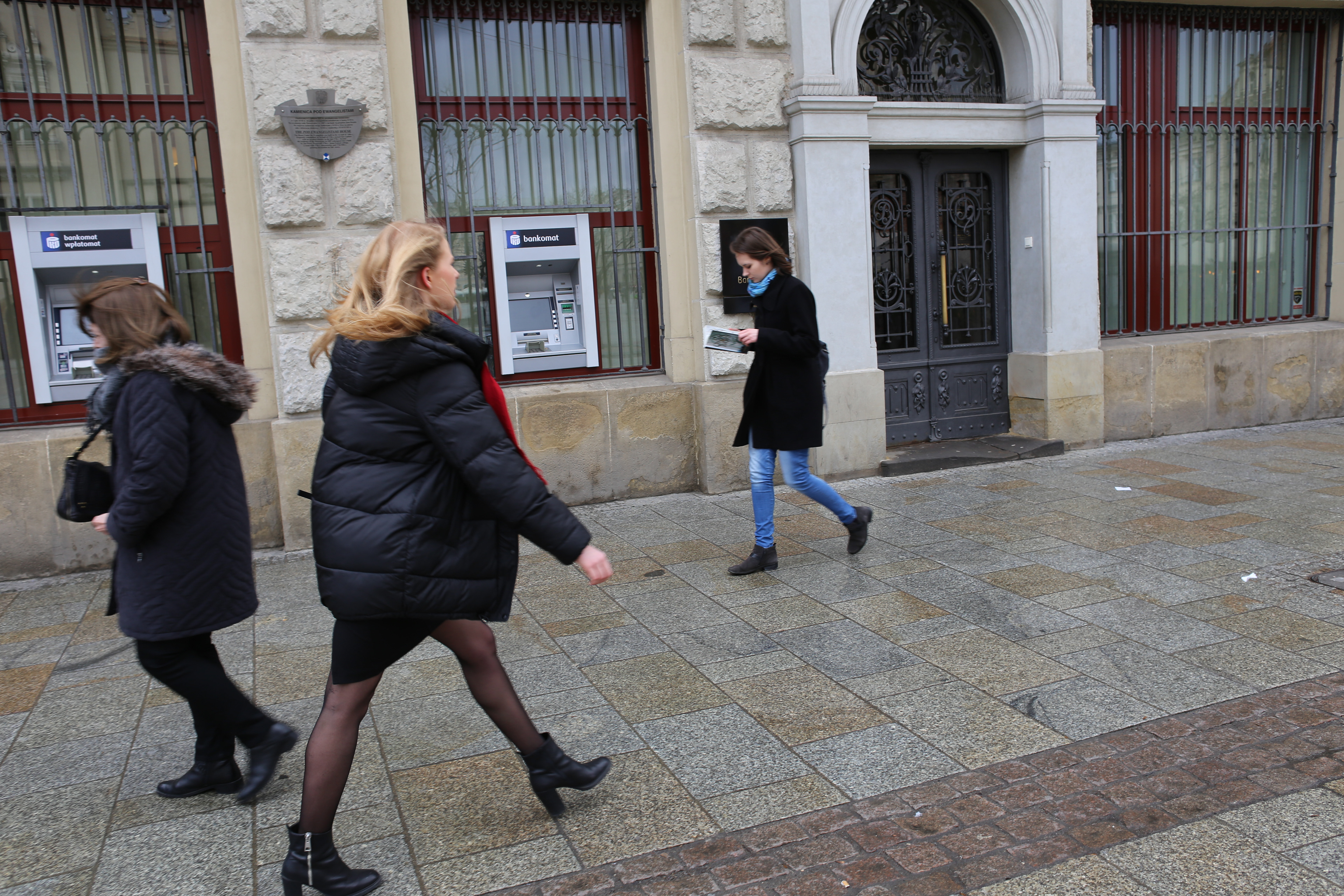
On the right side, a third woman walks toward the opposite direction while reading a small paper or booklet. She wears a long dark coat, light blue jeans, black shoes, and a blue scarf wrapped around her neck. Her posture is slightly hunched as she focuses on the page, creating a quiet narrative contrast to the brisk pace of the other pedestrians.
What stands out here is how the 28 mm focal length preserves the entire environment. The building, the barred windows, the ATMs, the paving stones, and the spacing between the people all remain clearly visible. A tighter lens would isolate individuals but lose the urban story. With 28 mm, the photograph becomes less about a single person and more about the choreography of city life.
The second photograph shifts the scene dramatically from the narrow sidewalk to a broad historic square. Here the lens shows another of its strengths: combining architecture, activity, and atmosphere in one frame without feeling cramped. The location appears to be a grand European market square dominated by a large historic building with elaborate Renaissance or Baroque detailing. Cream-colored decorative parapets run along the roofline, punctuated by sculptural elements, while a tall dark tower rises from the center like a watchful sentinel over the plaza.
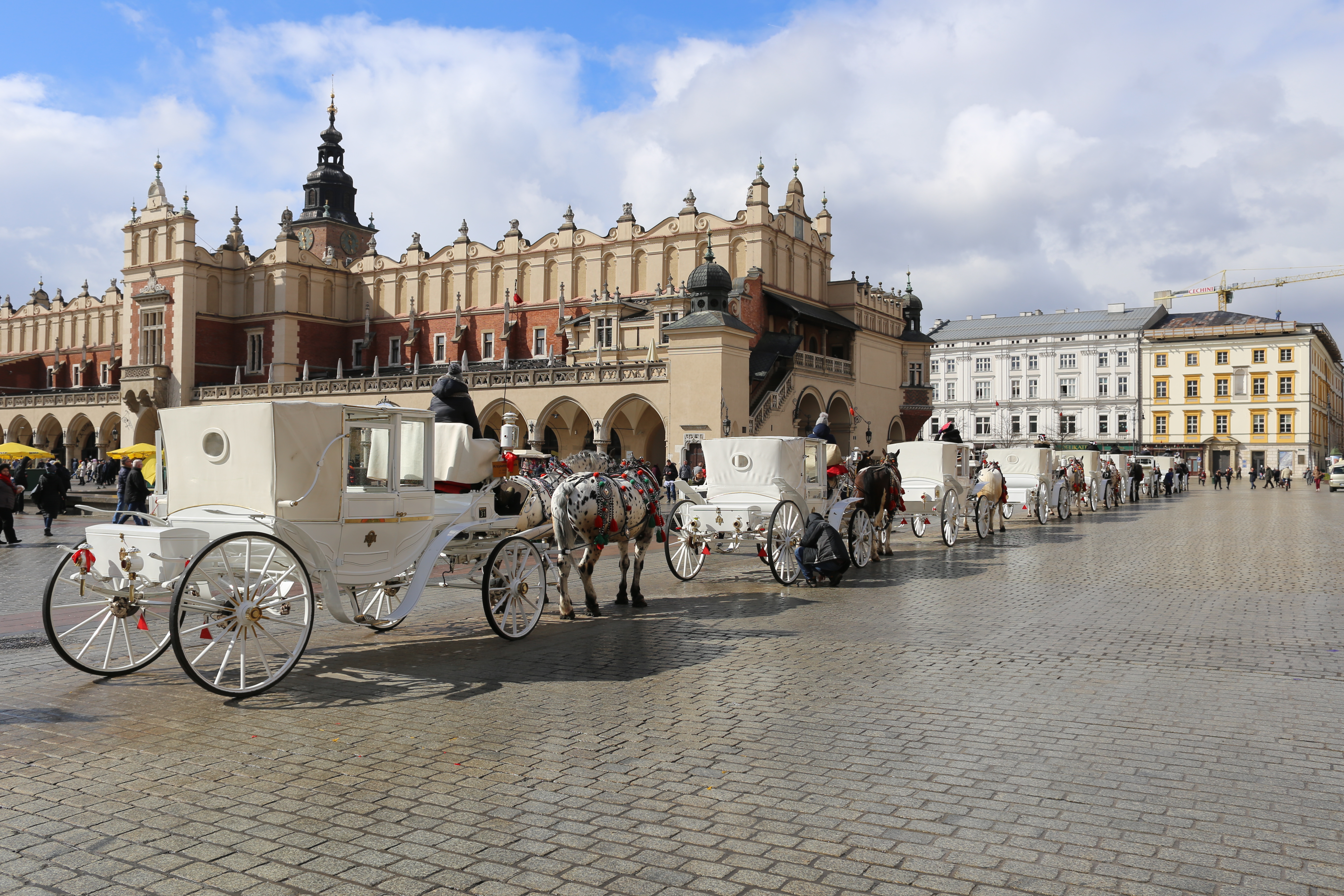
In the foreground, a long row of white horse-drawn carriages waits for tourists. The carriages are bright and almost ceremonial in appearance, their glossy white surfaces reflecting sunlight. The horses—some spotted, some dark—stand patiently harnessed to the carriages. Red tassels and decorative elements hang from the harnesses, adding small bursts of color against the otherwise pale palette.
The cobblestone square stretches across the entire lower half of the frame, its wet stones catching light from the partly cloudy sky. The clouds are large and dramatic, allowing sunlight to break through in patches that illuminate the carriages and parts of the buildings behind them. On the far right side of the square, colorful historic buildings—yellow, white, and pastel tones—form a soft architectural backdrop.
The 28 mm perspective works beautifully here because it keeps the carriages prominent while still allowing the historic hall, tower, and surrounding buildings to breathe inside the frame. The scene feels spacious and immersive, almost like standing in the square yourself.
This kind of versatility explains why many street photographers gravitate toward lenses around 28 mm. It encourages getting closer to the action rather than observing from afar. At the same time, it leaves enough room for the surrounding environment to become part of the narrative.
Technically, the Canon EF 28 mm f/1.8 USM also brings practical advantages for this type of photography. The f/1.8 aperture allows shooting in lower light conditions and enables subject separation when needed. The USM focusing motor is fast and quiet, which is particularly useful when capturing spontaneous street moments where hesitation can mean missing the shot. And despite being an older design, the lens remains compact and lightweight, something that matters during long walks through cities or travel days when carrying heavier gear becomes exhausting.
Mounted on modern mirrorless cameras through an adapter, lenses like this often feel rediscovered rather than outdated. The optical character remains the same, but stabilization from the camera body, better sensors, and improved autofocus systems can give these classic lenses new life.
Street photography often rewards simplicity: one camera, one lens, and the willingness to observe. A 28 mm lens embodies that philosophy well. It invites the photographer to step into the scene rather than observe from a distance, turning everyday streets, passing pedestrians, and historic squares into layered visual stories.