Why I Leave the Curve In — Shooting Travel with a Fisheye and Keeping It Honest
The first thing that hits you here isn’t the architecture, it’s the bend. The square seems to breathe outward, the cobblestones curling at the edges like they’re trying to escape the frame. That arc in the foreground—almost decorative, almost too perfect—pulls you in before you even realize what you’re looking at. This is Rynek through a fisheye, and I didn’t “fix” it. I never do.
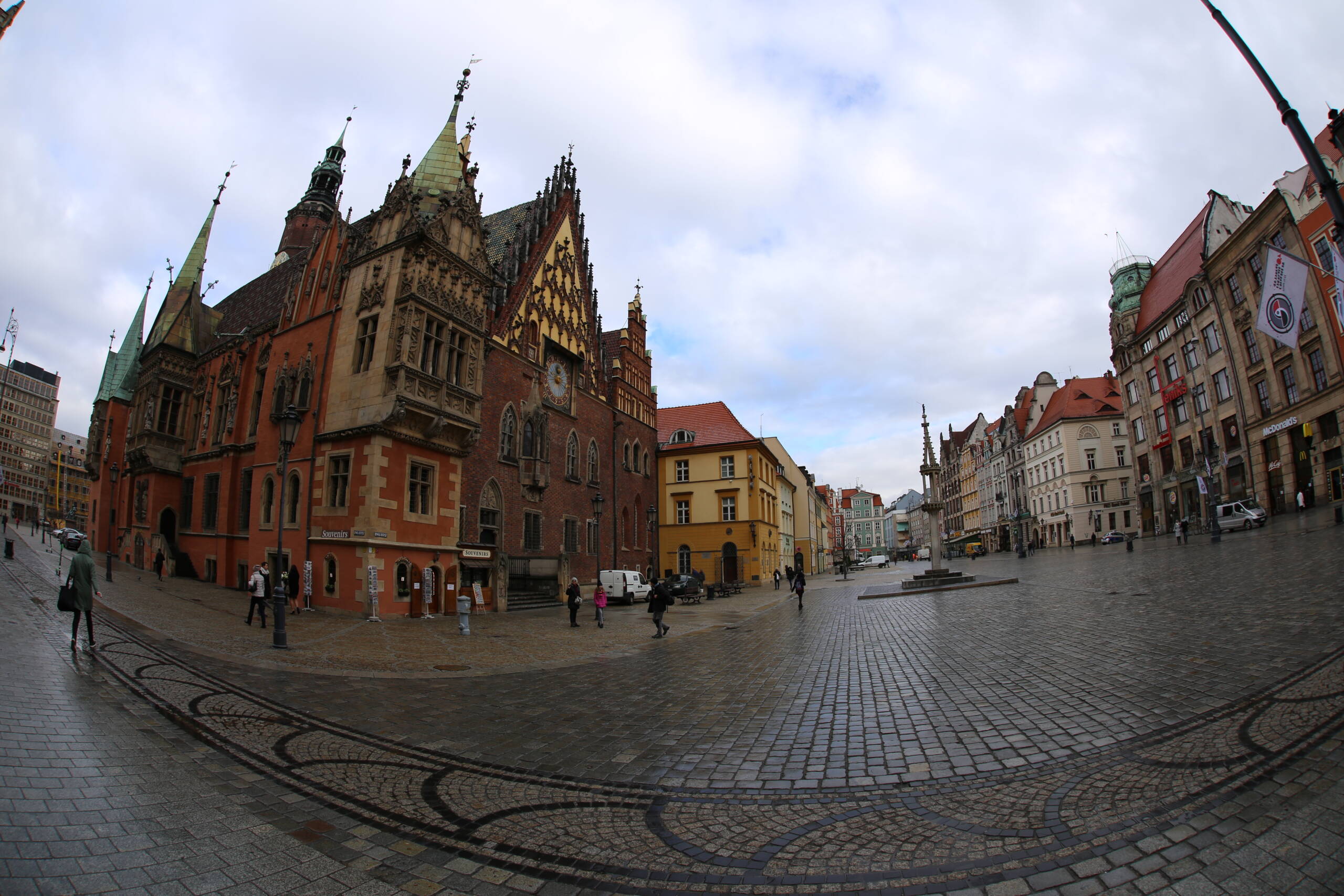
On paper, this is exactly the kind of image people rush to correct. Vertical lines leaning, edges warped, proportions exaggerated. The ornate façade of Wrocław Town Hall tilts just enough to make architects uncomfortable. The buildings along the right stretch and taper as they approach the edge of the frame, like they’re being gently pulled into another dimension. Even the lamppost on the far right feels slightly off, like it knows something the rest of the scene doesn’t.
But here’s the thing—this is how it felt standing there.
The square wasn’t flat in experience, even if it is in reality. It was expansive, slightly overwhelming, with space opening up in every direction. The fisheye exaggerates that, sure, but it also translates something that a corrected image flattens out. When you remove distortion, you’re not just straightening lines—you’re standardizing the memory. You’re turning a moment into something more… compliant.
And travel, at least the way I see it, isn’t supposed to be compliant.
There’s a kind of playful honesty in leaving the distortion intact. The wet cobblestones reflect the sky in broken fragments, and the curve amplifies that effect, making the ground feel alive rather than static. People walking across the square seem slightly more isolated, each moving through their own pocket of space. The whole scene becomes less documentary and more experiential, closer to how your brain stitches together wide, open places when you’re actually there.
Also—and maybe this is the less philosophical part—it’s just more fun. The fisheye turns a well-known location into something a bit unpredictable. Wrocław isn’t trying to be surreal, but the lens nudges it in that direction anyway. It adds a layer of interpretation without needing filters or heavy edits. The image feels like it has a point of view, not just a record.
There’s always that temptation in post-processing to “correct” things. Straighten, align, normalize. Make the image behave. But sometimes the imperfections are the whole reason the photo works. The curve at the bottom of this frame, the slight lean of the towers, the way the square opens like a stage set—they’re not flaws. They’re the experience.
So I leave it. Every time.