Street Photography in Harsh Midday Light
Street photography does not always need dramatic weather, rare gestures, or a perfectly staged city corner to come alive. Sometimes it works best when the scene feels almost ordinary at first glance, a hot sidewalk, scattered pedestrians, a road running behind them, the sort of urban moment most people would walk past without even slowing down. What makes this frame interesting is the way it gathers several separate lives into one visual field and lets them coexist without forcing a single story. That is one of the real pleasures of street photography, honestly: it gives form to coincidence. In this image, the scene is built from movement in different directions. An older figure at the far left leans into a walker and moves away from the camera, while in the center foreground a person with a large halo of curly hair also walks away, carrying bags and wearing a loose sleeveless shirt that catches the light. Slightly beyond, a couple moves across the frame, hand in hand, their body language relaxed and self-contained. On the right edge, another passerby enters the foreground with a crossbody bag and downcast gaze, almost cutting through the composition as if unaware of everyone else. None of these people seem connected, except by the camera’s timing, and that is exactly where the photograph starts to breathe.
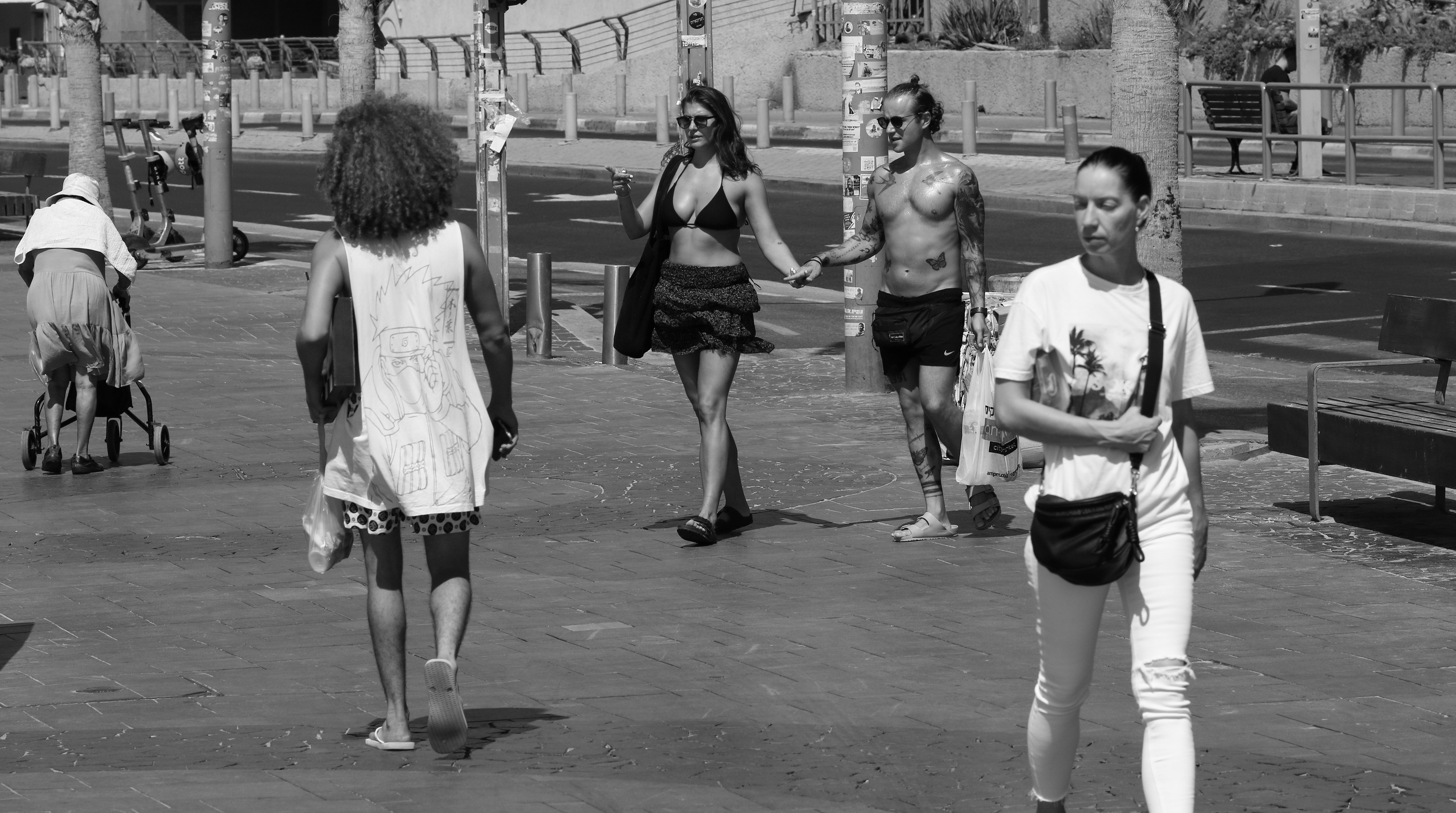
The black-and-white treatment helps a lot here. In color, this same scene would probably be louder, maybe more descriptive than interpretive. You would notice skin tones, signage, clothing colors, the brightness of the street, and perhaps the image would become more about place in a literal sense. Stripped to monochrome, the picture turns toward rhythm, contrast, posture, and separation. The white clothing in the foreground right becomes a bright anchor. The darker tones of the road and shaded pavement push the eye inward. The central couple stands out not because they are isolated, but because their tonal range is balanced so neatly against the sticker-covered poles and the open strip of street behind them. Even the pavement matters more in black and white: its texture, scratches, seams, and sun-bleached irregularities become part of the emotional surface of the frame. It feels hot, exposed, a little unforgiving, which suits the scene.
What makes this especially street-photographic is that the image does not rely on a single subject performing for the lens. Instead, it holds several micro-scenes at once. The couple in the middle suggests ease and intimacy, but the foreground figures interrupt any temptation to make them the entire story. The person in white on the right is close enough to blur the hierarchy of attention, while the older figure on the far left adds a completely different tempo, slower, heavier, more fragile. Then the person with curly hair walking away through the center acts almost like a visual hinge between all these lives. The oversized shirt, the sandals, the shopping bag swinging low, all of it gives the camera something casual and unpolished to hold onto. Street photography often succeeds when it resists neatness, and this frame does that well. It feels found, not arranged.
The composition is busy, but not messy. That difference matters. The vertical poles break the space into segments and create little stages for each passerby. The palm trees echo that rhythm and help structure the background, while the empty stretch of road behind the pedestrians keeps the figures from collapsing into one another. The benches, bollards, scooter, and curbside railings all sit quietly in support, giving the urban environment enough specificity without becoming the point. I like, too, how the camera position stays low enough to keep the pedestrians substantial in the frame but not so close that the image feels intrusive. It watches rather than chases. That restraint gives the scene a more observational quality, which is often where good street photography lives.
Midday light is usually treated as a problem, and sure, it can be brutal, but here it actually helps define the photograph’s character. The shadows are sharp, the highlights unforgiving, and the transitions between bright fabric and darker skin tones or pavement are crisp. That harshness suits the subject because the city itself feels hard-edged in the frame. Nothing is softened for effect. The light reveals surfaces, posture, and tension. It also creates a slightly documentary mood, as if the camera is less interested in beauty in the conventional sense and more interested in the raw arrangement of public life. That’s a strength, not a flaw. Street photography does not always need golden-hour tenderness. Sometimes it needs heat, glare, and the plain fact of people crossing paths.
What lingers after looking at the image is not any one individual but the social texture of the street itself. Youth, age, style, movement, exposure, routine, privacy, display, all of these things overlap here for a fraction of a second. The couple appears self-possessed, the foreground walker on the right seems inward and detached, the older figure at left seems focused only on the next step, and the central back-turned figure carries the casual anonymity that cities produce so easily. Street photography works when it notices that a sidewalk is never just a walkway. It is a temporary theater of parallel lives. This frame catches that idea well, and without trying too hard, which is maybe the nicest part. It just sees the street for what it is: layered, uneven, fleeting, human.
- street photography
- black and white
- urban life
- candid photography
- midday light
- city streets
- human moments
- documentary style