Shooting Against the Sun
There’s a rule they teach early in photography classes, usually delivered with the confidence of someone who has never broken it: keep the sun at your back. The logic is clean. Light falls on your subject. Your subject is properly exposed. Everyone goes home happy. It’s the kind of advice that produces technically correct photographs — evenly lit, well-exposed, and almost entirely forgettable.
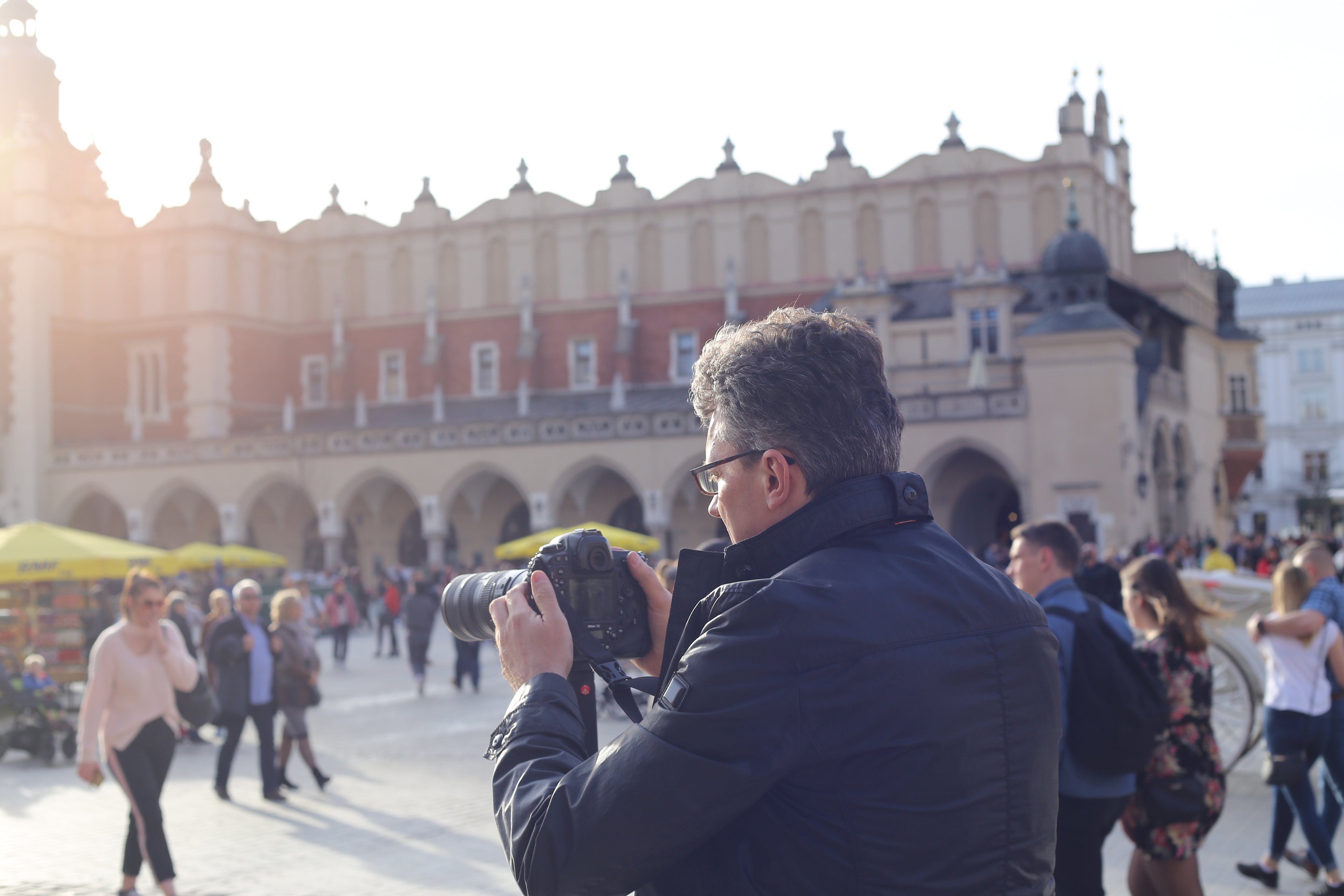
The image I made in Kraków’s Rynek Główny on a bright autumn afternoon broke that rule completely. I was standing in the middle of one of the largest medieval market squares in Europe, shooting directly into the sun, watching it blow out the upper left corner of my frame and wondering if I was wasting my time. I wasn’t.
What Contre-Jour Actually Does
Shooting into the light — contre-jour, as the French call it, literally “against the day” — does several things simultaneously, not all of them welcome. It clips your highlights. It muddies your shadows. It introduces lens flare, which can be painterly or disastrous depending on your focal length, your aperture, and a degree of luck that no amount of skill fully replaces. It makes your camera’s metering system quietly panic.
What it also does is something no amount of fill flash or reflector can convincingly replicate: it separates your subjects from their backgrounds through pure luminosity. When the light source is behind your scene, edges glow. Figures become silhouettes or near-silhouettes. Depth is implied rather than described. The image stops being a document and starts being an impression — and impressions, it turns out, are often more emotionally true than documents.
The photographer I captured in this frame understood this instinctively, or had learned it the hard way, which amounts to the same thing. He was positioned in the square with the Sukiennice — the magnificent 14th-century Cloth Hall — directly behind him, and the sun somewhere above and ahead. His DSLR was up, his eye was at the viewfinder, and he was doing exactly what I was doing: making a calculated bet that the chaos of overexposed sky and blown-out stone would resolve into something worth keeping.
Reading the Frame
Look at what the backlight does to the architecture. The Sukiennice’s Renaissance arcade, normally a study in precise carved detail, dissolves into warm, creamy haze. The decorative parapets at the roofline float against the sky like a paper cutout. You lose the stonework. You gain something harder to name — a sense that the building is exhaling light rather than receiving it, that it has been here so long it has become partly luminous.
The crowd in the square does something similar. The figures in the middle distance are rendered in partial silhouette, their faces lost, their bodies reduced to posture and movement. The woman in the pink coat at left. The couple in the background. The clusters of tourists who were, in reality, checking phones and consulting maps and doing all the mundane things tourists do — in this light, they become anonymous, timeless, interchangeable with the crowds who crossed this same square in 1400 or 1700 or 1950.
This is what aggressive backlight buys you: it strips the contemporary. It removes the specific. A square full of people with smartphones and synthetic fabrics begins to look, under the right contre-jour conditions, like a scene from a painting.
The yellow market umbrellas at the left edge of the frame are worth dwelling on. They are the one element of saturated, specific color in an image that otherwise trends toward warmth and overexposure. They do critical work. Without them, the composition floats — beautiful perhaps, but unmoored. Those yellows give the eye an anchor, a point of entry, a reason to read the rest of the frame as real rather than dreamlike. Small details perform large structural functions in street photography. You don’t always put them there deliberately. Sometimes you find them in the edit and realize they were doing the work all along.
The Technical Reality
None of this is accidental, but none of it is fully controlled either. That’s the contract you sign when you shoot contre-jour in a busy public square.
The exposure in this image is a compromise. Properly exposing for the photographer in the foreground meant accepting that the sky would blow out entirely. Attempting to preserve sky detail would have silhouetted him beyond recognition. The solution — slightly underexpose relative to the bright background, allow the flare to do what it wants in the upper corner, treat the blown highlights as a compositional element rather than a failure — is not really a solution at all. It’s a negotiation. You decide what you’re willing to lose and what you need to keep.
The lens flare that washes the upper left is real and unmanipulated. Some photographers would remove it in post. I would argue that removing it is the wrong instinct — it’s evidence of the conditions, proof that you were there with the sun in your face, documentation of the act of making the image. Photography that hides its own process tends to look anonymous. Photography that shows the seams is more honest and, often, more interesting.
The Broader Principle
Rynek Główny has been photographed tens of thousands of times. There is no angle that hasn’t been covered, no weather that hasn’t been documented, no festival or market day or winter snowfall that someone hasn’t pointed a lens at. The challenge in any heavily photographed place isn’t finding the right subject. It’s finding the right conditions — and then having the willingness to do something uncomfortable with them.
Shooting into the sun is uncomfortable. Your LCD is unreadable. Your histogram looks like an accusation. Your instincts, trained on years of properly exposed images, insist you’re making a mistake.
Sometimes that discomfort is the signal you’re looking for. The image that costs you your confidence in the moment is often the one worth keeping afterward.
Turn around. Face the light. Lose control on purpose.