Sports Photography: The Decisive Moment Is Not Always a Single Moment
Photograph hosted by PXEF.com.
Sports photography is usually described as the art of capturing the decisive moment. The winning goal, the finish-line expression, the instant a racket meets a ball. But the phrase can be misleading. Sometimes what makes a sports photograph compelling is not one decisive instant at all, but several simultaneous actions that happen to arrange themselves into a picture.
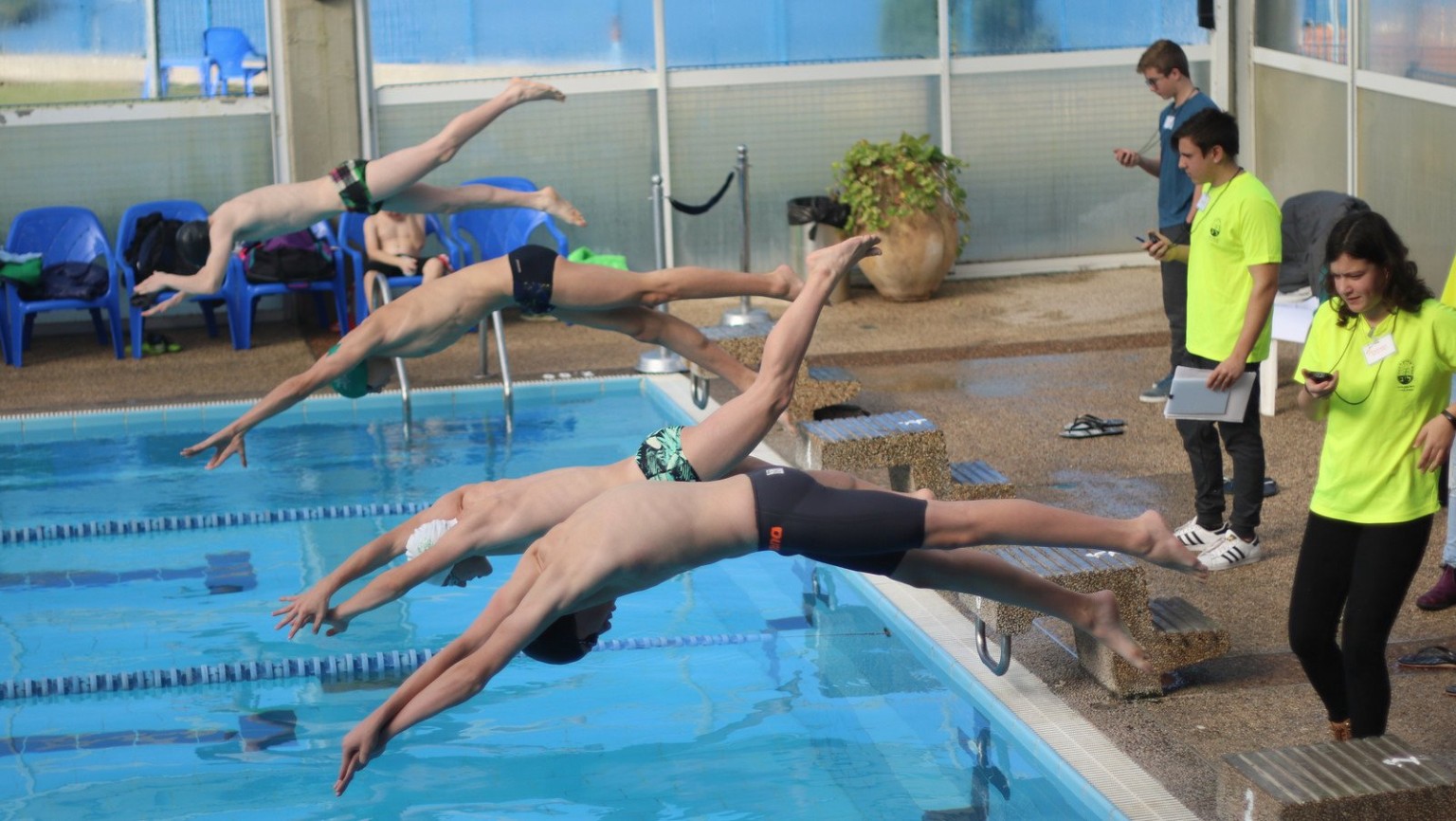
Consider this swimming start. Four swimmers are airborne, but they are not identical silhouettes. One seems almost horizontal, another is diving steeply, and the nearest swimmer stretches diagonally across the foreground with fingertips reaching toward the water. The bodies overlap and form a visual sequence, like consecutive frames from a film somehow caught in a single exposure. The blue water and pale deck divide the picture into two competing worlds: the athletes moving at full commitment and the people on the sidelines going about their work.
That contrast is what I like most. Two people in bright yellow shirts stand beside the pool, occupied with their phones or equipment. A third stands farther back. Their relative stillness is a reminder that a sporting event is not composed entirely of dramatic moments. There are chairs, bags, wet concrete, sandals, starting blocks and a potted plant. Real life refuses to leave the frame simply because the race has begun. A tighter crop might make the photograph cleaner, but it would also make it less interesting.
Timing still matters, of course. Press the shutter a little earlier and some swimmers may still be on the blocks; a little later and the leading hands will have broken the surface. Anticipation is more reliable than reflexes. A photographer who understands the rhythm of a start can pre-frame the water, choose a shutter speed fast enough to arrest the dive, focus where the bodies will travel and then wait for the movement to unfold. Burst shooting helps, but it does not replace knowing what to expect. A hundred badly framed frames are still badly framed.
There is also a question of what kind of photograph we want. The conventional sports image isolates the star athlete and eliminates distractions. It favors clean backgrounds, long lenses and a recognizable peak of action. Those are useful instincts, especially when the photograph must communicate a result quickly. But a wider documentary view can reveal something else: the geometry of a competition, the shared effort of several participants, the unglamorous setting in which athletic grace appears for a fraction of a second.
Swimming offers a particularly interesting problem because much of the sport takes place underwater or at water level. At the start, however, the athletes briefly become airborne. Their bodies are completely legible, and the photographer gets a rare chance to show swimming without the water hiding half the action. The outstretched arms, pointed feet and varied angles make the image almost sculptural. It is less about who is winning than about what a human body looks like when it commits itself to movement.
Sports photography needs technical competence, but technique is only the entry ticket. A sharp picture can still be dull, while a slightly untidy one can be full of life. The real skill is deciding what deserves to stay in the frame and recognizing the relationships that make a fraction of a second worth remembering. Sometimes the decisive moment is not a single athlete doing something exceptional. Sometimes it is an entire scene briefly falling into place.