The Vogue Portrait Look on Budget Gear: A Reflector, an Adapted 85mm, and Better Sun
Editorial fashion portraits are lit and directed, not caught. That is the whole gap between a snapshot of a well-dressed person and a frame that reads as a magazine page. None of it requires a strobe pack, a studio, or a lens that costs more than the camera. It requires putting the sun somewhere useful, bouncing something back into the face, and standing further away with a longer lens.
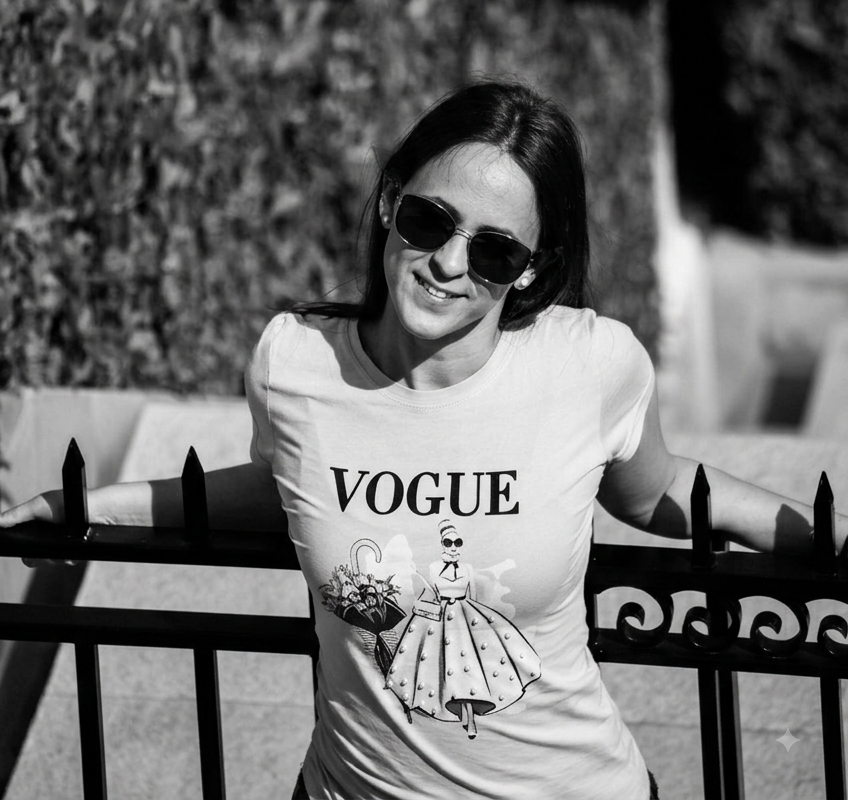
The frame above is a useful teaching case because it does two things right and three things the hard way. The monochrome conversion is correct for the conditions. The pose has weight in it, arms open on the railing, torso turned off-axis. But the sun is directly overhead and unmodified, the background sits close enough to stay sharp and busy, and the sunglasses remove the one element an editorial portrait cannot do without.
Put the sun behind the subject
Hard top-down sun is the one light a fashion shoot never uses raw. It drops the eye sockets into shadow, flattens the nose, and burns the forehead and cheekbones to paper. The fix is not shade. Shade is safe and dull. Turn the subject so the sun falls behind them and slightly off to one side, then expose for the face. The sun stops being the key light and becomes a rim, separating hair and shoulders from whatever is behind them. That rim is most of what people read as “professional” in a portrait.
Now the face is underexposed by two or three stops, which is the point. You are going to fill it.
Fill with something you already own
A five-in-one collapsible reflector runs about the price of a UV filter and does more than any lens upgrade at this level. Silver for punch, white for something softer. Hold it low, roughly chest height, angled up into the face from the camera side. Watch the catchlight appear in the eyes as you tilt it. That catchlight is the difference between a person and a mannequin.
If you would rather use flash, a single hotshoe speedlight fired through a small softbox at roughly one stop under the ambient reading will do the same job with more consistency and less help required. Set the camera to high-speed sync if you want to stay wide open, or drop to a lower ISO and stop down to f/4 and accept slightly more background detail.
Focal length is separation
The classic editorial compression comes from 85mm to 135mm on full frame. On an adapted EF 85mm f/1.8 or a 100mm f/2, both of which sell used for less than a modern kit zoom, you have exactly the right glass. Neither lens has image stabilisation and neither needs it at portrait shutter speeds.
The variable that matters more than aperture is the distance between subject and background. At f/2 with the subject standing a metre in front of a hedge, the hedge stays legible and competes. Move the subject six or eight metres forward and the same hedge dissolves into tone. Same lens, same aperture, different photograph.
A crop body multiplies this in your favour. An 85mm on APS-C frames like a 136mm and forces you to back up, which increases compression and further softens what is behind. Using the smaller body as the tight portrait camera and the full-frame body for anything environmental is a sensible division of labour on a two-camera walk.
Direct the pose, then take the glasses off
Editorial posing is engineered rather than natural. Weight on the back foot. Chin pushed forward and angled slightly down, which defines the jawline and prevents the nostrils dominating. A visible gap between the upper arm and the ribcage, because a limb pressed flat against the body flattens and widens. Hands occupied with something specific, a collar, a pocket, a hem, since idle hands look idle.
And unless the eyewear is the product, the glasses come off. Editorial photography is built on eye contact or a deliberate refusal of it, and mirrored lenses give you neither.
Simplify everything behind the subject
One background element. A wall, a stretch of sky, a single texture. The frame above has three competing at once: hedge, ironwork with repeating finials, and pale architecture in the upper right. Any one of them alone would work. Together they pull the eye off the face and around the edges of the picture.
The rebuild
Same subject, same fence, late afternoon rather than noon. Sun behind her and to camera left, catching the hair. Reflector low and in front, silver side. Adapted 85mm at f/2, subject pulled well clear of the hedge, camera at chin height. Glasses in her hand. Expose for the skin and let the rim blow slightly, because in monochrome a clipped highlight along the shoulder line reads as light rather than error.
Total spend beyond what is already in the bag: one reflector.
As an Amazon Associate I earn from qualifying purchases.