Wildlife Photography With a Telephoto Setup: What It Takes to Get a Leopard Frame Like This
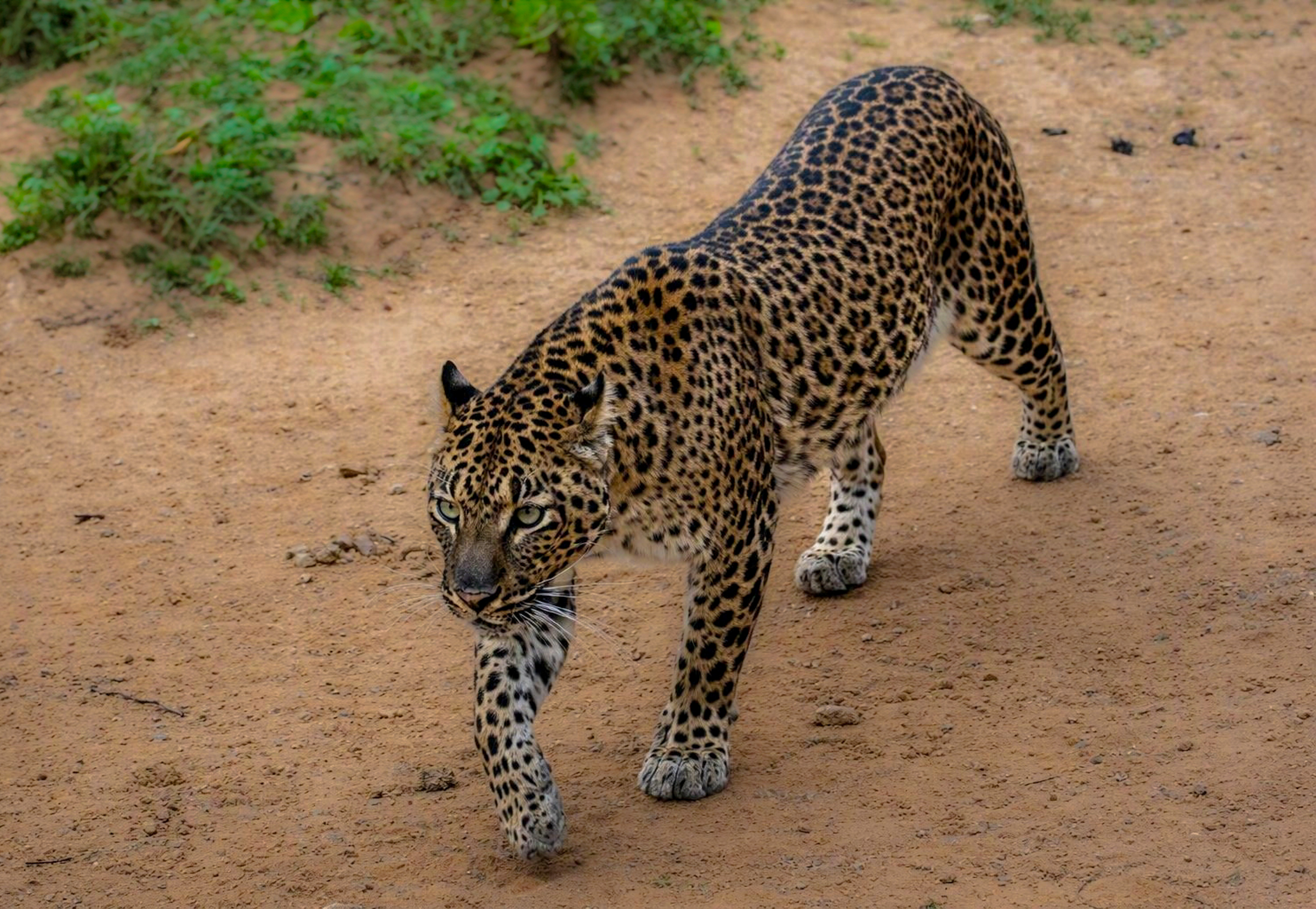
A leopard walking straight down the middle of a dirt track, head low, eyes locked on the lens. It is the frame everyone wants and the one most people blow, because the animal is doing the one thing telephoto gear handles worst: closing distance along the axis of the lens while the light is flat and the vehicle is still rolling.
Focal length is a distance problem, not a prestige problem
The reflex is to buy the longest lens available. That is backwards. Focal length is set by how close you can legally and safely get, and in most reserves that number is decided for you by the track layout, not by your ambition.
A big cat at 30 to 50 meters fills the frame nicely somewhere between 300mm and 400mm on full frame. Past that you start cropping the animal’s feet off and losing the environment that tells the viewer where it is. The dirt, the scrub at the top of the frame, the pale dust on the paws: all of that is context, and context is what separates a photograph from a zoo record shot. In the frame above the animal has room to walk into. Fill it edge to edge and the walk disappears.
Where extra reach genuinely pays is birds, small mammals, and anything that will not tolerate a vehicle inside 80 meters. If that is the target, 500mm or 600mm stops being vanity and starts being the minimum.
Crop bodies are the cheap way through this. An APS-C sensor takes a 400mm lens to an effective 640mm framing without adding a gram of glass or a cent to the invoice. The trade is noise at high ISO, which matters a lot at dawn and dusk, which is exactly when the cats move. That trade is worth making anyway if the alternative is a lens that costs more than the trip.
Shutter speed, and why 1/1000 is not paranoia
A walking leopard is slow. The walk is not the problem. The problem is the head, which turns, and the whiskers, which do not care about your plans, and the vehicle, which is never as still as you think it is.
Run 1/1000s as the floor for a moving big cat. Go to 1/1600s if it breaks into anything faster. Stabilization, in body or in lens, buys back shake, but it does nothing at all for subject motion, and people forget this constantly. IS is not a shutter speed substitute when the subject is the thing that is moving.
That floor forces the rest of the exposure. Wide open, usually f/4 or f/5.6 depending on the lens, and then ISO goes wherever it has to go. Auto ISO with a hard shutter floor is the correct way to shoot this, not manual fiddling while the animal walks past. Modern sensors clean up at ISO 3200 far better than a blurred frame cleans up at ISO 400.
Autofocus settings that actually matter
Continuous AF, animal eye detection on if the body has it, and a tracking area rather than a single point. A head on approach is the easiest case for modern eye detect and the hardest case for old phase detect systems, because the subject distance changes continuously and predictively.
The setting people skip is AF tracking sensitivity. Turn it down. On a track with grass, branches, and dust in the frame, a twitchy setting will jump off the cat and onto a bush the moment something crosses the sensor. A slower, stickier setting stays on the animal through the clutter.
Back button focus is worth the week of retraining. It separates the decision to focus from the decision to shoot, which matters when the animal stops, sits, and stares for forty seconds and you want to fire without the camera hunting again.
Shooting from a vehicle
Nobody hand holds a 500mm lens for three hours. Nobody should try.
Kill the engine. Diesel vibration travels straight up the chassis into the lens and shows up as a soft frame you cannot explain later. A bean bag on the window frame or the roof edge beats a tripod in a vehicle every time, because a tripod couples you rigidly to a platform that shifts every time someone moves.
Choose your side before the drive starts. Sitting on the wrong side of the vehicle when the cat appears is the most common way to lose a sighting, and no amount of gear fixes it. Sit low if the option exists. An eye level frame with the animal reads far better than the standard looking down at the cat angle, which flattens the subject and makes everything look like a snapshot from a bus.
The light window is small
Cats move at the edges of the day. That gives you maybe ninety minutes of usable directional light at each end, and a long flat middle where the sun is overhead and the contrast is ugly.
Overcast is a gift, not a setback. The frame above has soft, even light with no blown highlights on the pale chest and no crushed shadows in the rosettes, which is exactly what harsh midday sun destroys. If the day goes hard and bright and the animal shows up anyway, shoot it, then consider black and white in post. Harsh light is a problem for colour and an asset for tone.
What this setup actually costs
Less than the forums suggest.
A used 100-400mm zoom, a crop body, a bean bag, and a spare battery will produce frames indistinguishable from the expensive kit at web and print sizes most people ever use. The big primes buy you a stop and a half of light and faster AF in bad conditions. They are real advantages. They are not the difference between getting the shot and not getting it.
The difference is being in the right seat, with the engine off, at the right hour, with the shutter floor already set.