Bending Marienplatz: Fisheye Compression in a Crowded Square
Fisheye lenses punish hesitation. Point one at the wrong moment in the wrong place and you get a novelty gimmick — curved horizon, bloated foreground, everything looking simultaneously too close and too far. The effect announces itself before the subject does, and once a viewer’s eye catches the distortion, the distortion is all they see. This is the trap most photographers walk into with ultra-wide glass: the lens becomes the photograph. The actual subject — the city, the building, the moment — gets swallowed by the technical party trick.
Point one at Marienplatz on an overcast weekday morning and you get something else entirely.
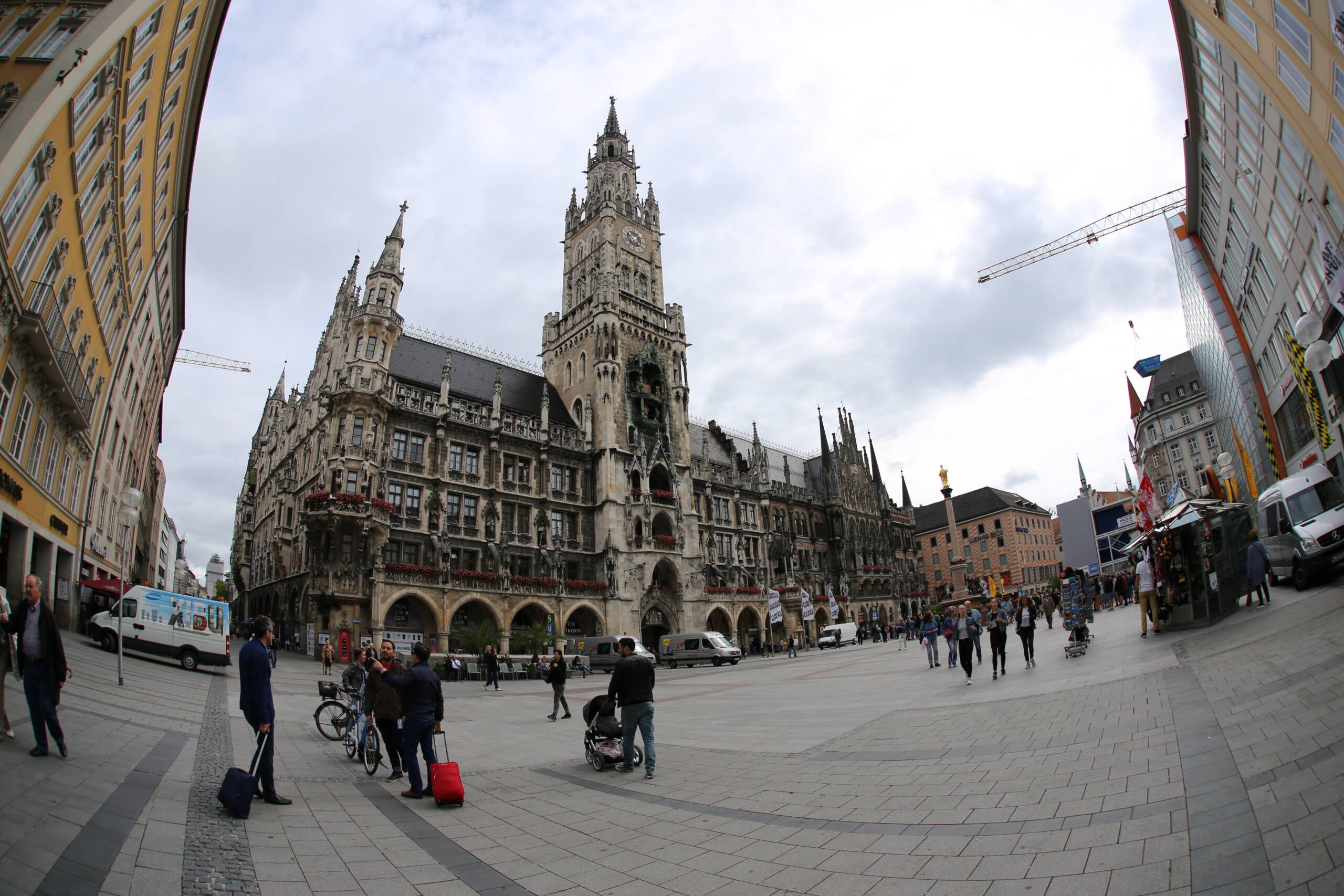
The difference isn’t location, exactly. It’s fit. Fisheye lenses require subjects that can absorb the distortion without being destroyed by it — subjects with enough inherent drama, enough structural verticality, enough visual mass that the barrel effect reads as amplification rather than manipulation. Most subjects can’t do this. A modest street, a low-slung building, a flat landscape — the fisheye warps these into something unrecognizable. But certain places were built for exaggeration. They were designed by architects who wanted the viewer to feel overwhelmed, outscaled, aware of their own smallness in front of the edifice. Those places and fisheye glass are a natural pairing. Munich’s New Town Hall is one of them.
The New Town Hall gives the lens what it needs: vertical mass. The Gothic tower climbs toward center frame while the façade sweeps outward in both directions, the barrel distortion amplifying rather than distorting the building’s already theatrical proportions. The fisheye doesn’t lie here — it exaggerates something that is genuinely exaggerated. Neo-Gothic excess rendered in stone, then bent a few more degrees for good measure. Georg von Hauberrisser designed the building across four decades of construction beginning in the 1860s, and he was not designing for understatement. The pinnacles, the arches, the ornamental density across every horizontal band of the facade — this is a building that was already pushing toward the limits of what a civic structure is supposed to do. The fisheye just honors the intention.
It helps to understand what barrel distortion actually does spatially. Straight lines near the edges of the frame curve inward toward the center. The effect is most pronounced at the frame’s periphery and diminishes toward the optical axis. This means that a building centered in the frame keeps its primary vertical lines relatively intact — the tower reads as a tower — while everything flanking it bends and stretches. In a scene with a strong central anchor, this creates a sense of the world being pulled toward a vanishing point. The surrounding architecture curves away like walls of a fishbowl. The center subject holds. When you apply this to Marienplatz, the New Town Hall becomes gravitational. Everything else — the yellow residential facades on the left, the commercial buildings on the right, the paved expanse of the square itself — curves and recedes. The building doesn’t just dominate the frame; it warps the frame’s geometry to make dominance the only possible reading.
What makes or breaks fisheye work in a public square is foreground population. Too sparse and the distortion becomes the subject — you get an empty curved plaza and a building at the end of a visual funnel, and there’s nothing for the eye to do after it registers the effect. Too dense and you lose spatial legibility. Overlapping figures in a fisheye frame compress into visual noise faster than in normal focal lengths because the distortion affects each figure differently depending on where they fall relative to the optical axis. The scatter here — a few clusters of pedestrians mid-conversation, a cyclist, someone pushing a stroller — gives the frame human texture without crowding out the geometry. The distance between figures is generous enough that each reads as a discrete element. The space between them lets the paving pattern show through, and that paving pattern matters: the curved lines of the plaza stones rhyme with the barrel distortion, making the lens choice feel inevitable rather than imposed.
The figures nearest the lens curve slightly with the glass. That’s not a flaw; it’s the lens declaring what it is. There’s a school of thought that treats edge distortion in fisheye photography as something to minimize — to crop, or to correct in post, or to avoid by keeping figures away from the frame’s periphery. This view treats the fisheye as a malfunctioning wide-angle lens. But that’s the wrong frame entirely. The fisheye is its own optical instrument with its own spatial logic, and working with that logic means accepting what it does to objects at the frame’s edges rather than treating those objects as compositional problems to solve. The slight curve of the pedestrian on the left side of the frame isn’t an error. It’s information about where they are in relation to the lens, and it’s part of what makes the image coherent as a fisheye image rather than a wide-angle image with distortion artifacts.
The overcast sky earns its place. Flat cloud cover at a location like this means no burned highlights on the pale stone, no harsh shadow cutting across the arcade arches below the Glockenspiel. The light is even and uninspiring in the best possible sense — it gets out of the way of the architecture. This is worth dwelling on because the instinct in travel photography is often to wait for dramatic light: golden hour, raking side light, shafts breaking through cloud. And in many contexts that instinct is correct. But the New Town Hall’s facade is extraordinarily detailed — carved figures, relief panels, Gothic tracery running across every horizontal register. Dramatic directional light would deepen some of that detail and obliterate the rest. It would create areas of brilliant clarity and areas of impenetrable shadow, and the frame would become a story about light rather than a story about the building. Diffuse overcast renders the facade at consistent luminosity from the arcade arches at street level up to the pinnacles above the clock tower. Every layer of the building reads. The texture is available across the entire structure simultaneously, which is the condition under which this particular subject makes most sense photographically.
There’s also the sky itself to consider. Fisheye lenses capture an enormous field of view — typically around 180 degrees, sometimes more — and in a scene like this, a significant portion of that field is sky. A hard blue sky with bright sun would create an extreme dynamic range problem: the bright sky against the pale stone facade would require a compromise exposure that either clips the sky or loses detail in the building’s shadowed recesses. The overcast sky and the facade occupy a much closer tonal range, which is why the exposure here can hold detail in both.
One thing to watch shooting fisheye at Marienplatz: the surrounding buildings intrude on both sides of the frame, and unless you control for it, you end up with half an advertisement and a construction crane fighting the tower for visual priority. Here both are present. There’s a partially legible advertising board on the left and a construction crane cutting into the upper right quadrant of the sky. These are facts about Marienplatz on a given weekday in a given year — the square is a living city center, not a heritage diorama, and the commercial and infrastructural apparatus of a working city is visible from it in all directions. Whether their presence in the frame is honest documentation or compositional laziness depends on what you think travel photography is for.
If you think it’s for producing images that look like the destination’s tourism board would approve them, these elements are failures. They compete with the building and remind the viewer that the building exists in a contemporary context full of delivery trucks and renovation scaffolding. If you think it’s for producing images that represent a real encounter with a place at a specific moment, they’re assets. The crane places the image in time. The signage places it in a commercial ecosystem. The image becomes a document of Marienplatz in use rather than Marienplatz as monument, and the fisheye — which already bends and stretches the frame’s peripheral content, which already foregrounds the act of looking rather than pretending the camera is a neutral eye — is exactly the right tool for making that kind of document.
The lens has no interest in pretending the world is tidier than it is. Neither should the photographer using it.