Below you will find pages that utilize the taxonomy term “manual focus”
Posts
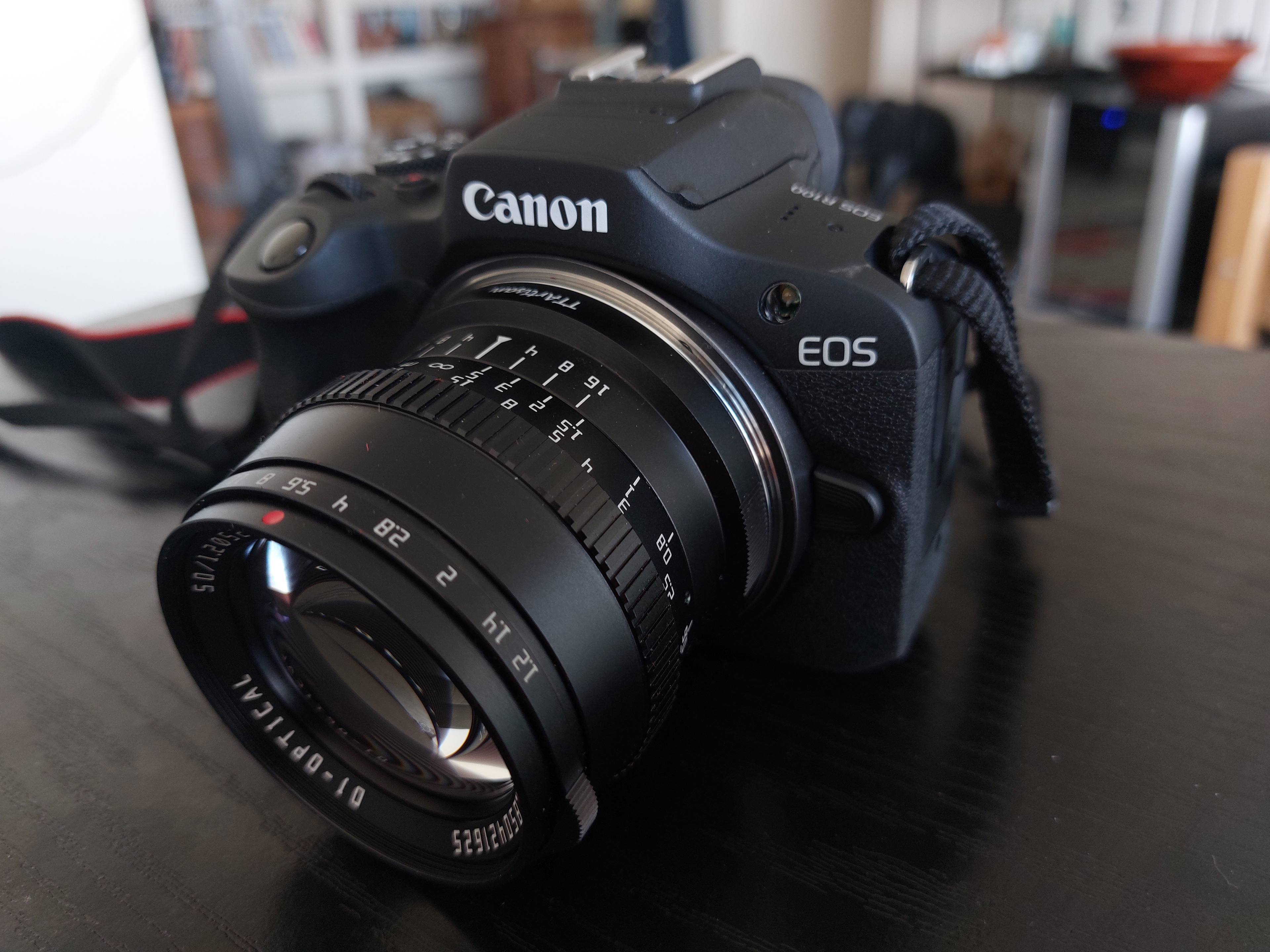
Travel Photography, Cartier-Bresson Style, With a Canon R100 and a TTArtisan 50mm f/1.2
Most people don’t think of a Canon R100 and a cheap Chinese manual 50mm as a setup worth discussing in the same breath as Henri Cartier-Bresson. But standing in front of this tiny camera, the absurdly fast TTArtisan lens flaring a little at the edges like a half-remembered summer glare, you suddenly realise something: Bresson didn’t care about gear the way the internet does. He cared about reaction time, about intent, about walking the streets ready to trip a shutter at the exact moment life blinked.
Posts
Fujifilm X-S20 + Helios 44-2 58mm f/2: Swirl Season
The Helios 44-2 58mm f/2 is a Soviet-era lens manufactured at the KMZ optical plant in Krasnogorsk, produced in quantities so large that the secondary market is essentially inexhaustible. Clean copies sell for $30 to $80 depending on coating variant and condition. Via an M42-to-Fujifilm X adapter (approximately $15), it attaches to the X-S20 and produces images that Instagram’s lens simulation filters have been attempting to replicate, with limited success, for a decade.
Posts
Fujifilm X-T30 II + Jupiter-9 85mm f/2: Soviet Portrait
The Jupiter-9 85mm f/2 is a Soviet optical instrument derived from the pre-war Carl Zeiss Jena Sonnar design, manufactured at the KMZ factory and exported in modest quantities under the Jupiter brand. Optically, it inherits the Sonnar formula’s characteristic rendering: a smooth background blur without the Helios 44-2’s swirling tendencies, strong center sharpness with a gradual rolloff toward the edges, and a color rendering — particularly in the green channel — that has a coolness contemporary photographers find refreshing after years of the warm-biased output from modern lens coatings.
Posts
Nikon Zfc + Nikkor AI-S 105mm f/2.5: Vintage Honest
The Nikon Zfc was designed with deliberate aesthetic intent: a retro body styled after the FM2 film camera, with physical dials for shutter speed and exposure compensation, a silver and black finish, and a form factor that attracts a specific kind of photographer — someone interested in the relationship between tool and process, not just specification and output. Fitting the Nikkor AI-S 105mm f/2.5 to it, via Nikon’s FTZ II adapter, completes an argument the camera body was already making.
Posts
OM System E-M10 IV + Olympus OM 50mm f/1.4: Full Circle
There is something pointed about mounting a 1970s Olympus OM-System 50mm f/1.4 lens onto an OM System digital body four decades after the original system was discontinued. The Olympus OM mount, discontinued in the 1980s when Olympus moved to autofocus, left behind a generation of lenses that are available cheaply on the secondary market and adapt to Micro Four Thirds via a $20 OM-to-MFT adapter without optical compromise. On the E-M10 IV, the company’s most accessible current body, the old glass completes a circle that the company’s rebranding as OM System seems designed to acknowledge.
Posts
Sony A6400 + Minolta MD 50mm f/1.4: Flea Market Glass
The Minolta MD 50mm f/1.4 is a lens that predates autofocus entirely. It was manufactured through the 1970s and 1980s, attached originally to Minolta’s SLR bodies, and is now scattered across eBay listings and flea market tables in sufficient quantities that finding a clean copy for $30–$60 is not particularly difficult. Adapted to the Sony A6400 via a $20 MD-to-E mount adapter, it produces something that a significant community of photographers finds genuinely irreplaceable.