How and Why to Travel With Two Cameras: One Wide, One Mid-Tele
The photographer in this frame is doing something that looks excessive and isn’t. Wide zoom at the eye, telephoto hanging off the other shoulder, already in his hand before he’s finished the shot he’s taking. He isn’t showing off. He just isn’t going to change a lens today.
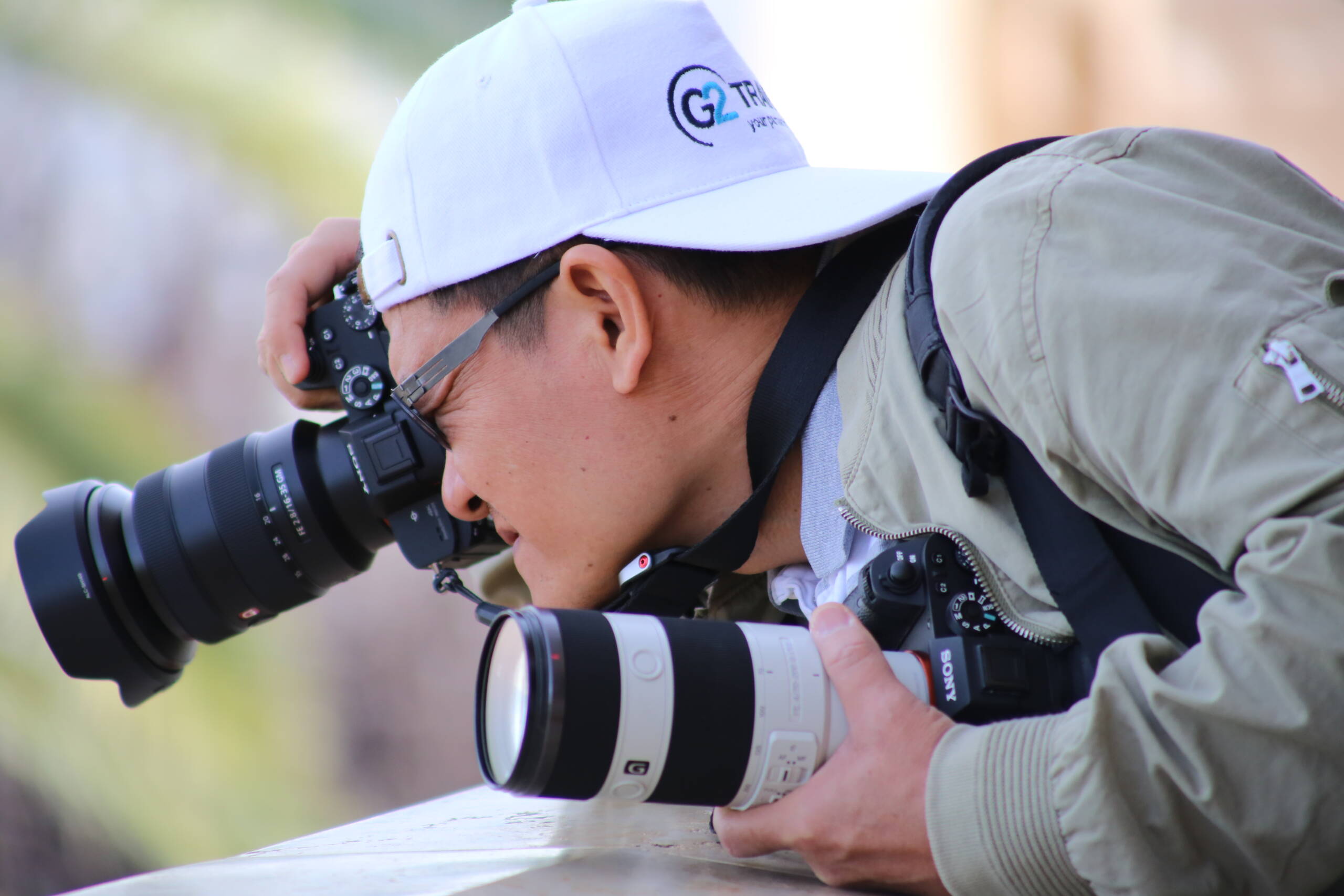
That’s the whole argument for two bodies. Everything else is detail.
Lens changes cost more than you think
Not the twenty seconds. The twenty seconds are fine when you’re standing in a hotel room.
The cost is that you stop looking. You’re head-down over an open camera in wind, or at the edge of a crowd, or on a boat, and while you’re doing that the light changes or the person walks out of frame. Then there’s the dust. Swap lenses on a beach or in a dry hill town a few times a day for two weeks and you’ll spend an evening cloning sensor spots out of every sky you shot.
You also make worse decisions. When changing costs something, you talk yourself into the lens you’ve already got on. Half the frames you didn’t take on your last trip were lost that way, quietly, without you noticing.
Two bodies removes the decision. You pick up whichever camera already has the right lens.
What I actually carry
Canon R8 and R100. Wide zoom on the R8, mid-tele on the R100.
The R8 is the full-frame body, so it gets the wide end, where full frame actually buys you something: the field of view, the low-light headroom, the files you’ll want if a frame turns out to be the one from the trip.
The R100 gets the longer lens, and the crop factor stops being a compromise and turns into the point. An 85mm behaves like roughly 135. A 100mm gets you to around 160. That’s free reach on the cheapest body Canon sells, and reach is the thing travel shooting runs out of first: details on facades, a face across a market, a bird you weren’t expecting.
The asymmetry is deliberate. A second body doesn’t need to match the first. It needs to be light enough that you’ll actually bring it. A matched pair of full-frame bodies is a rig for someone getting paid. A good body plus a small cheap one is a rig for someone walking eight hours a day.
Carrying them without hating yourself
Two neck straps is the mistake everyone makes once. They tangle, they swing into each other, and you’ll be untangling nylon while the shot leaves.
Cross-body, one strap over each shoulder, cameras riding at hip level on opposite sides. Or one on a sling and the small one in a jacket pocket if the lens is short enough. Whatever you pick, keep it fixed. Wide body on the same side every day, tele on the other. You want your hand to know which camera it’s reaching for before your brain does.
Match the settings across both. Same white balance, same picture profile, same auto ISO ceiling. Otherwise you get home to two sets of files that don’t sit next to each other in a sequence, and you’ll spend the edit fixing a problem you created at breakfast.
What it costs you
Two batteries and two cards to manage, and two charging cycles every night. Weight, obviously, though less than you’d guess when the second body is small.
The R100 in particular has no in-body stabilisation and a fixed screen, so give it the telephoto in decent light and don’t ask it for handheld dusk work. That’s the trade for the size.
And you’ll look like a person with too much equipment. In some places that matters. If you’re trying to shoot a street quietly, or you’re somewhere you’d rather not advertise a camera bag, one small body and one lens is the better tool and it isn’t close.
When one camera is right
Long hikes where every gram gets audited. Cities where you want to disappear. Days when you deliberately want the constraint, because a single prime does force better seeing, and anyone who’s spent a week on a 35mm knows it.
The rest of the time, on a trip you’re not repeating, the second body earns its place the first afternoon something happens fast at the wrong focal length.
As an Amazon Associate I earn from qualifying purchases.