Prague Old Town Square in Flat Overcast Light: The Ultra-Wide Frame That Works
Grey sky, mid-morning, mid-October. This is the light most people complain about and then shoot in anyway, because you don’t get to reschedule a trip around the forecast. It’s also the only light that renders a square like this one without tearing the exposure apart.
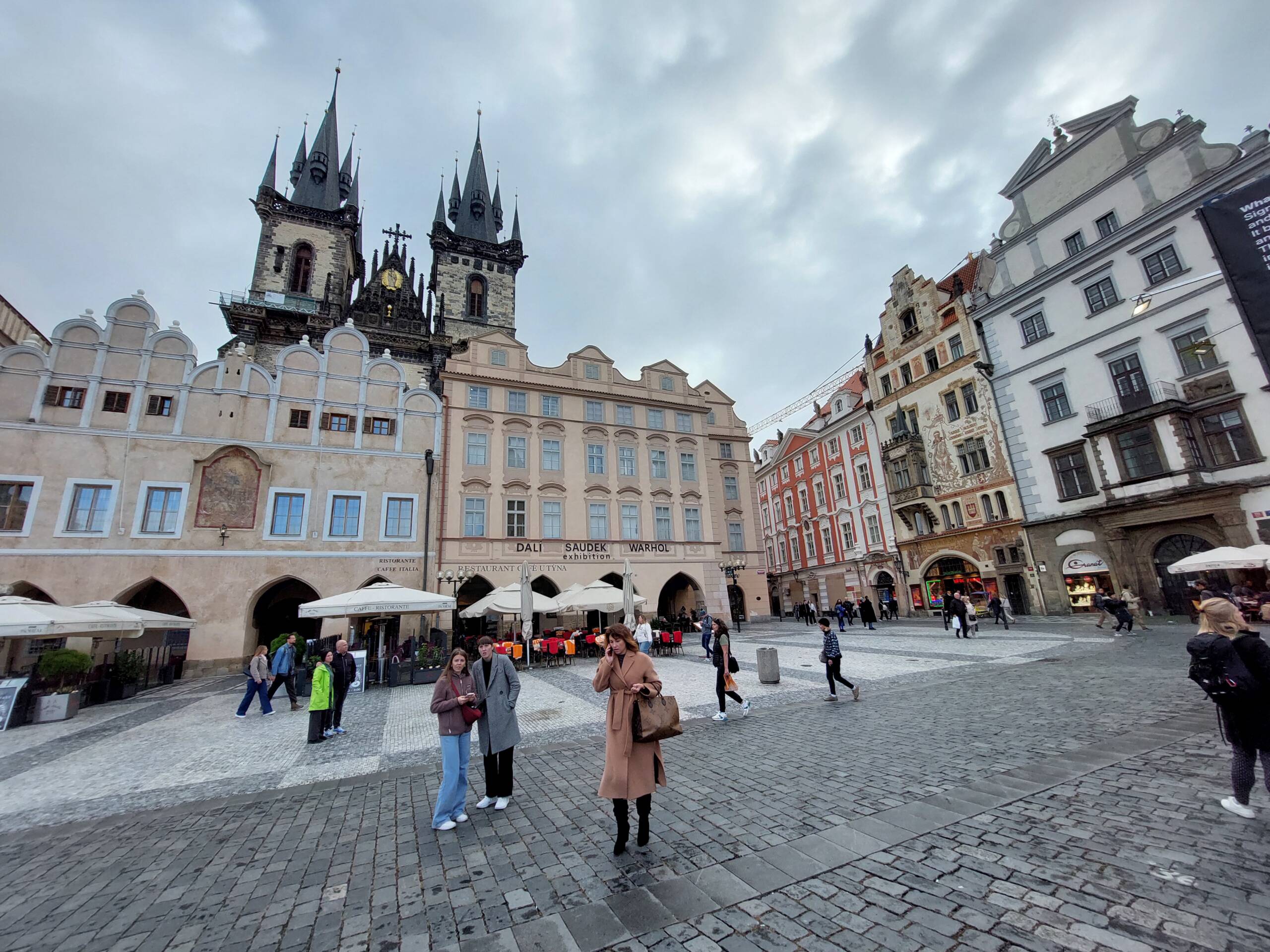
Look at what the cloud cover is doing. The pale plaster on the west range keeps its texture. The arcades underneath aren’t black holes. The dark Gothic towers of the Týn Church hold detail instead of going to silhouette, which is exactly what happens to them against a clear blue sky at this hour. One diffuse source, roughly six stops of range across the whole scene, nothing clipped. Direct sun would have cost me either the façades or the shadow under the arches.
The sky is the risk, not the light
Flat light is generous to buildings and brutal to skies. Half this frame is cloud. It survives because the overcast has structure in it, streaks and breaks and a bit of tonal separation. If the cloud had been uniform white, none of that would be true and the top half would read as dead paper.
The fix in that case is simple. Tilt down, put the horizon high, let the paving take two thirds. Don’t try to save a blank sky in post by dragging the highlights down. It goes grey and muddy and everyone can see what you did.
Ultra-wide needs the ground
Wide angle pushes distant subjects away fast. Those towers are maybe eighty metres off and they’re already small in the frame. That’s the tax you pay for taking in the whole square, and there’s no way around it except changing lens.
So the bottom of the frame has to earn its space. Here the cobbles do it. The fan-set granite sets, the pale inlaid bands crossing the square, the wet-looking sheen on the stone. That pattern is the actual subject of the lower half, and it pulls the eye from the front edge back toward the arcades. Without it you’d have a lot of empty grey.
Two things to watch when you shoot this low and this wide. Verticals lean at the edges, badly on the left building here. Some of that corrects cleanly, some of it doesn’t, and over-correcting stretches the corners into mush. And the closest paving stones sit around a metre from the sensor, so stop down further than feels necessary. f/8 minimum.
Wait for the people
An empty square photographs like a stage set. This one has three layers of figures, and they’re what give the architecture its scale. The woman in the camel coat is the anchor, roughly a third in from the left, far enough forward to read clearly. The pair behind her sits a beat further back. Then a scatter of walkers in the middle distance, small enough to say “this space is big.”
That arrangement isn’t luck, it’s just waiting. Frame it, lock it, stand there for two or three minutes and take a frame every time somebody lands where you want them. Nine fifty in the morning in October is the window. Same composition in July at two in the afternoon is a wall of heads and umbrellas.
Small things in post
Overcast pushes everything blue. Auto white balance will leave the plaster looking cold and slightly dead. Warm it a touch, then stop, because the cloud turns yellow before the buildings turn right.
Lift the mid-tones under the arcades. Hold the sky where it is. Add contrast locally rather than globally, since a global curve will crush the towers.
And try it in black and white before you decide. Dark spires, thin cloud, grey stone. It converts better than the colour version deserves.