Why the Best Travel Photos Have Another Photographer in the Frame
The Louvre has been photographed more than almost any building on earth. Your version adds nothing. The pyramid is lit the same way every night, from the same fixed positions, and the courtyard gives you maybe four viewpoints that anyone bothers with. Show up with a camera and you are re-shooting a postcard that already exists in better light, with better weather, taken by someone who waited three hours for the sky to go the right shade of blue.
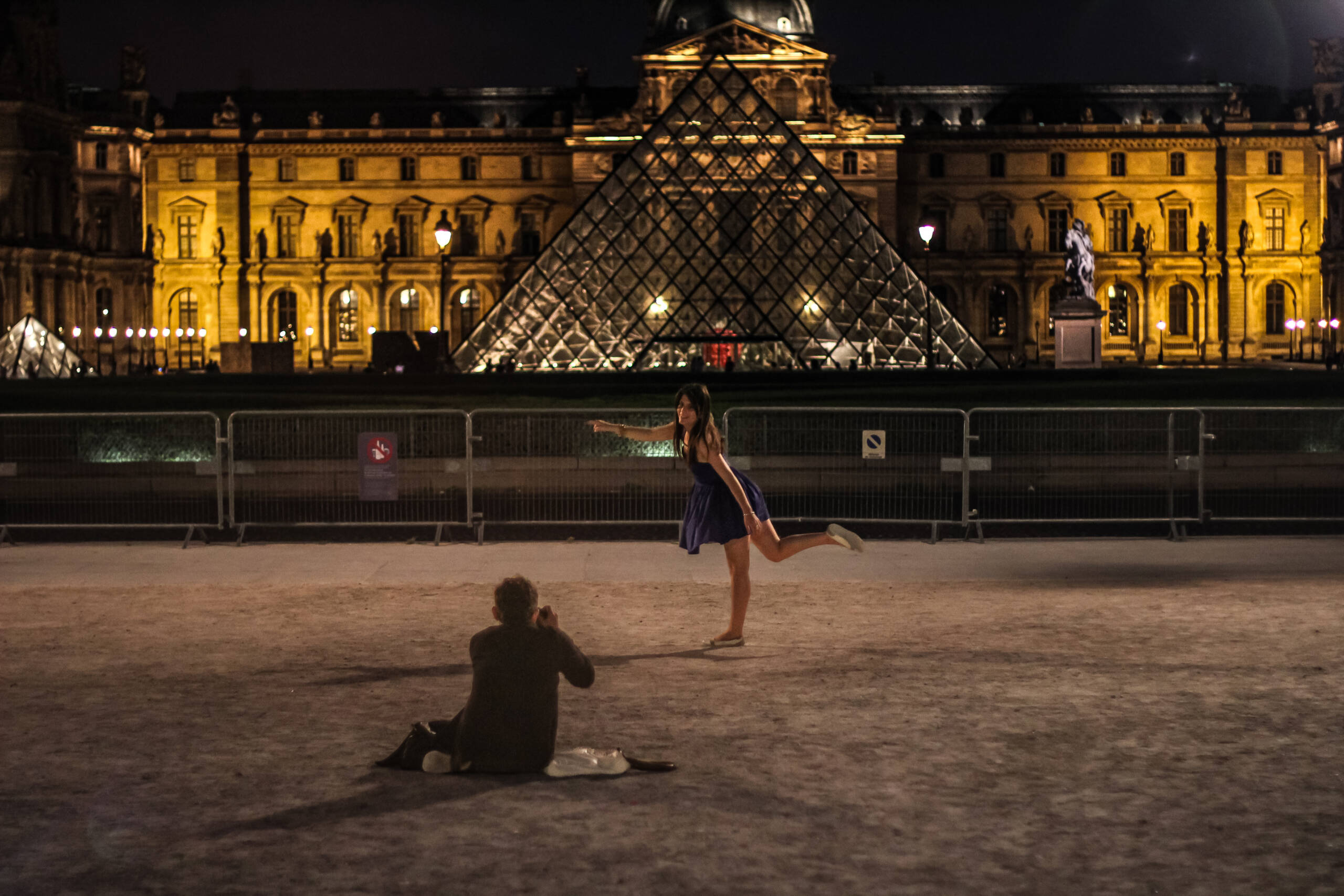
What has never been photographed is what happened in front of you at 11pm on a Tuesday. A woman balancing on one leg in a blue dress. A man sitting flat in the gravel because he needed a lower angle and there was nothing to kneel on. The gap between them, which is the actual subject.
The monument is the light source, not the subject
Once you stop treating the building as the thing you came for, it becomes useful. A floodlit facade is a giant softbox pointed at your foreground. You get separation for free: bright warm mass at the back, cool ambient on the people, a clean edge between them. Expose for the highlights on the stone and let the figures sit two or three stops under. They will read as shape rather than detail, which is what you want. Faces at this distance are noise.
This is also why the shot works handheld. You are not trying to hold the building’s detail, so you can drop the shutter to whatever your hands allow, open up, and accept the grain. Sharpness in the foreground and mush in the sky is a fine trade. Sharp everywhere and no subject is not.
Photographing the ritual, not the landmark
There is a whole choreography at every major site and almost nobody shoots it. One person poses. One person directs. The pose is always the same pose. The kicked-back leg, the arm out, the pretend candid stride. It is performed sincerely and it looks absurd from thirty feet away, which is exactly the tension you are looking for.
The comedy is not the point on its own. The point is that this is what visiting a famous place actually consists of now. People spend more minutes making images of the Louvre than looking at it. Photograph the looking-past and you have documented the site more honestly than another frontal shot of the pyramid ever will.
Scale comes along for free. Nothing gives a building size like a small human body in the bottom third, and nothing anchors an empty courtyard like two people who are clearly together and clearly some distance apart.
How to actually get it
Stay back. The distance is the composition. If you close in, you turn a scene into a portrait of strangers and it stops working for you and for them.
Shoot from behind or beside the other photographer, never past them into their subject’s face. You want their body, their posture, their arms up. The pose they are capturing should be readable but secondary.
Wait for the beat after the shutter. The pose collapses, someone laughs, the phone comes down to check the screen. That frame is usually better than the one they were making, and it is the one they will never have.
Wide is safer than long at night. A 24mm or 28mm keeps enough of the location to explain where you are, and short lenses forgive slow shutters. A 50 works if the pair are far apart and you can afford to lose context.
Watch the middle ground. Barriers, signage, bollards, the strip of grass, all of it sits between your foreground and your background and all of it either builds the layers or clutters them. Move ten feet sideways until the fence line runs clean.
The obvious caution
Public space, public behaviour, fine. Someone who has clearly noticed you and does not want it, not fine, and it is not worth arguing about. Lower the camera. There is another pair posing forty feet away, doing the same thing, in better light.
Nobody needs your photograph of the pyramid. They might want your photograph of the man sitting in the dirt to get the angle right.