Blue Hour on Jaffa Road: Salvaging a Dark Jerusalem Street Frame
There’s a window of maybe twenty minutes where a street like this works. The sky still holds blue. The sodium lamps are already on. Ten minutes later the sky goes black and you’re just shooting lamps against nothing. I got this one somewhere in the middle of that window, standing on the tram tracks at the bottom of Jaffa Road with the Holy Trinity domes sitting at the far end of the street like a full stop.
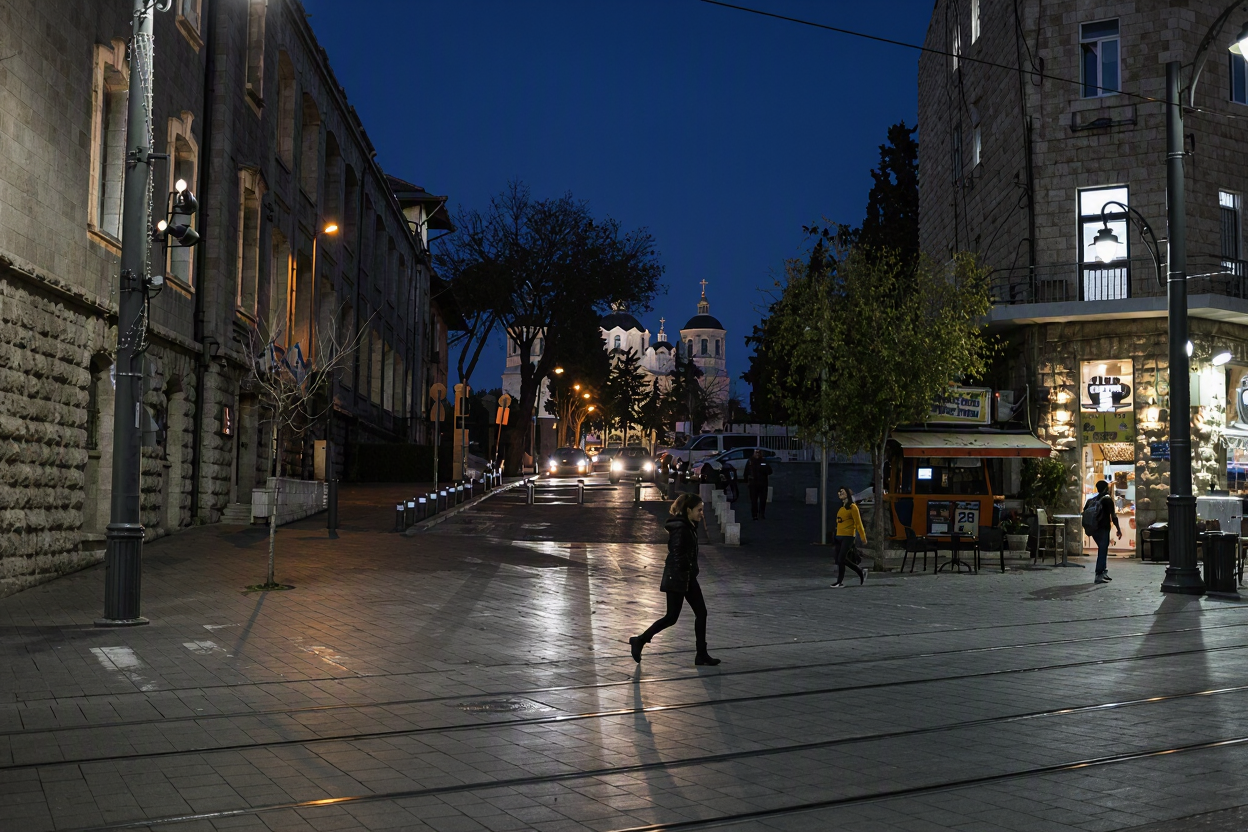
The file looked like nothing when I opened it. Median brightness around fourteen percent. The paving read as grey sludge, the stone on the left could have been any material at all, and the cathedral was a vague pale smear behind the trees. Every element I actually wanted was in there. None of it was legible.
The white balance trap
First instinct with a frame this blue is to hit auto white balance and let the software sort it out. Don’t.
Auto white balance is usually some flavour of grey world. It assumes the scene averages out to neutral, works out how far off neutral your average is, and corrects the difference. That assumption holds for a lot of daylight photography. It falls apart completely on a street lit by sodium vapour, because the street genuinely is orange. It’s supposed to be orange. Correct it to neutral and you’ve deleted the light source.
I ran the numbers on the ground plane before touching anything. Excluding sky, the lower half of the frame sat at roughly R 0.052, G 0.050, B 0.044 in linear values. Grey world would have wanted gains of about 0.93 on red and 1.12 on blue to flatten that out. Apply those and the paving turns cold, the lamps turn grey, and the whole reason for taking the picture evaporates.
So I left the warmth alone and fixed a different problem. The sky was reading teal rather than indigo, which is a green excess, not a blue one. Small gains, 1.025 on red and 0.978 on green, and the twilight went where it should have been. Stone read as stone. Sodium stayed sodium.
Worth saying plainly: the tint slider and the temperature slider do different jobs, and on night frames the tint slider is usually the one doing the actual work.
Half a stop of restraint
I lifted the shadows twice. The first version opened everything up. You could read the stonework on the left facade all the way down to the arcade, count the courses, see the window mouldings.
It was worse.
With the left building fully described, the frame had two subjects fighting each other. The facade is big, it’s close, and it occupies about a third of the image. Give it detail and it wins. Give it detail and the cathedral, which is the thing at the end of the street doing all the compositional work, becomes a background item.
So I cut the shadow lift in half and added a directional falloff across the left third at thirty percent. The stone still has texture. It just recedes now. The eye runs down the wet paving, past the walker, and lands on the domes, which is what it was always meant to do.
Median brightness ended at sixteen percent. Barely brighter than the original. The difference is entirely in where those tones sit relative to each other.
Sharpening around light sources
Two things will wreck a night frame in post. Halos around the lamps, and noise blooming in the sky.
The lamps I handled with masking. Clarity at a 34 pixel radius, but zeroed out above eighty percent luminance and below six percent, so the local contrast operation never touches the bulbs or the deepest blacks. Sharpening went in at two scales, roughly 1.4 and 4.5 pixels, behind a Sobel edge mask. Flat areas get nothing. The tram rails and the crosses on the domes get everything.
The sky was easier than expected. Channel standard deviation in a flat patch came in around 0.005, so this wasn’t a high ISO scramble and the noise never became an issue. A light bilateral pass on the chroma channels cleaned up the last of the blotchiness in the deep blues and that was it.
What moody actually means here
It isn’t darkness for its own sake. Every frame is dark at blue hour. The work is deciding where the detail lives, and then having the discipline to take it away from everywhere else.
One walker, one lit shopfront, one wet reflection down the middle of the street, and a church at the vanishing point. Everything else recedes.