Farmers Market Photography: Why the Single Oyster Beats the Whole Stall
The stall had everything a photographer thinks they want. Whole crabs on crushed ice, whelks in their shells, three grades of oyster, lemon wedges cut that morning, parsley banked up like hedging. I shot the counter twice, wide, both frames from standing height. Both were mush. Too much of everything and no reason for the eye to stop anywhere.
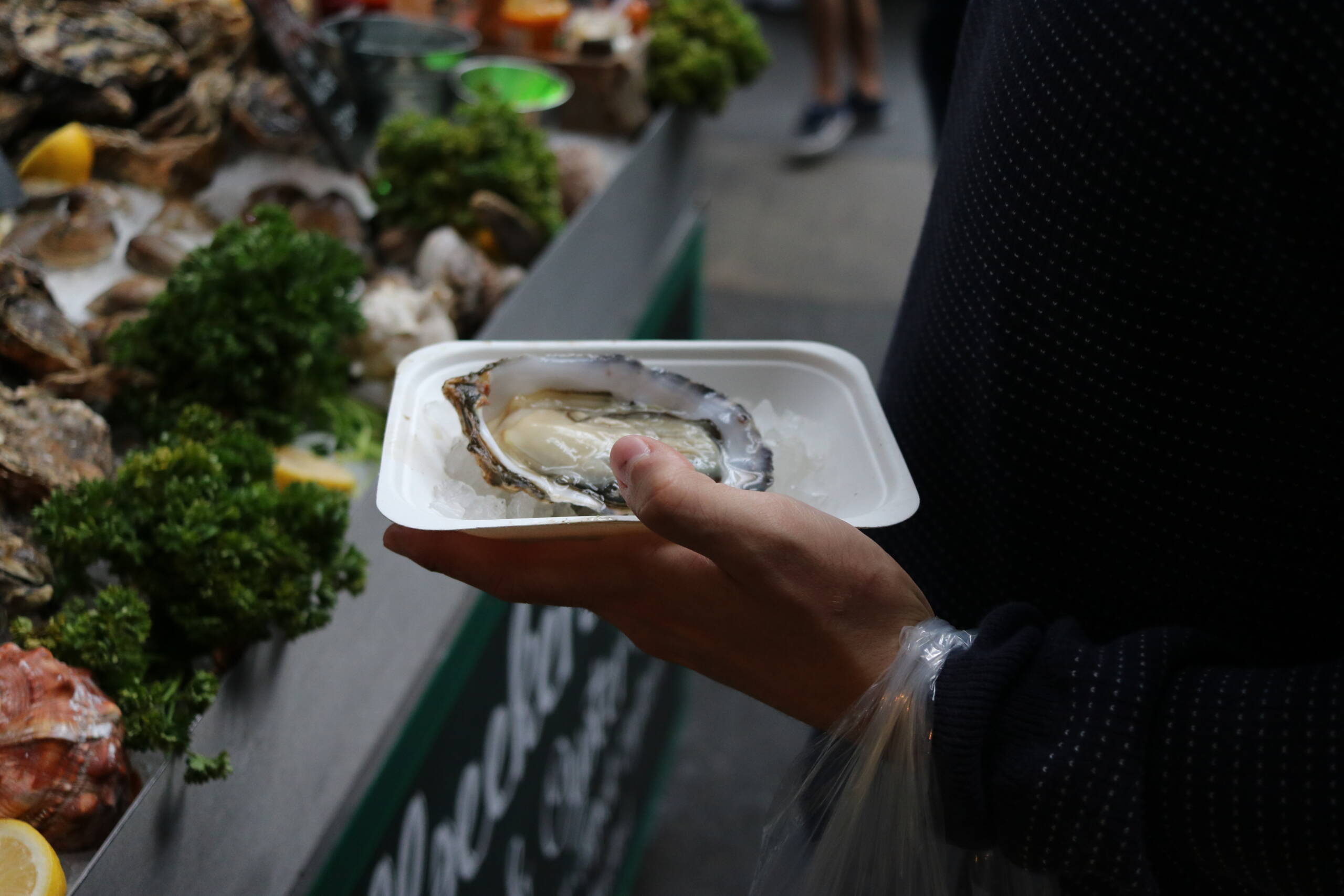
Then I bought one oyster, the vendor handed it over in a paper tray, and the picture was already made. One subject, one hand, everything behind it reduced to green and grey texture. That is the whole lesson of shooting food markets and it took me an embarrassing number of wasted frames to learn it.
A stall is inventory, not a subject
Vendors arrange for volume. They want the display to read as abundance from four metres away, which is the opposite of what a photograph needs. Point a camera at abundance and you get a wall. No hierarchy, no entry point, nothing for the viewer to land on.
Pull one item out of the wall and the wall becomes background. Better still, let the customer pull it out for you. A tray in a hand does three jobs at once: it gives scale, it says the thing was bought rather than staged, and it puts the subject on a plane you can isolate from everything behind it.
Focus on the near lip of the shell
At this distance, wide open, the depth of field is thinner than the oyster itself. If you focus on the meat you lose the shell edge, and the shell edge is where all the detail lives. That fluted grey and blue rim is the only genuinely sharp-looking thing in the frame. The meat is soft and wet and reads fine slightly out of focus. The shell does not.
Eye detection is useless here so switch to a single small point and put it on the near edge. Then take three frames rocking slightly back and forth, because a handheld body at close range moves more than you think between half press and shutter. Sit down with them later. One will be right.
Market light is a tent, and tents have a colour
Under the awning the light is soft, directional, and coming from the open side of the stall. That part is a gift. What is not a gift is the colour. Green canopy, green chalkboard, striped fabric, all of it bouncing into a subject that is mostly white and mostly wet. Auto white balance will read the ice as neutral and push the whole frame magenta trying to correct.
Shoot raw and set white balance yourself later off the crushed ice, which is the closest thing to a grey card you will find on a seafood counter. If you have to nail it in camera, cloudy is usually closer than auto.
Ice also blows out. The tray is white, the ice is white, and the meat is a pale cream that sits maybe a stop under both. Meter for the highlight and drag exposure down two thirds. Recovering a blown ice highlight is not possible. Lifting the shadow on a parsley bank is trivial and nobody looks at the parsley anyway.
Buy something first
This is not politeness for its own sake, though it is that too. A vendor who has just taken your money will hold the tray still, turn it, wait, and let you get closer than any stranger with a camera gets. The transaction is what buys the access. Six pounds for an oyster is cheaper than every other way of getting a hand into your frame.
It also changes the picture. The tray in this frame is being carried away from the counter, not presented to a lens. That is why the thumb is in it, why the hand is loose, why the plastic glove is still bunched at the wrist. None of that survives a posed shot.
What I shot it on
Adapted 85mm f/1.8 on a crop body, so roughly a 135mm equivalent field of view, wide open, ISO left to climb into the low four figures under the awning. The long-ish focal length matters more than the aperture. It compresses the counter behind the subject into a soft band and it keeps you out of the queue, which is the real constraint at a busy stall. A 50mm gets you the same blur but puts your elbows where people are trying to buy fish.
Shoot the one thing. Let the market be weather.