Shooting a Restaurant Open Kitchen in Mixed Light
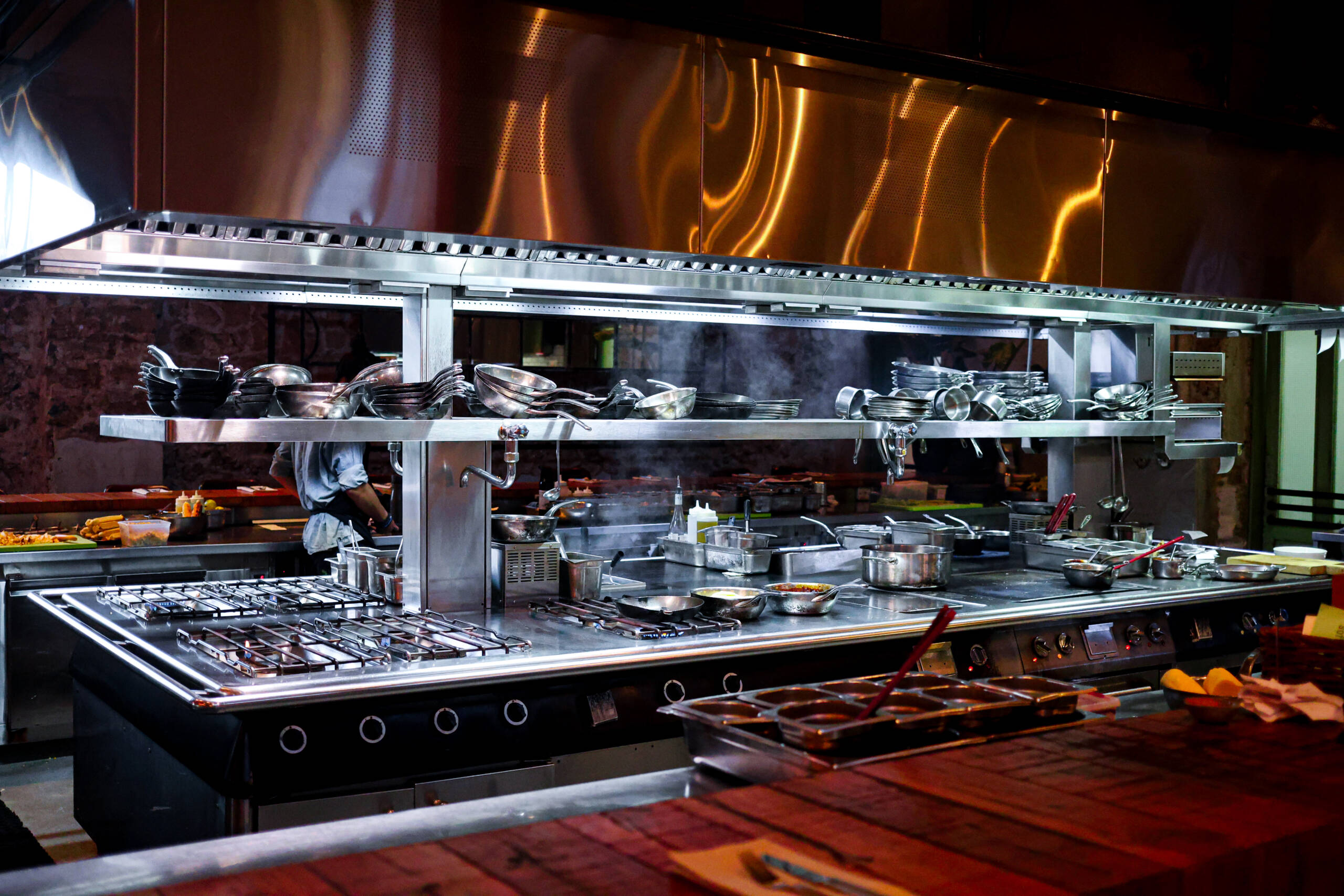
An open kitchen is one of the least cooperative environments you can point a camera at. The light source is whatever the restaurant installed for cooks, not photographers, and it rarely agrees with itself from one fixture to the next. In this frame the copper hood throws a warm, almost orange glow across the top third, while the stainless prep line below sits under a cooler, harder white. Shooting straight into that split without a plan produces a mess of clashing color temperatures.
The fix is to pick a white balance and commit to it rather than chase a neutral average. Setting for the warmer tungsten-leaning light lets the copper read as intentional atmosphere instead of a color-cast mistake, and it pushes the steel and steam toward a blue-white contrast that reads as “kitchen” rather than “error.” Auto white balance will try to split the difference and flatten both.
Steam and motion are the other variable. Line cooks move, pans get lifted, vapor drifts across the frame unpredictably. A fast prime in the f/1.8–f/2.8 range earns its keep here, letting you hold a shutter speed fast enough to freeze hands and cutlery while still working in light that’s dim enough to blow highlights on the hood if you’re not careful. Wide open on a fast lens also melts the background clutter that’s unavoidable in a working kitchen into something closer to a texture than a distraction.
ISO is where you spend the rest of the budget. Modern sensors handle 3200–6400 cleanly enough that noise is the smaller cost compared to motion blur or a tripod you can’t set up in a service line. Meter for the highlights on the metal surfaces rather than the shadows under the hood; blown steel is unrecoverable, but shadow detail can be lifted in post without much penalty.
None of this requires exotic gear. A single fast prime, a sensor that’s tolerant of high ISO, and a decision about which light source you’re going to trust are enough to turn a chaotic service line into a coherent frame.