Long Lens Street Photography at Dusk: Working the Promenade From Behind
The seafront promenade is one of the few street environments that reliably delivers subjects moving in a predictable direction at a predictable pace. People walk the length of it, they walk slowly, and they walk away from you as often as toward you. That last part is usually treated as a wasted frame. It isn’t.
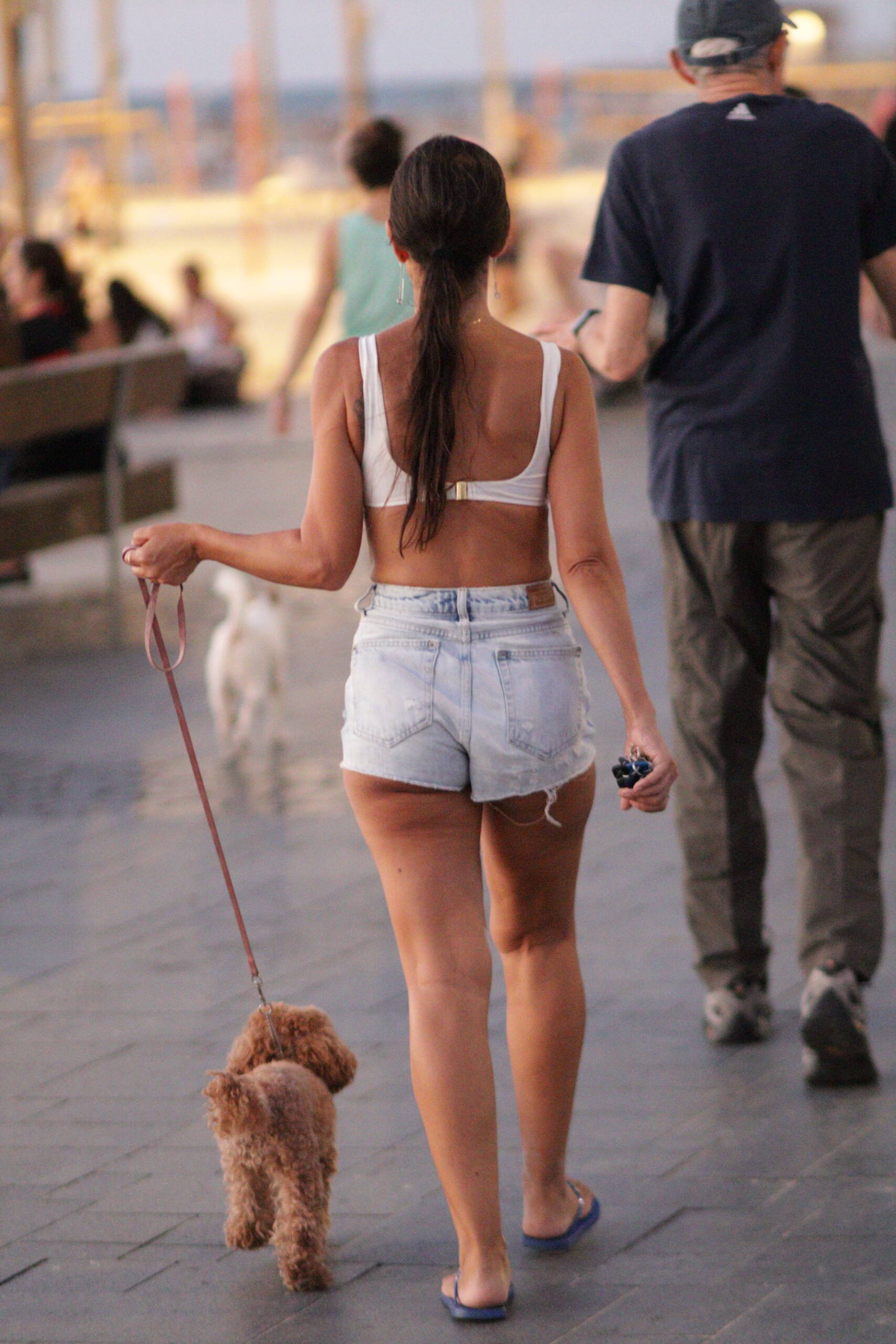
A long lens does most of the work here. At 85mm or 100mm on a crop body you are effectively shooting at 135mm or 160mm, which stacks the promenade into a shallow ribbon and pulls the distant benches, café lights and background walkers into a soft wash directly behind the subject. Shot wide open, the separation is automatic. There is no need to hunt for a clean background because the background stops being a background and becomes tone.
The dog is the reason the frame holds together. A leash running diagonally from the top left of the subject down to the bottom left corner gives the composition a line that nothing else in the scene provides — the paving stones run flat, the figures are all vertical, and without that diagonal the image is a stack of parallel shapes. Small animals also solve the eye-contact problem: the leash tells you where the attention is going, so the viewer follows it instead of waiting for a face.
Exposure at this hour is the harder problem. Dusk on a west-facing promenade means the ambient light is dropping perhaps a stop every ten minutes while the artificial lights behind the subject are staying constant, so a meter reading from three frames ago is already wrong. Shooting in aperture priority with auto ISO and a shutter floor around 1/250s covers walking pace without freezing the dog’s legs into something rigid. Anything slower and the animal smears while the human stays sharp, which reads as a mistake rather than motion.
The other adjustment worth making is on focus. Continuous AF with a small tracking zone placed low in the frame will hold the moving subject; a wide-area zone will jump to whichever passerby crosses closer to the lens, and on a busy promenade that happens constantly. Expect a hit rate somewhere around one usable frame in five, and shoot accordingly.
Note that the reverse view is a genre with a real ceiling. Working from behind removes the expression, and without a gesture, an animal, a bag, a stance or a line to carry the composition, you are left with a person’s back — technically clean and completely inert. The frame has to earn the angle.