Palermo Street Style, Where the City Becomes a Fashion Set
Palermo is a city that seems to understand photography instinctively. Its historic buildings, tropical-looking greenery, Mediterranean light and animated public spaces create scenes that could belong equally to a travel documentary, a fashion editorial or a European art-house film. Sometimes all three meet in a single photograph.
This image captures a particularly appealing side of the Sicilian capital. A young woman wearing sunglasses, a light cardigan, a short dark skirt, sheer tights and black loafers stands on a wet stone walkway surrounded by carefully trimmed hedges and tall palm trees. Her relaxed pose and slightly extended leg give the photograph the feeling of an informal fashion shoot. A small camera hangs from a strap across her body, an appropriate detail in a city where practically everyone seems to find something worth photographing.
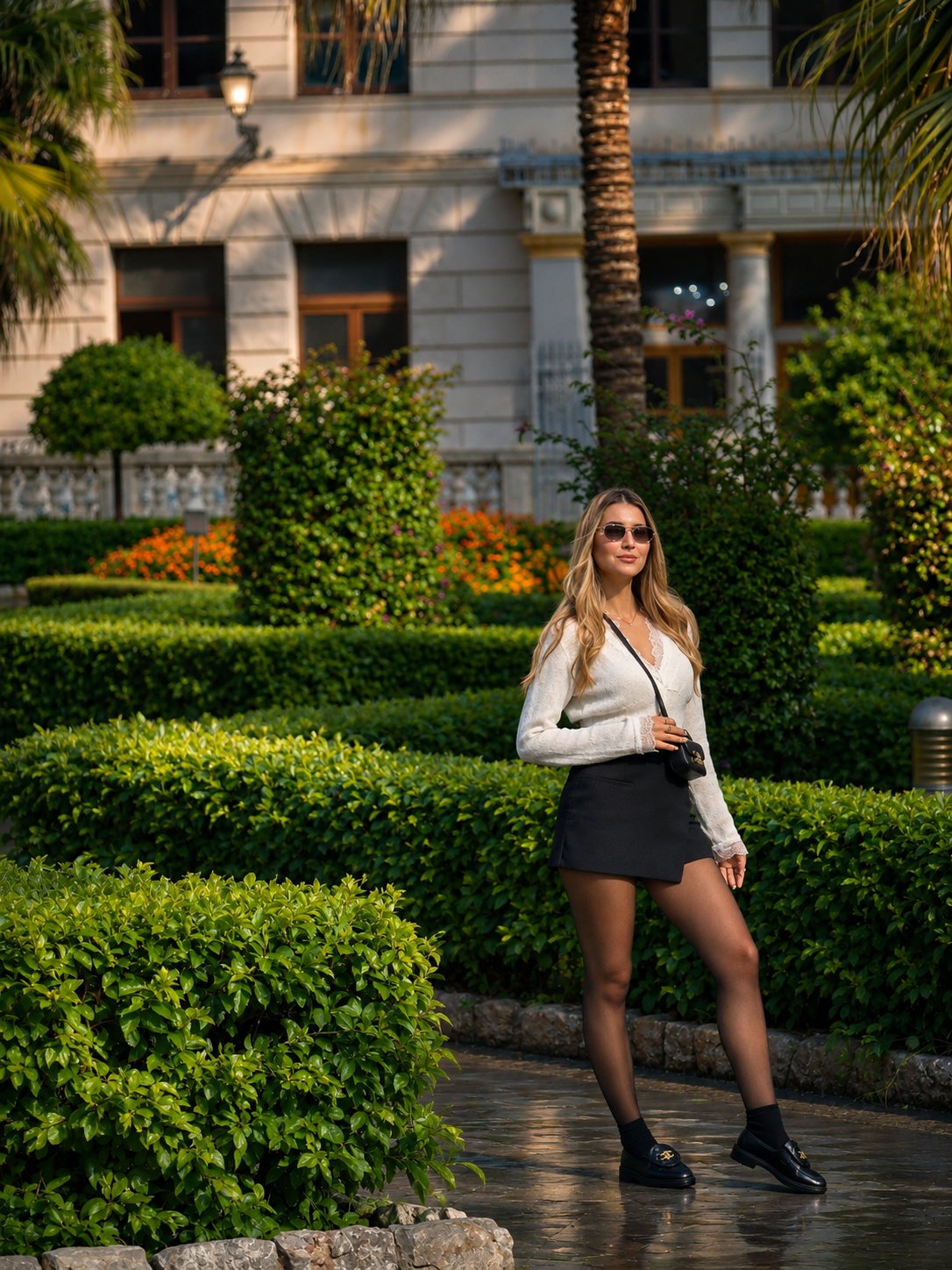
Palermo street style among the palms. Photograph hosted by Pxef.com.
Behind her rises an elegant cream-colored building with tall arched windows, dark wooden frames and classical architectural details. The architecture gives the scene a distinctly European character, while the palms introduce something almost subtropical. The contrast is part of Palermo’s personality. This is a Mediterranean city where grand urban architecture and exuberant greenery coexist without seeming out of place.
The wet pavement is especially interesting. It reflects patches of greenery and the pale building, adding texture and a subtle cinematic quality to the foreground. The light is soft rather than harsh, allowing the white cardigan, dark clothing and multiple shades of green to retain their detail. The photograph has a surprisingly rich palette for such an ordinary moment.
What makes this composition work is the relationship between the person and the environment. The woman is not isolated against a blurred background, as she might be in a conventional fashion portrait. Instead, she occupies a relatively small portion of the frame. The garden, palm trees, architecture and reflective pavement all contribute to the story. It is a portrait of a person, certainly, but also a portrait of Palermo.
This environmental approach is particularly rewarding in cities with strong visual identities. A close-up might produce a flattering portrait, but stepping back allows the surroundings to explain where the photograph belongs. Here, the vertical palm trunks, repeating windows and horizontal lines of the hedges establish a geometric structure around the subject. The large palm on the right almost forms a natural curtain, framing the scene without enclosing it completely.
Palermo offers endless variations on this visual language. Around its monumental squares, historical facades provide dramatic backgrounds. In its markets, colorful produce, improvised displays and passing crowds create spontaneous street scenes. Its gardens introduce a softer atmosphere, where palms, stone pathways and elegant buildings offer the ingredients for fashion and lifestyle photography.
The city is especially compelling because it does not require every scene to be perfectly arranged. The second photograph moves from the elegant garden to a much busier, less polished Palermo: a small square where a weathered stone fountain shares the foreground with a concrete bench, a fruit stall and cafe tables. Here, the setting is not a backdrop for a posed portrait. It is an active piece of urban life, with several small stories unfolding at once.
At the left, two visitors sit on the bench, turned partly toward one another, while the fruit seller stands behind baskets of red and yellow produce beneath the Al Caracciolo Drink & Food awning. Bright red chairs cluster near the stall; cream-colored Coca-Cola chairs and tables occupy the right side. A pigeon investigates the pavement beneath the fountain, and pedestrians move through the darker alley beyond. The eye travels naturally from the people in the foreground to the fountain and then into the depth of the street, where hanging lights and overlapping awnings give the scene a distinctly cinematic atmosphere.
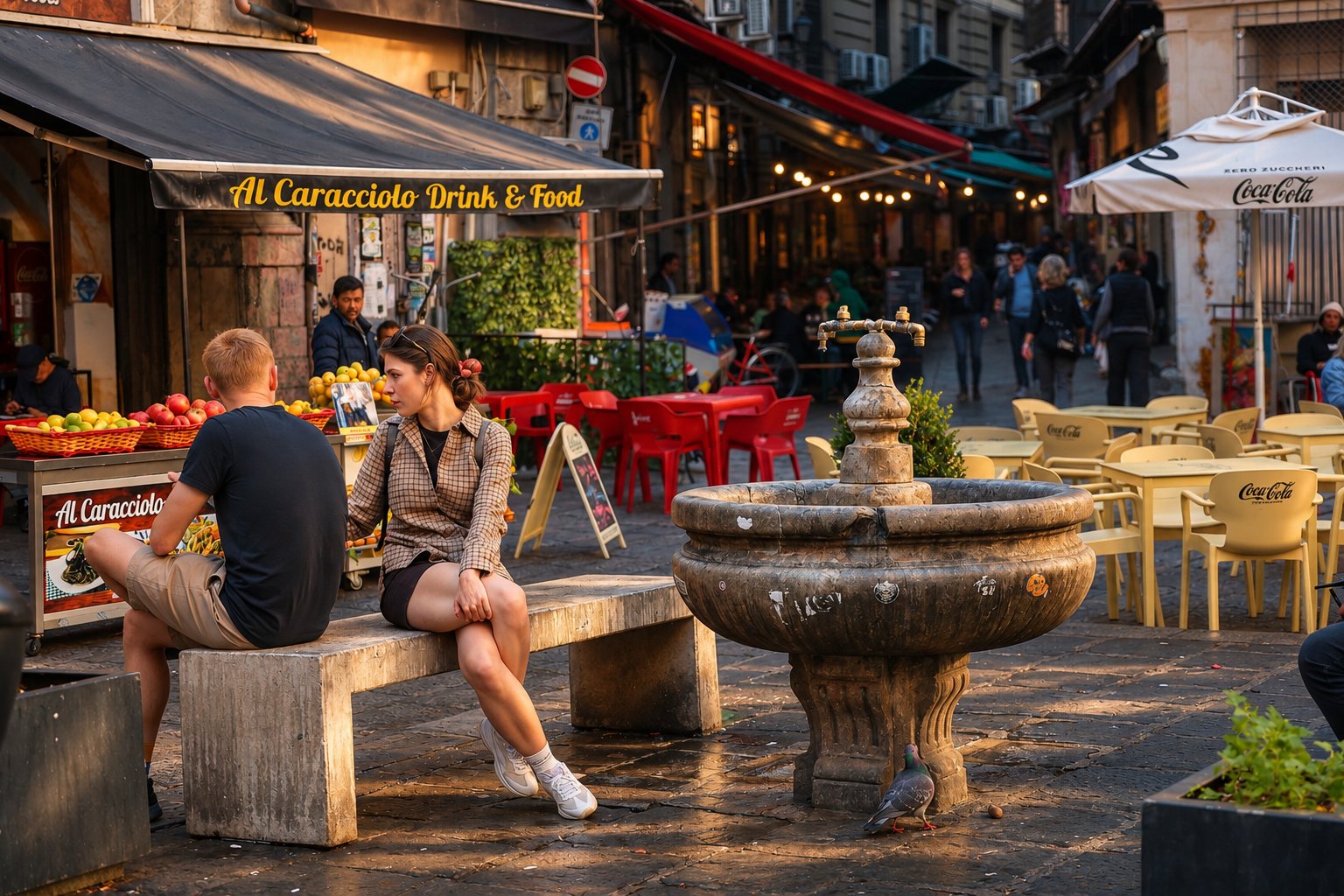
Everyday Palermo: a stone fountain, fruit stand, cafe seating and passing pedestrians in a layered street photograph. Photograph hosted by Pxef.com.
The contrast between these two photographs explains much of Palermo’s visual appeal. One scene is composed around a single figure amid greenery and orderly architecture; the other is crowded with incidental gestures, shop signs, worn stone and competing colors. The fountain anchors the composition, but the real subject is the city functioning around it. Rather than eliminating every distraction, the photographer allows the details to accumulate into a convincing sense of place. A few imperfections are part of the story.
For photographers, the lesson is simple: Palermo rewards compositions that include context. A longer focal length can isolate an interesting person against architectural detail, but a wider view can tell a richer story about the environment. Look for repeating shapes, contrasting colors, reflective surfaces and natural frames. Most importantly, watch how people occupy the spaces around them.
There is something charming about a city where a garden walkway can resemble a fashion runway and a casual travel photograph can acquire the atmosphere of a film still. Palermo has that ability. Its beauty is not confined to famous monuments or carefully selected viewpoints. Sometimes the most photogenic scene is simply someone standing among palm trees on a damp November morning.