Wedding Photography: The Best Frames Happen Between the Poses
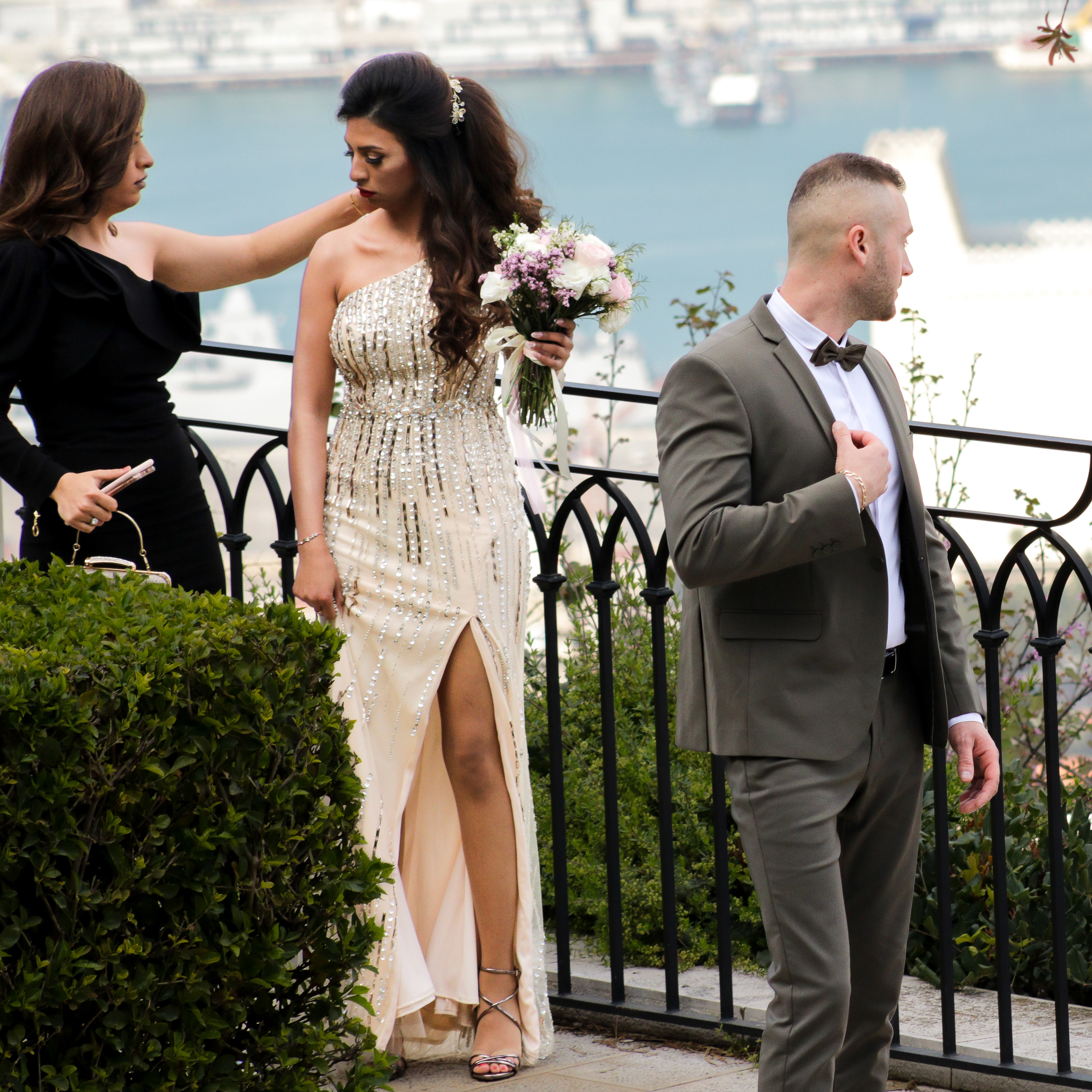
Three people on a terrace above a working harbour, and none of them is looking at any of the others. A friend in black reaches over to fix the bride’s hair, phone and clutch still in her other hand. The bride looks down at her own dress, bouquet held out to the side like something she’s been asked to hold rather than something she chose. The groom has turned his back on both of them to fasten his jacket. The whole frame is held together by the black railing running behind them, and by the fact that everyone is mid-task.
This is the part of a wedding day that couples don’t book and photographers don’t schedule. It’s also where most of the good pictures are.
The Interval Is the Assignment
Every wedding has a spine of set pieces: the ceremony, the rings, the first dance, the group shot on the steps with the tall uncle at the back. You have to deliver all of it, and you’ll be judged on whether you did. But those frames are the same at every wedding, because the events themselves are the same. What differs is the ten seconds before each one, when somebody’s strap has slipped, somebody’s collar is wrong, and nobody has arranged their face yet.
Shoot those. The bride looking down at her hem, the mother straightening a sleeve, the groom checking a button because he doesn’t know what else to do with his hands. You get expressions that no amount of “relax, be natural” will produce, and you get relationships. The woman in black in this frame is doing something only a very close friend or a sister does, and she’s doing it without asking.
The practical rule: after every posed setup, don’t lower the camera. Keep shooting for another five seconds while everyone unclenches. That’s when the picture arrives.
Stand Back and Use a Long Lens
This frame is shot from a distance with a short telephoto, and it couldn’t have been made any other way. At two metres with a 35mm, the friend would have seen the lens and stopped mid-reach. Everyone would have straightened up.
An 85mm or a 100mm on full frame gives you enough room to disappear. A 135mm gives you more, at the cost of needing space to back into, which you often don’t have indoors. On a crop body the same lenses reach further for free, which is a reasonable argument for carrying a second, cheaper body on a long day rather than swapping glass in a crowd. Fast primes matter here for a second reason beyond low light: wide open, the background falls apart into tone, and a wedding venue is usually full of things you don’t want sharp. Bins, cables, a folding table, someone’s cousin on a phone call.
The trade is that at f/2 on a 100mm you have almost nothing in focus. If two people are on slightly different planes, one of them will be soft. Stop down to f/2.8 or f/4 when a couple is standing at an angle to you and accept the busier background.
Meter for the Dress, Not the Face
The bride in this frame is wearing beadwork, which is the hardest thing at a wedding to expose. It isn’t just bright, it’s thousands of tiny mirrors, each one throwing a specular highlight straight back at the sensor. Average metering will read the whole scene, decide it’s fine, and hand you a dress with no detail in it at all. Once those highlights clip, they’re gone; there’s nothing in the file to recover.
Expose for the gown and lift the shadows later. Faces have far more latitude than white satin does, and a face pulled up a stop in raw looks normal, whereas a blown dress looks like a mistake. If your camera has highlight-weighted metering, this is the day to use it. If it has zebras, set them to about 100 and watch the dress rather than the skin.
Overcast helps enormously, which is what’s happening here. Thin cloud over a harbour is a softbox the size of the sky, and it lets the beading read as texture instead of glare. Hard midday sun on the same dress would have been a fight.
Let the Background Argue
Most wedding backdrops try to agree with the couple. Flowers, drapes, a nice wall. This one doesn’t. Behind the group there’s a container terminal, cranes, a ferry, a stretch of grey water, and the railing cuts across it all in hard black. Formalwear in front of industry. That tension is the reason the picture holds your eye longer than a garden shot would.
You get this by scouting for structure rather than for prettiness. Look for a strong line at roughly shoulder height that will separate your subjects from whatever is behind them, and look for a background with recognisable shape but no recognisable detail, so it reads as place without competing. A harbour, a rooftop, a road cutting through a hillside. Then put your people in front of it and wait for them to forget you’re there.
The shrubs in the lower corners of this frame do a job too. They’re close to the lens, badly out of focus, and they build a soft frame that pushes the eye toward the middle. Foreground clutter is only clutter when it’s sharp.
What You Owe the Couple
None of this replaces the checklist. Deliver the ceremony, the rings, the parents, the group shots, the cake, and deliver them clean and correctly exposed, because those are the frames that go to relatives and get printed. The gap-shooting is what you add on top.
But be honest with yourself about which pictures the couple will still be looking at in fifteen years. It won’t be the lineup on the steps. It’ll be the one where her friend reached over without being asked.