Long Lens Reach on a Budget: Cheap Glass, Crop Bodies and Whether You Need a Monopod
Stand behind a line of photographers pointed at something offshore and you can price the whole row without asking a single question. Two or three big white primes, a handful of black consumer superzooms, at least one lens discontinued before mirrorless existed. One person has a monopod planted in the sand and the rest are holding everything up with their arms. They are all framing the same subject at roughly the same size.
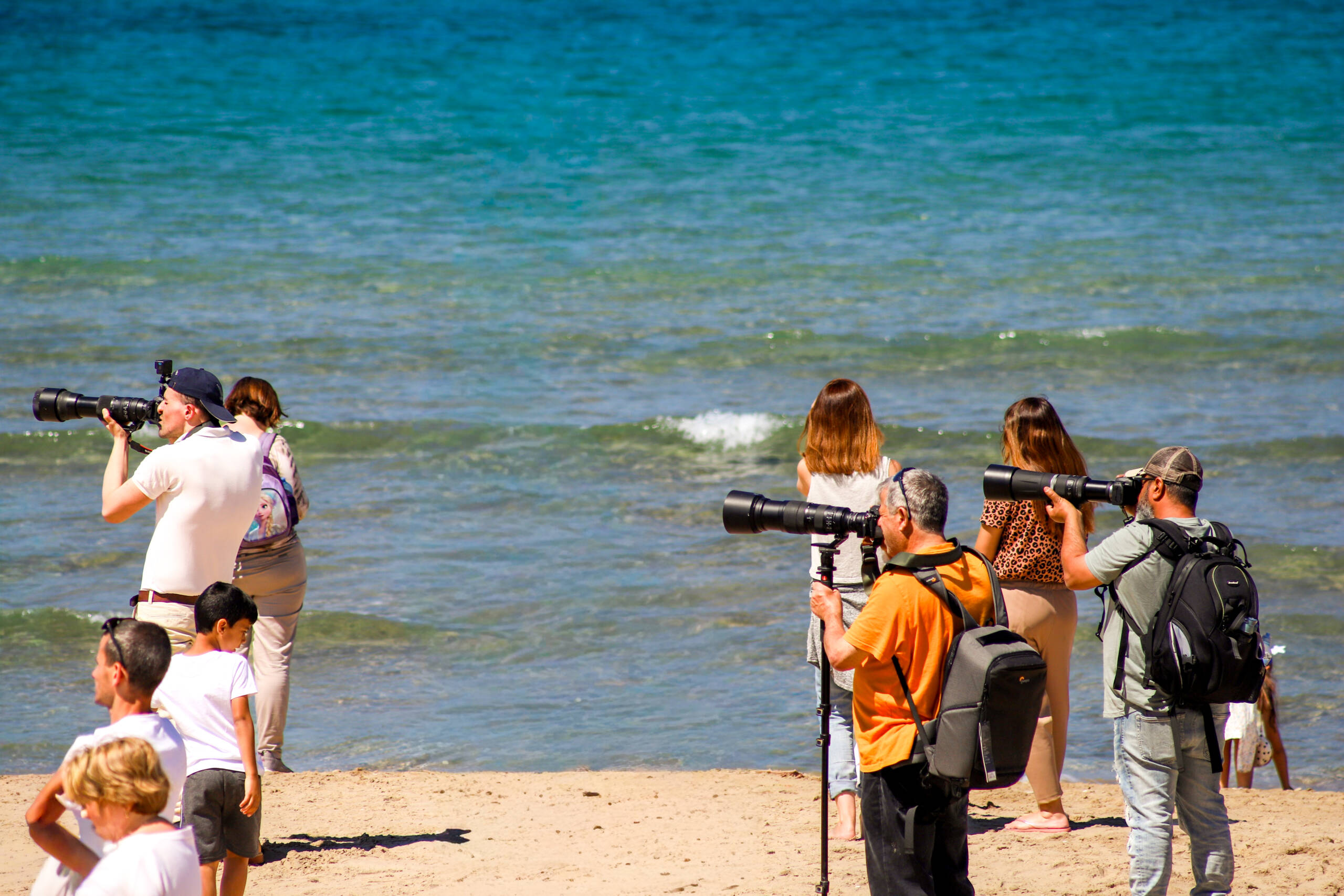
Two questions come out of that scene. How much reach can you buy cheaply, and once you have it, do you need something holding it up. The answers are connected, because the cheap route to reach is always the heavy one.
The crop body does the work the money was supposed to do
Put a 400mm lens on a full frame body and you get a 400mm field of view. Put the same lens on an APS-C body and you frame like a 640mm. Nothing optical changed. The sensor is smaller, so it records the middle of the image circle and throws away the edges you were going to crop anyway.
The reason this matters is pixel density. Crop a 24MP full frame file down to APS-C framing and you are left with about 9MP. Shoot the same framing on a 24MP APS-C body and you keep all 24. Same lens, same distance, nearly three times the pixels on the subject. At web size the difference is invisible. If you want to crop further, it is the whole ballgame.
So the cheapest reach upgrade available is not a lens. It is a second-hand crop body used as a dedicated long-lens camera with your existing telephoto on the front.
Bright sun cancels out slow apertures
The expensive lenses in that row are expensive because they are fast. An f/2.8 or f/4 super telephoto buys shutter speed in bad light and cleaner subject separation. On a beach at noon you need neither.
Do the arithmetic. Sun over water, ISO 200, f/6.3, and you are still at 1/2000 or better. A 600mm f/6.3 zoom costing a fraction of a 400mm f/2.8 is working in exactly the conditions it was built for. The background is open sea, so separation is free.
The moment the light drops, that reverses hard. If most of your long-lens work happens at dawn, at dusk, or under stadium lighting, budget reach stops being a workable answer. Be honest about which one you actually shoot.
What to buy, in order
A used 150-600mm class zoom. The Sigma and Tamron versions have been around long enough that the used supply is deep. Heavy, slow to focus by modern standards, soft wide open at the long end. Stop down a third of a stop and they are fine.
A used 400mm f/5.6 or a first generation 100-400. DSLR-era telephotos are optically excellent and mechanically simple. On an adapter they focus slower than native glass but they focus. Best value in the category right now, precisely because nobody wants a screw-drive lens on a mirrorless camera.
A teleconverter, with eyes open. A 1.4x on a 400mm gives 560mm and costs a stop. Many bodies get unreliable past f/8 and some combinations refuse to focus at all. Check your specific pairing before buying, not after.
Mirror lenses, only if you like the look. A 500mm catadioptric is tiny, cheap, manual focus, fixed at f/8, and turns every out-of-focus highlight into a doughnut. Against water the whole background fills with rings. Most people buy one, shoot it twice, and sell it.
What money actually buys is autofocus
Sharpness is not where cheap telephotos lose. Modern sensors hide a lot and a stopped-down consumer zoom resolves more than enough. They lose on speed and tracking. The expensive lens locks on faster, holds an erratic subject, and recovers quicker after a miss. Over a hundred frames of something moving unpredictably, that shows up as keeper rate.
You are not buying image quality. You are buying a higher percentage of frames in focus. If your subject sits still you will never feel the gap. If it changes direction constantly you will feel it all day.
The monopod is a load-bearing accessory, not a stability one
Which brings us to the pole in the sand. The common mistake is treating a monopod as a sharpness tool. It removes vertical weight from your arms, and that is the main thing it does.
A 600mm zoom plus a body runs around two kilos. Held at eye level that is fine for thirty seconds and miserable after twenty minutes. Fatigue shows up in your frames long before your shoulders complain, as slower reactions, sloppier framing, and a growing willingness to take the shot instead of waiting for the better one.
What it does not do is kill shake. A monopod cuts vertical movement and does very little about rotation or lateral drift. Call it one stop, sometimes less. Stabilisation in the lens or body is worth several. If your problem is a shutter speed you cannot reach, stabilisation solves it and a monopod barely helps. In bright daylight over water, shutter speed is not the problem. Weight and waiting are.
Handheld wins when the subject is erratic, when the session is short, when the ground is crowded, and when you are working the line and shooting from three different spots. The monopod wins on long static waits, with heavy or unstabilised adapted glass, for video, and in low light where that extra stop turns into keepers.
Buy the head, not the legs
A basic aluminium monopod costs almost nothing and does the job. Carbon fibre saves a few hundred grams for several times the money, which matters if you are hiking with it and not otherwise.
The head is where the decision lives. Screwing the camera straight onto the stud is cheapest and tilts in every direction, at the cost of flopping around when you let go. A small tilt head with a quick release plate is the practical choice for stills, keeping the horizon under control while letting you swing up and down. A ball head is usually wrong for moving subjects, since you either lock it and lose the pan or loosen it and lose the horizon.
If the lens has a tripod collar, mount by the collar. Hanging two kilos of glass off a mount designed to hold a lens rather than a camera is how mounts get damaged.
Sand adds one wrinkle nobody mentions. The foot sinks, and it keeps sinking under load, so your framing height drifts while you are watching the subject instead of the horizon. Plant it once at the depth it wants to sit and leave it. Grit works into the leg locks, so rinse the bottom section in fresh water afterwards and dry it extended rather than collapsed. Twist locks packed with salt seize. Buy the cheap one, treat it as a consumable, replace it in three years without feeling anything.
None of this makes your photographs sharper. The cheap lens gets you the same framing as the white one, the crop body gets you the pixels, and the monopod makes the last frame of a long session as good as the first. What you are buying back at every stage is not quality. It is hit rate.