Below you will find pages that utilize the taxonomy term “APS-C”
Posts
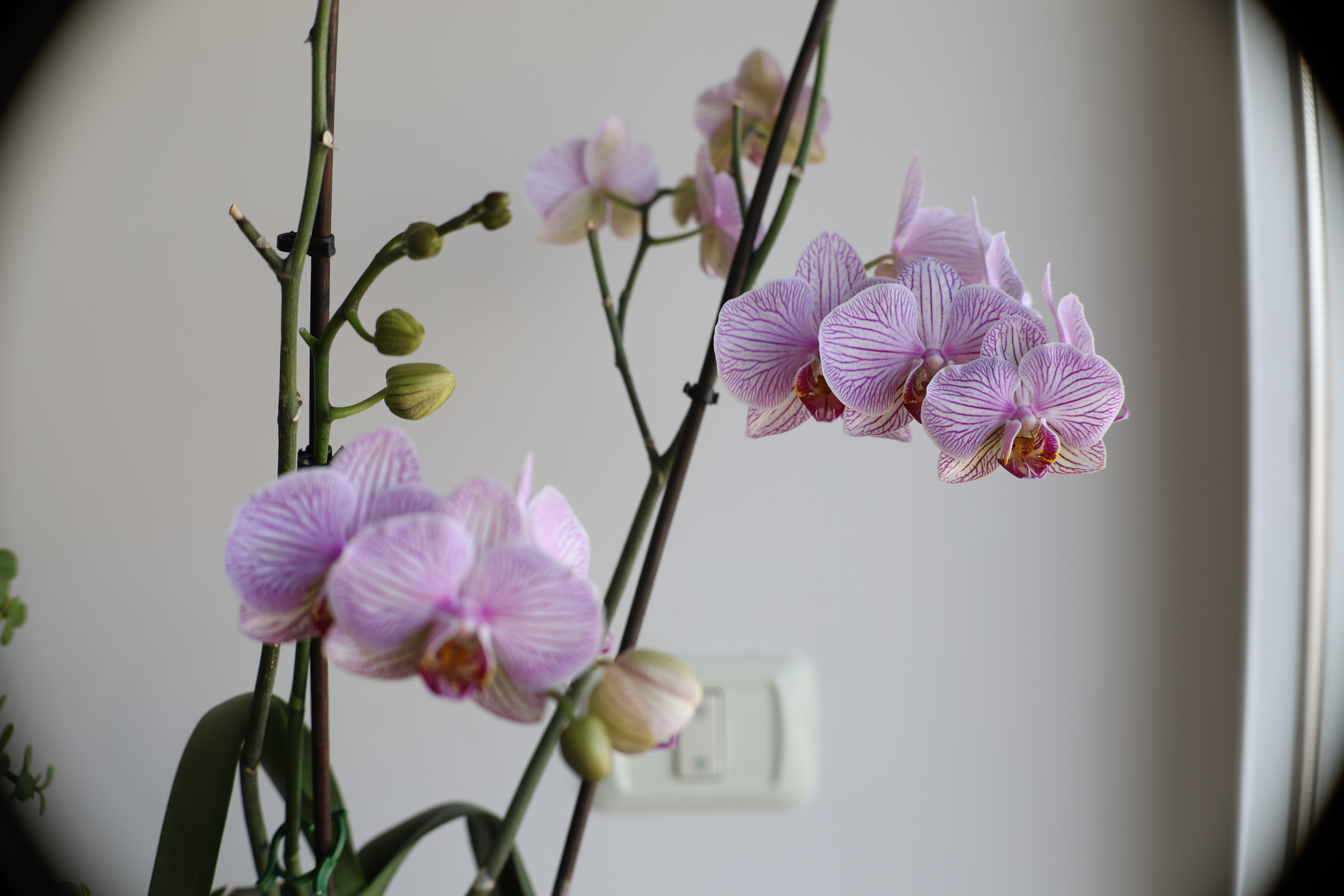
When APS-C Glass Pretends to Be Full Frame, A Little Optical Surprise
I took this photo on a quiet indoor afternoon, no plan behind it, just light falling nicely and an orchid doing its thing by the window. The flowers are pale pink with those fine purple veins that always look a bit unreal, like someone traced them with a pencil after the fact. The light comes from the right, soft and diffused, wrapping gently around the petals and letting the background fall away.
Posts
Canon R100 + EF 85mm f/1.8: Cheap Portrait Machine
The Canon R100 is the least expensive entry point in the RF mirrorless system, and Canon has been reasonably candid about what corners were cut to get it there. No in-body stabilization. A single card slot. A relatively modest sensor at 24 megapixels. An electronic viewfinder that experienced photographers will find cramped. And yet, mated to a used EF 85mm f/1.8 USM via the Canon EF-EOS R adapter, it becomes one of the most compelling portrait setups available for under $700 combined.
Posts
Canon R50 + EF 100mm f/2.8 Macro: Close Enough
The EF 100mm f/2.8 Macro USM — not the L version, the original — is the overlooked sibling of Canon’s more celebrated L-series macro. At used prices around $350, it delivers 1:1 macro reproduction with optical quality that the price differential does not adequately explain. Via the Canon EF-EOS R adapter on the R50, it becomes a 160mm equivalent macro lens with full electronic communication and a use case that extends well beyond close-up work.
Posts
Canon R7 + EF 70-200mm f/4L: Reach Without Ruin
The arithmetic of cropped sensors and telephoto glass is one of the more useful free lunches in photography. The Canon R7 — a serious APS-C body with genuinely professional-grade autofocus and a 32.5-megapixel sensor — transforms the EF 70-200mm f/4L into a 112–320mm equivalent. A zoom range that, on full frame, would require an expensive, heavier f/2.8 lens or a dedicated super-telephoto prime. Here it arrives via a quarter-century-old zoom that trades used for well under $600.
Posts
Fujifilm X-S20 + Helios 44-2 58mm f/2: Swirl Season
The Helios 44-2 58mm f/2 is a Soviet-era lens manufactured at the KMZ optical plant in Krasnogorsk, produced in quantities so large that the secondary market is essentially inexhaustible. Clean copies sell for $30 to $80 depending on coating variant and condition. Via an M42-to-Fujifilm X adapter (approximately $15), it attaches to the X-S20 and produces images that Instagram’s lens simulation filters have been attempting to replicate, with limited success, for a decade.
Posts
Fujifilm X-T30 II + Jupiter-9 85mm f/2: Soviet Portrait
The Jupiter-9 85mm f/2 is a Soviet optical instrument derived from the pre-war Carl Zeiss Jena Sonnar design, manufactured at the KMZ factory and exported in modest quantities under the Jupiter brand. Optically, it inherits the Sonnar formula’s characteristic rendering: a smooth background blur without the Helios 44-2’s swirling tendencies, strong center sharpness with a gradual rolloff toward the edges, and a color rendering — particularly in the green channel — that has a coolness contemporary photographers find refreshing after years of the warm-biased output from modern lens coatings.
Posts
Fujifilm X-T5 + XF 56mm f/1.2 WR: The Standard
Fujifilm refreshed the XF 56mm in 2022 and the photography community received the update with the mild suspicion that greets any revision of a beloved original. The original 56mm f/1.2 R was a cult lens — optically flawed in the right ways, character-rich, with a rendering style that felt closer to medium format than its APS-C designation suggested. The WR version had a lot to live up to.
It more than earns its successor status.
Posts
Nikon Z50 II + EF 70-300mm f/4-5.6 IS II: Long and Light
Telephoto zoom ownership typically involves a familiar trade negotiation: reach versus weight versus cost, with meaningful performance in all three simultaneously requiring a budget that narrows the market to professionals and committed enthusiasts. The Nikon Z50 II paired with a used Canon EF 70-300mm f/4-5.6 IS II via the Sigma MC-21 EF-to-Z adapter disrupts that negotiation in a way worth examining.
The EF 70-300mm f/4-5.6 IS II is one of Canon’s most undervalued lenses.
Posts
Nikon Zfc + Nikkor AI-S 105mm f/2.5: Vintage Honest
The Nikon Zfc was designed with deliberate aesthetic intent: a retro body styled after the FM2 film camera, with physical dials for shutter speed and exposure compensation, a silver and black finish, and a form factor that attracts a specific kind of photographer — someone interested in the relationship between tool and process, not just specification and output. Fitting the Nikkor AI-S 105mm f/2.5 to it, via Nikon’s FTZ II adapter, completes an argument the camera body was already making.
Posts
Sony A6400 + Minolta MD 50mm f/1.4: Flea Market Glass
The Minolta MD 50mm f/1.4 is a lens that predates autofocus entirely. It was manufactured through the 1970s and 1980s, attached originally to Minolta’s SLR bodies, and is now scattered across eBay listings and flea market tables in sufficient quantities that finding a clean copy for $30–$60 is not particularly difficult. Adapted to the Sony A6400 via a $20 MD-to-E mount adapter, it produces something that a significant community of photographers finds genuinely irreplaceable.
Posts
Sony A6700 + Canon EF 135mm f/2L via MC-11: Sleeper Reach
The Canon EF 135mm f/2L USM is one of the most respected telephoto primes ever made and one of the few legacy lenses where the secondary market price has declined meaningfully as photographers have migrated to mirrorless systems and RF glass. Used copies trade in the $600–$750 range — less than they commanded five years ago, and substantially less than the optical quality warrants. The Sigma MC-11 adapter, which communicates the EF protocol to Sony E-mount bodies with high fidelity, adds approximately $199.
Posts
Sony A6700 + Sigma 30mm f/1.4 DC DN: Smart Money
There is a version of this review that spends its first paragraph apologizing for recommending an APS-C system with a third-party lens. This is not that review. The Sony A6700 paired with the Sigma 30mm f/1.4 DC DN is one of the most capable and practical camera combinations available for under $2,000, and it earns that claim without qualification.
The Sigma 30mm on APS-C produces a field of view equivalent to roughly 45mm in full-frame terms — close enough to the classic 50mm standard to feel immediately natural, wide enough to work in tight interior spaces without distortion.
Posts
Fujifilm X-H2S Review: The APS-C Camera That Stopped Making Excuses
There’s a particular kind of camera that gets recommended to serious photographers who aren’t ready to commit to full-frame — the consolation prize wrapped in enough specs to feel like a choice rather than a compromise. The Fujifilm X-H2S is not that camera. It is, without qualification, a serious tool for serious work.
What It Is The X-H2S sits at the top of Fujifilm’s X-series lineup — the larger, heavier, more capable sibling to the X-T5.
Posts
85mm on Crop Body Is Poor Man’s 135mm
I love fast 135mm lenses—but the Canon RF 135mm f/1.8 L IS USM sits at around $2,300, and I’m not interested in selling a kidney for a lens. I’m also pretty averse to burdening myself with heavy, expensive gear while traveling. So the workaround, at least for how I shoot, is simple: a Canon EF 85mm f/1.8 USM picked up used for about $300, mounted on a crop body. It becomes a kind of “poor man’s 135mm”—a fraction of the cost, easier on the back and shoulder, and, as this image shows, more than capable.
Posts
Canon, Build the Missing Budget Telephoto: RF 85–180mm f/2.8 or RF 100–200mm f/2.8
Canon’s RF system already has some remarkable lenses, but one category still feels oddly unfinished: the lightweight, budget-friendly telephoto zoom for full-frame photographers who want speed without carrying a massive professional lens. Right now the lineup jumps from compact consumer zooms straight to the big 70–200mm f/2.8 class. Those lenses are fantastic, but they are expensive, heavy, and simply more equipment than many photographers want to carry every day. What is missing is a practical middle ground.
Posts
Canon, Please Give Us an RF-S 50–150mm f/2.8
Running two cameras has become my way of keeping photography practical. One body carries a wider lens, the other stays ready for reach, and suddenly the whole workflow becomes smoother. No frantic lens swapping, no heavy bag filled with glass, just two cameras that together cover the real situations photographers actually encounter. For me that pairing is the Canon R8 and the Canon R100. One full-frame body for versatility and low-light capability, one lightweight crop body for reach and mobility.
Posts
The Sigma 50–150mm f/2.8 for Canon APS-C — A Forgotten Gem That Still Makes Sense in the Mirrorless Era
Some lenses age poorly. Others become oddly relevant years later. The Sigma 50–150mm f/2.8 for Canon APS-C cameras belongs firmly in the second category. It was designed during the DSLR era, yet its concept fits almost perfectly with today’s mirrorless APS-C systems.
The key version worth talking about is the non-stabilized Sigma 50–150mm f/2.8 EX DC HSM. This lens weighed roughly 770 grams, which immediately tells you what Sigma was trying to achieve: a professional constant-aperture telephoto built specifically for crop sensors, but without the bulk of a traditional 70–200mm f/2.
Posts
85mm on Crop vs 135mm on Full Frame — Do You Get the Same Subject Separation?
Portrait photographers run into this comparison sooner or later because on paper the math looks simple. An 85mm lens on an APS-C crop camera produces roughly the same field of view as a 135mm lens on a full-frame body. So framing the subject — head and shoulders portrait for example — ends up looking almost identical. Stand at roughly the same distance, frame the same composition, and the scene inside the frame feels very similar.
Posts
Deciding Between a Used Canon RP and a Used Canon R100: Weighing the Options
When it comes to choosing between two used cameras, the decision can feel like a tug-of-war between performance, features, and value. In my case, the choice is between the full-frame Canon RP, priced at $570, and the APS-C Canon R100, available for just $230. While both cameras belong to Canon’s RF ecosystem, they cater to vastly different needs, making this comparison a blend of technical trade-offs and practical considerations.
The Canon RP, launched as an entry-level full-frame mirrorless camera, marked a significant moment for affordable full-frame photography.
Posts
The Telescopic Effect: How Canon’s Crop Mode Visually Extends Your Lens Reach
Canon’s crop mode is often introduced through numbers—crop factors, megapixels, percentages—but that framing misses what photographers actually feel when they flip it on. The defining experience is visual. The moment crop mode is engaged, the viewfinder tightens, distractions fall away, and the subject steps forward with a confidence that feels unmistakably telephoto. Nothing about the lens changes, no digital zoom is applied, yet the camera behaves as if the focal length itself has grown.
Posts
The Weight of Canon’s R-Series: From Featherlight APS-C to Full-Frame Heavyweights
The Weight of Canon’s R-Series: From Featherlight APS-C to Full-Frame Heavyweights Weight is one of those specs that photographers often glance over—until they’re halfway through a long day of shooting and their neck strap is digging in. Canon’s R-series is fascinating because it runs the spectrum, from ultra-light beginner models to professional full-frame bodies with real heft. Looking at just the body-only weights, the differences paint a clear picture of who each camera was designed for.
Posts
Canon R100 vs. R50 vs. R10: Finding the Right Fit for Your Needs
Choosing the right camera can be daunting, especially when comparing closely related models like the Canon R100, R50, and R10. Each model is designed to cater to different types of photographers and videographers, with unique strengths tailored to various priorities. Here’s a detailed breakdown to help you decide.
The Canon R100 is equipped with an older 24.1-megapixel APS-C CMOS sensor and a DIGIC 8 image processor. While its image quality for still photography is solid, its processing capabilities lag behind newer models, limiting its performance in video recording and advanced features.
Posts
The Case for APS-C: Performance and Affordability Redefined
The ongoing debate between full-frame and APS-C cameras often centers around performance, but a deeper dive reveals a far more nuanced picture—especially when cost is factored in. The misconception that full-frame cameras are inherently superior has led many photographers and videographers to make decisions based on incomplete or misleading information. It’s time to debunk some of these myths and highlight why APS-C cameras, paired with a new generation of highly capable, low-cost lenses, offer an unbeatable value proposition for those looking to maximize their creative potential without overspending.
Posts
Budget Photography Powerhouse: Canon R100 and TTArtisan 50mm f/1.2 Lens Combo
For photographers looking to explore creative potential without a hefty price tag, the combination of the Canon R100 camera and the TTArtisan 50mm f/1.2 APS-C lens represents a budget-friendly entry into the world of impressive imagery. With a combined price of around $400 at BH Photo—$300 for a brand-new Canon R100 and just $100 for the TTArtisan lens—this duo provides a remarkably affordable pathway to high-quality, expressive photography.
The Canon R100, with its compact, lightweight design, offers an appealing entry into Canon’s mirrorless system.
Posts
Choosing the Right Sensor: APS-C, Full-Frame, or Medium Format on a Budget
Budget plays a crucial role when deciding between APS-C, full-frame, and medium format cameras, as the costs can vary dramatically with each type. APS-C sensors are the most budget-friendly option, making them an excellent choice for beginners, hobbyists, and those looking to capture quality images without significant financial commitment. The camera bodies and lenses designed for APS-C are often more affordable and compact, offering great value for general photography, travel, and casual shooting.