Photo Walks: Why a Group of Twenty Photographers Shoots Less Than One Person Alone
Count the cameras in this frame. Roughly a dozen visible, probably twenty in the group, DSLRs on neck straps and wrist straps and one small compact hanging off a belt loop. Now count how many are being used. One, at the far left, and she is holding it at chest height with her hand over the top plate, not shooting anything. Everyone else is standing on a pavement outside a clothing shop, looking at their phones, looking at their bags, looking at the back of the person in front of them. Two people are bent over rummaging for something. The organizer has his back to the group and is talking.
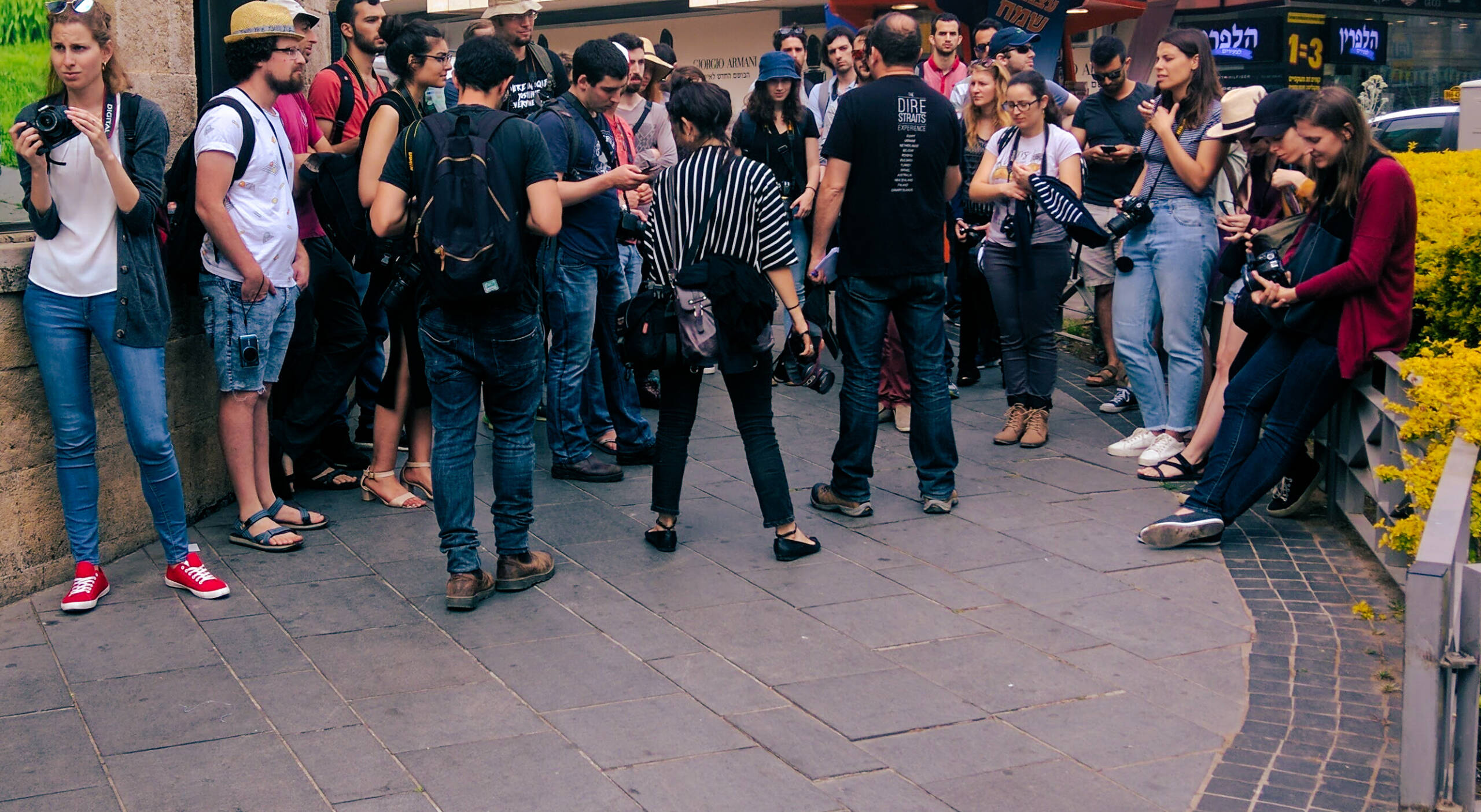
This is the honest picture of a photo walk. Most of it is standing.
The huddle is the format
A photo walk is not a walk. It is a sequence of huddles connected by short transits. The group gathers, waits for stragglers, hears a briefing, moves fifty metres, stops, gathers again. Anyone who has been on one knows the ratio. If it runs three hours you might spend forty minutes with a camera at your eye, and that is a good day.
The stopping is not incompetence on the organizer’s part. It is arithmetic. Twenty people move at the speed of the slowest one, and the slowest one is whoever just found a shot and wants ninety seconds with it. Multiply by twenty and the group either stops constantly or leaves people behind. Most organizers choose stopping.
The group is the thing standing between you and the picture
Three problems, all structural.
First, mass. Twenty people with cameras change every scene they enter. Street vendors go stiff. Kids perform. Anyone who was doing something unselfconscious stops doing it. You have brought a camera crew to a place that was interesting because nobody was watching it.
Second, convergence. When the group stops, everyone shoots the same doorway from the same three metres of pavement, because that is where the group happens to be standing. Go home, open the shared album, and you will find nineteen versions of one frame with slightly different white balance. The walk generated volume and almost no variety.
Third, permission. In a group, people wait. They wait to be told this is a good spot, they wait for someone else to raise a camera first, they wait for the organizer to finish talking. Solo, you would have crossed the road and shot the thing you saw. In the huddle you stand and hold the camera at chest height, exactly like the woman on the left of this frame.
What a walk is actually good for
None of that makes them worthless. It makes them good at different things than the ones they advertise.
Access and nerve. If you are new to photographing strangers, twenty people doing the same thing at once is cover. Nobody singles you out. That is a real training benefit and hard to buy any other way.
Gear exposure. In one afternoon you will see a dozen bodies and twice as many lenses in use, and you can ask to hold any of them. That is worth more than a month of reading forum threads about whether a manual 50 on an adapter is workable. Somebody in the huddle has one on the front of a crop body right now and will hand it to you.
Local knowledge. Organizers pick routes because they know which stairwell is open, which market tolerates cameras, which security guard does not. That routing is the genuine product.
People. The reason anyone goes back is the group, not the pictures. Worth saying out loud rather than pretending the output justifies the afternoon.
How to work one anyway
Bring a project. Decide before you arrive that today is only faces, or only reflections, or only one lens. A constraint gives you something to do during the forty minutes of standing, which is when everyone else checks their phone.
Walk ahead or behind. The pictures are in front of the group or behind it, never inside it. Get thirty metres of separation and rejoin at the next stop. Ask the organizer where the next stop is and you can do this all day without anyone noticing.
Shoot the group. This is the one nobody does, and it is the reason this frame exists. A knot of twenty photographers standing on a pavement not taking pictures is a better subject than the doorway they are all pointed at. It also has the advantage that your subjects are not going to object to being photographed.
Take one lens. Choosing gear during a stop wastes the stop. A single prime removes the decision and forces the feet to work.
Leave early if it stops producing. There is no obligation to complete the route. The last hour of most walks is a long march back to the meeting point with the light gone.
The picture that survives
Look at what is actually happening in this frame and it is not a photography event. It is a group of people waiting, mostly on their phones, dressed for a warm day, with the shops behind them and a hedge on the right. The cameras are props at this exact moment. Somebody there will go home with a nice shot of a doorway.
The best picture on a photo walk is usually the walk.