Background Separation Is a Distance Problem Before It Is an Aperture Problem
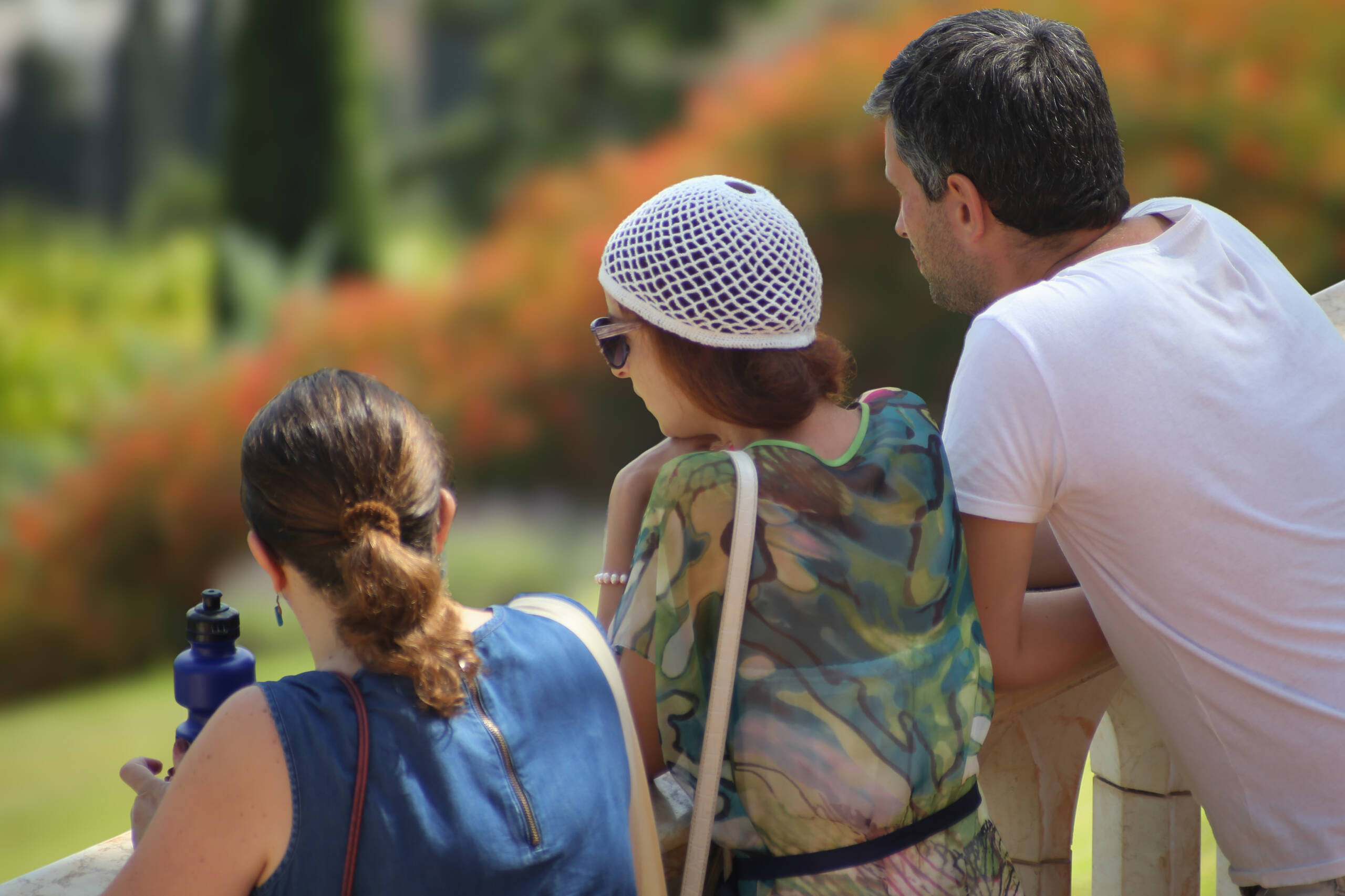
Three people leaning on a railing, all of them facing away, and behind them a wall of orange that used to be flowering shrubs. Nothing back there survives as an object. It survives as colour.
Most people who want this look go shopping for a faster lens first. That is usually the wrong move. Aperture is involved, but it is the third thing that matters, and buying your way to f/1.2 will not fix a frame where the bush is a metre behind the subject’s head.
Distance does the heavy lifting
Blur in the background scales with how far the background sits behind the plane of focus, relative to how far the subject sits from you. That ratio is the lever. In this frame the people are maybe eight metres out and the flowering hedge is somewhere past thirty. The hedge never had a chance.
Flip the numbers and the same lens at the same aperture gives you a perfectly legible bush. Subject at thirty metres, hedge at forty, and now you are photographing a hedge with people in front of it.
The practical version: before you touch a dial, look at what is behind your subject and ask how far back it is. If the answer is “close,” move. Move the subject, move yourself, or change your angle so the sightline runs out into open space instead of hitting a wall. Two steps sideways beats a stop of aperture more often than photographers want to admit.
Focal length multiplies what distance gives you
Once the geometry is right, focal length amplifies it two ways. A long lens sees a narrow slice of the world, so whatever is back there gets cropped down to a few big shapes instead of a busy scatter of small ones. And it magnifies the blur circles themselves, so those shapes smear further.
Shoot the same head size at 35mm and you get context, edges, a readable garden. Shoot it at 100mm or 135mm and you get a colour field. Neither is better. They are different pictures. But if separation is the goal, the tele wins before you have opened up at all.
This is where cheap glass earns its place. An 85mm f/1.8 or a 100mm f/2 costs a fraction of the fast zooms and does this job better than any of them. Put one on a crop body and the reach comes free.
Aperture is the last adjustment, and it has a cost
Wide open is not automatically correct. Three people sitting at a railing are not on one plane. The near woman is closer to the camera than the woman in the crochet cap, who is closer than the man in the white tee. At f/2 on a 100mm lens at that working distance, you get one of them. Maybe two.
So the question stops being “how shallow” and becomes “who is sharp.” Here the focus sits on the middle subject, and the cap holds detail while the near shoulder and the man’s face both fall off. That is a choice you have to make on purpose, because the lens will happily make it for you and pick wrong.
If you want two of three, stop down to f/4 and lean harder on distance and focal length to keep the background gone. The hedge at thirty metres does not care much whether you shot f/2 or f/4.
Tone separation does what blur cannot
Blur alone does not separate anything. Tone does.
Look at what actually reads in this frame. The white crochet cap and the white t-shirt punch out because they sit against dark green and mid-orange. The printed silk top does not. Its greens and ochres are the same values as the blurred foliage behind it, so the outline goes soft even though that part of the frame is in focus and the background is not.
That is the failure mode nobody warns you about. You do everything right optically and the subject still sinks into the mush because it shares a tonal range with what is behind it. The fix is compositional. Shift so the subject sits against a lighter or darker patch, or accept that the bright elements will carry the picture and let the rest be texture.
Backs to the camera raise the stakes
When people face away, you lose the thing that normally holds a frame together. No eyes, no expression, no obvious emotional read. What is left is structure: how the three heads step across the frame, how the white shapes anchor the middle and right, how the whole background drops out so there is nothing to look at except the arrangement.
Get the separation wrong on a candid like this and you have a snapshot of the backs of strangers’ heads. Get it right and the arrangement becomes the subject.
Check the background before the settings. Then the lens. Then the aperture.