Night Street Photography on a Fast Telephoto: The Technical Choices Behind a Cinematic Frame
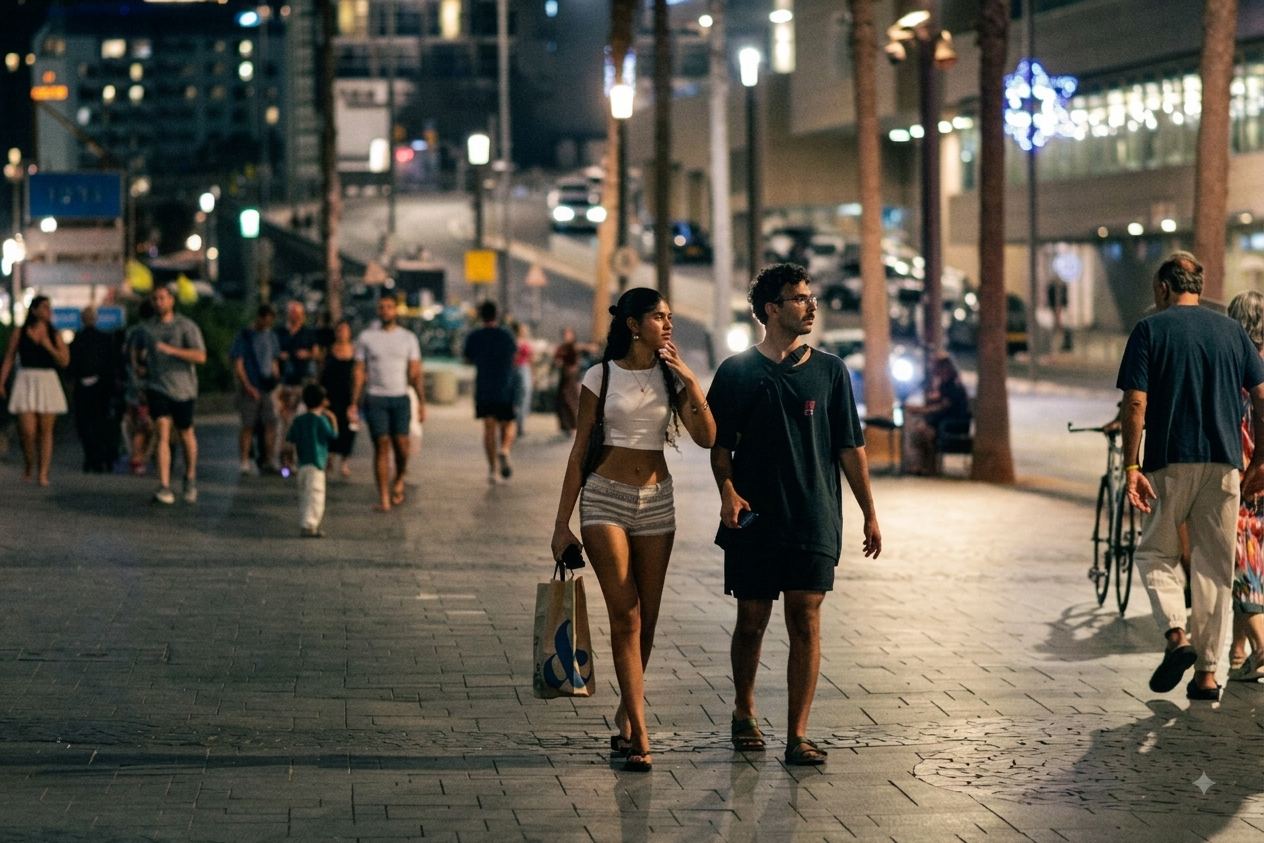
A frame like this one looks like a still from a film, and people usually credit the grade for that. The grade is the last five percent. Everything that makes it read as cinema was decided at the moment of shooting: how far back I stood, what focal length I put between me and the subject, how much of the background I let dissolve, and which of the four or five competing light sources I let win.
Focal Length Does the Staging
This is a long lens frame, somewhere in the 85mm to 135mm range on full frame. Shot at 35mm from three metres away the same scene falls apart. The couple would be sharp against a background that recedes forever, streetlights would shrink into pinpricks, and the walkers behind them would sit twenty metres back in the picture the way they do in life.
Compression collapses that. At 85mm from roughly twelve to fifteen metres, the crowd behind the subjects stacks into a shallow wall of bodies. The palm trunks, the lit building, the traffic, all of it flattens into layers that sit almost on top of each other. Cinema does this constantly, because a long lens on a dolly gives a director control over what the frame contains without moving the actors. Street photography gets the same tool for free.
The cost is working distance. You are shooting people from across a plaza, which is why nobody in the frame is reacting to a camera.
Wide Open, But Not for the Reason People Think
The aperture is doing two jobs. The obvious one is light. Night promenade lighting sits around EV 4 to EV 6 at best, and at f/2 you can hold 1/160 second at ISO 3200 to 6400 on a modern sensor. That is a usable exposure with clean shadows on anything current.
The less obvious job is what a fast lens does to point sources. Every streetlight, headlight, shop sign and window at the far end of the promenade turns into a soft disc. That is the entire background texture of this image. Stop down to f/5.6 and those discs shrink into hard bright dots that fight the subjects for attention. Wide open they become a wash of warm and blue tone with no detail to read, which is exactly what you want behind a face.
Watch the geometry of the discs when you buy glass for this. Older fast primes render them as cats-eyes toward the corners because of mechanical vignetting. Some people love that. It is a look, not a flaw, but it is a look you cannot remove afterwards.
Shutter Speed Is a Judgement, Not a Rule
Walking pace is about 1.4 metres per second. At 85mm and twelve metres, 1/125 second holds a face sharp and lets the swing of an arm or a foot smear slightly. That residual blur is worth keeping. It tells the viewer the frame is a moment inside continuous motion rather than a posed portrait.
Go to 1/500 and everyone freezes into a wax museum. Go to 1/60 and the plane of the face goes soft, which is the one thing the eye will not forgive. So 1/125 to 1/200 is the working band, and the ISO floats to fill in whatever the aperture cannot cover.
Autofocus setup matters more than any of this. Continuous servo, eye detection on, and a wide zone rather than a single point. Subjects walking toward you at f/2 move through the depth of field in less than a second. Single-shot focus and recompose is how you come home with a folder of sharp shoulders.
Reading the Light Before You Frame
Night street lighting is not one light. There are pools of hard overhead light on the paving, warm sodium or amber LED from the fixtures, cold white spill from shop and lobby glass, and a lot of bounce coming up off wet or polished stone.
The frame works because the subjects walk through a pool. Their faces catch soft top light, their legs pick up bounce from the paving, and the space they occupy is brighter than the space around it. Nobody arranged that. You watch where the pools are, you decide which one you want, and you wait for someone to walk into it. This is the single habit that separates night street photographers who get keepers from ones who get noise.
The mixed colour temperature is a gift. Warm foreground, cool background, no correction needed. That separation is the same thing a colourist builds artificially, and here the street built it for you.
Layering and Camera Height
Count the planes: empty foreground paving, subjects, mid-ground walkers, distant crowd, city lights. Five distinct depths in a scene that occupies maybe forty metres. The empty paving in the bottom third is doing real work. It gives the eye somewhere to enter and it stops the frame feeling packed.
Camera height is chest level, which puts the lens near the subjects’ eye line at that distance. Shooting from your own eye height at 175cm looks down slightly on people and the paving takes over the frame. Drop to waist and you get an unnatural heroic angle. Chest height reads as neutral, and neutral is what cinema uses for a walk-and-talk.
The Grade, Briefly
Small moves only.
Protect the highlights. Blown streetlights and clipped shop windows are the fastest way to make a night frame look like a snapshot, so pull them back until they have edges. Lift the shadows a little and put a soft toe on the curve so the blacks sit slightly off zero. That milky floor is a film print characteristic and it costs nothing.
Desaturate the greens, which in mixed street light go a sickly yellow-green on skin and paving. Leave the warm and blue separation alone, since it was real. Add grain, fine and low, enough to bind the noise into something with texture instead of something that looks like a high ISO problem.
Then consider the crop. A 2.39:1 slice through this frame keeps the subjects, the pool of light and the background layers, and drops the sky and the dead paving at the bottom. It is a cheat and everyone knows it is a cheat. It also works.
None of the above requires a fast body or an expensive lens. An adapted 85mm f/1.8 on a crop sensor gives you the same compression at half the working distance and costs less than a decent tripod.