Shooting From a High Vantage Point: Haze Is the Real Problem, Not the Height
Every high viewpoint makes the same promise and breaks it the same way. You climb, you turn around, and there it is: the whole city, the port, the coastline, everything at once. Then you look at the back of the camera and you’ve got a grey smear with a horizon somewhere inside it. The height was never the difficult part. Getting up there is a lift ticket or a set of stairs. The air is what beats you.
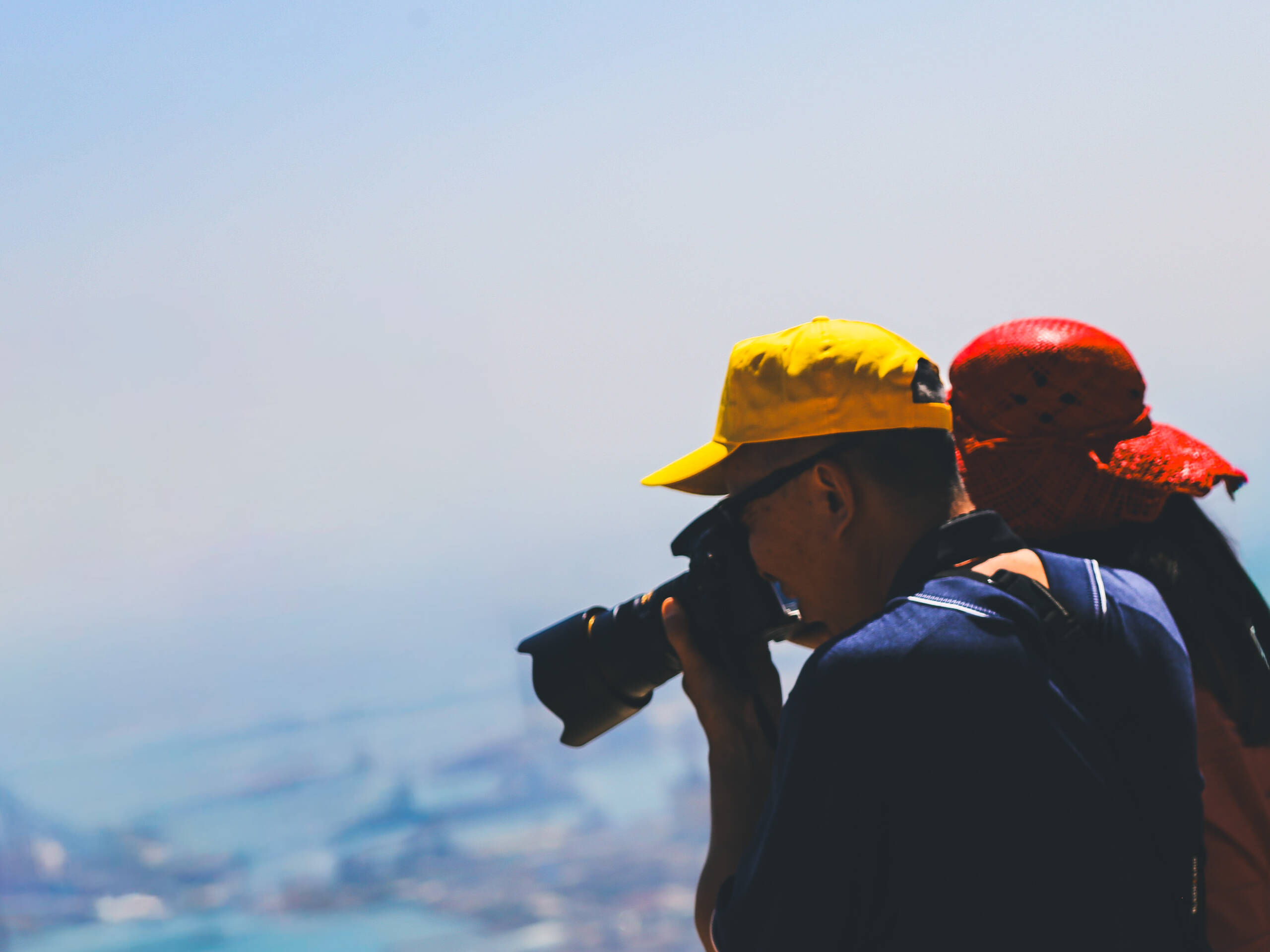
Look at the frame above. The subject has done everything right in terms of position, and the city behind him is still dissolving into pale blue nothing. That’s ten kilometres of atmosphere between the lens and the buildings, scattering light back at the sensor before it ever arrives. Contrast falls off with distance. From ground level you rarely notice because you’re never looking at anything ten kilometres away. From a summit, everything worth photographing is that far off.
Time of day matters more than gear
The single biggest improvement available to you is free, and it’s the clock. Go up early. The day after wind or rain is better still, because the air has been washed. Midday over a coastal city in summer is the worst possible combination: haze at maximum, sun overhead, no modelling on anything.
Blue hour and full dark are the reliable backup. Lights punch through haze that swallows daytime detail completely, and the same viewpoint that was hopeless at noon becomes a solid frame two hours later. If you can only make one trip up, make it that one.
A polariser earns its place here, but understand what it does. It cuts scattered light at roughly ninety degrees to the sun, on the near and middle ground. It will not rescue a distant skyline. Anyone telling you a circular polariser “cuts through haze” has been shooting mountains at close range, not cities at ten kilometres.
Go long, not wide
The instinct at a viewpoint is to reach for the widest lens in the bag and take in the sweep. That instinct produces the worst photograph you’ll make all trip. Wide from height means everything is small, nothing is a subject, and the haze occupies most of the frame.
Reverse it. Pick out a slab: a harbour mouth, a stack of container cranes, a ridge line with a road cut into it, one block of towers catching light differently from the block behind. A mid-telephoto is the right tool, and this is where a crop body pays for itself. An 85mm on APS-C is a 136mm equivalent for the price of a used lens and no extra weight in the bag. A 100mm becomes 160mm. Adapted glass works fine for this; you’re at infinity focus on a static subject with plenty of light, which is the easiest job you can hand an old lens.
Layers, and something near
The frame above works because it has a foreground. The photographer’s shoulder, the yellow cap, the red hat behind him. Without those, you have a hazy city and no scale, no depth, no reason for the viewer’s eye to enter the picture.
So use what’s up there with you. Railings, rock, the edge of a viewing platform, other visitors. Then look for receding planes in the distance: ridge, port, breakwater, ships. Each one sits in slightly more haze than the one in front, and each is slightly paler. That’s aerial perspective, and it’s the one thing the atmosphere gives you back. Compose for it deliberately and the haze stops being a defect.
Two practical things
Expose for the highlights and shoot raw. Haze lifts the blacks, so you’ll be recovering contrast later by pulling the black point and touching dehaze. Do that in post, not by underexposing in camera, or you’ll be dragging noise out of the shadows for nothing.
And keep your shutter up. High places are windy, the railing you’re leaning on is vibrating from everyone else leaning on it, and you’re on a long lens. 1/500 minimum. Faster if the wind is real. If there’s glass in the way, hood flat against it, shoot perpendicular, and put your body between the glass and any light source behind you.
When the air wins anyway
Sometimes it just wins. You had one day, the day was hot and still, and the frame is a pale wash. Convert it to black and white. Monochrome reads the haze as depth rather than as failure, and a curve that would look sickly in colour looks intentional in grey. You end up with a different picture than the one you climbed up for. You still end up with one.
The view was never the photograph. It’s just where you stand.