Coffee House Photography, Turning a Coffee Break Into a Visual Story
What do coffee and a camera have in common? An Instagrammer. There is a reason why coffee houses appear so frequently in the feeds of lifestyle and travel photographers. For the price of a cappuccino and a pastry, a photographer gets a ready-made still life, an interior to explore visually and a small everyday story to tell. A café can be a surprisingly useful place to practice photography, especially with modest equipment and no lighting kit.
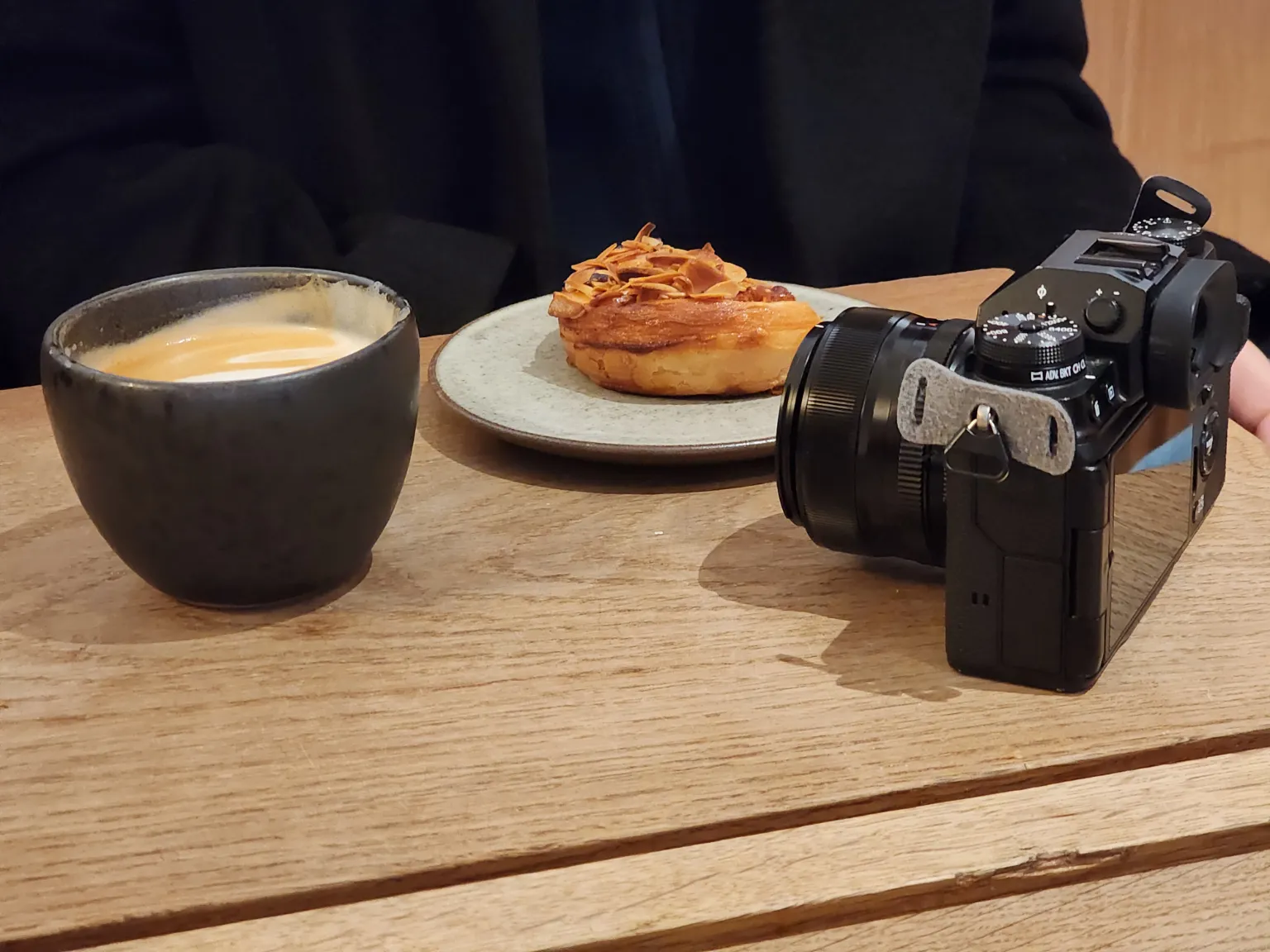
Look at the photograph. On the left is a dark ceramic cup with a creamy surface of coffee. An almond-topped pastry on a pale, slightly speckled plate sits farther back, while a black camera occupies the right side of the table. Its control dials, ribbed lens barrel and reflective rear screen introduce mechanical detail into an otherwise soft, warm scene. The wooden tabletop fills the lower half of the frame, and the dark clothing of the person behind it provides a relatively quiet background. The three objects have very different shapes and textures, yet they belong together.
Photograph: MediaGallery.org.
The camera changes the subject
Remove the camera from this photograph and you have a conventional food photograph. Keep it in the frame and the picture becomes a comment on the way we consume experiences in the age of Instagram. The pastry and coffee suggest a break; the camera suggests that the break may also be an assignment. It is a nice example of how a single object can change the meaning of a composition without changing its setting.
The arrangement works through depth. The cup is close to the photographer, the pastry is farther away, and the camera is close again on the opposite side. A slightly elevated viewpoint lets us see the coffee and the topping on the pastry while retaining the volume of the cup and the camera body. A completely overhead shot would flatten much of that volume. Shooting at table height would hide the coffee’s surface and most of the almonds.
The foreground is generous, perhaps more generous than a conventional food advertisement would allow. But the empty wood gives the objects breathing room. Try cropping a similar frame for a vertical social media post and you will discover how quickly that balance disappears. A tighter portrait composition might work better with just the cup and pastry, or with the camera behind them rather than alongside them. Compose for the intended format before pressing the shutter.
Use the café’s light and the lens you already own
A compact mirrorless body with a kit zoom or a small prime is quite sufficient. For a table scene, a focal length around 28 to 35mm in full-frame terms generally gives you enough room to work from your seat. On an APS-C body, that corresponds roughly to an 18 to 23mm lens, depending on the crop factor. A 50mm-equivalent lens is useful for isolating a pastry or a cup, though you may need to lean back to fit the whole arrangement.
Avoid the temptation to shoot everything at the widest available aperture. If you want the coffee, pastry and camera to remain recognizable, try f/4 or f/5.6 and adjust after checking the result. Their different distances from the lens will determine how much of each object stays sharp. For a close detail of the pastry, a wider aperture may be more appropriate. The settings are starting points, of course, rather than a recipe for reproducing this particular photograph, whose exposure and lens are not established by the image itself.
A seat beside a window is often the simplest lighting setup. Side light brings out the laminated layers of pastry and the ridges of a lens barrel. A white napkin just outside the frame can soften shadows on the opposite side. Watch for bright reflections on glazed ceramics and glossy screens, and move the camera a little before resorting to editing. In a café with both daylight and warm overhead lights, shooting RAW gives you more freedom to adjust white balance afterwards. Preserve some of the warmth if it belongs to the place.
There is no need to bring a collection of lenses, a tripod or a flash to every coffee house. An inexpensive kit zoom and a good sense of where the light is coming from will accomplish much more than a conspicuous bag of equipment that gets in the way of other customers.
Make a review into a sequence of photographs
One pretty picture of a cappuccino cannot communicate much about a coffee house. Think instead in terms of a short photographic sequence: a wider frame establishing the room, a detail of the drink and pastry, a view of the counter, perhaps an image of the street outside. If photographing identifiable staff or customers up close, ask first. A quiet café is still a shared space.
Vary the distance and angle between frames. A close-up of the coffee foam followed by another close-up of a plate may be attractive, but a wider scene provides context and makes the small details more meaningful. The same principle applies to planning a food photography session, even when the session is entirely spontaneous.
The attraction of coffee houses for Instagrammers has much to do with how readily these places supply the ingredients of a visual narrative. The companion article on MediaGallery.org explores that social media culture. From a photographer’s point of view, the more interesting challenge is to make an individual picture out of a familiar subject. Change your position, pay attention to the background and include an object that tells us something about the person at the table.
Then drink the coffee. Before it gets cold, preferably.