The Art of the High-Angle Cutaway: How a Two-Person Crew Covers a Whole City From One Balcony
Behind every seamless documentary transition and every establishing shot that opens a news package, there is a crew standing on a balcony in the sun waiting for something to happen. This frame catches two of them working a high vantage point above a dense, sun-bleached city, turning a public overlook into a small production control room.
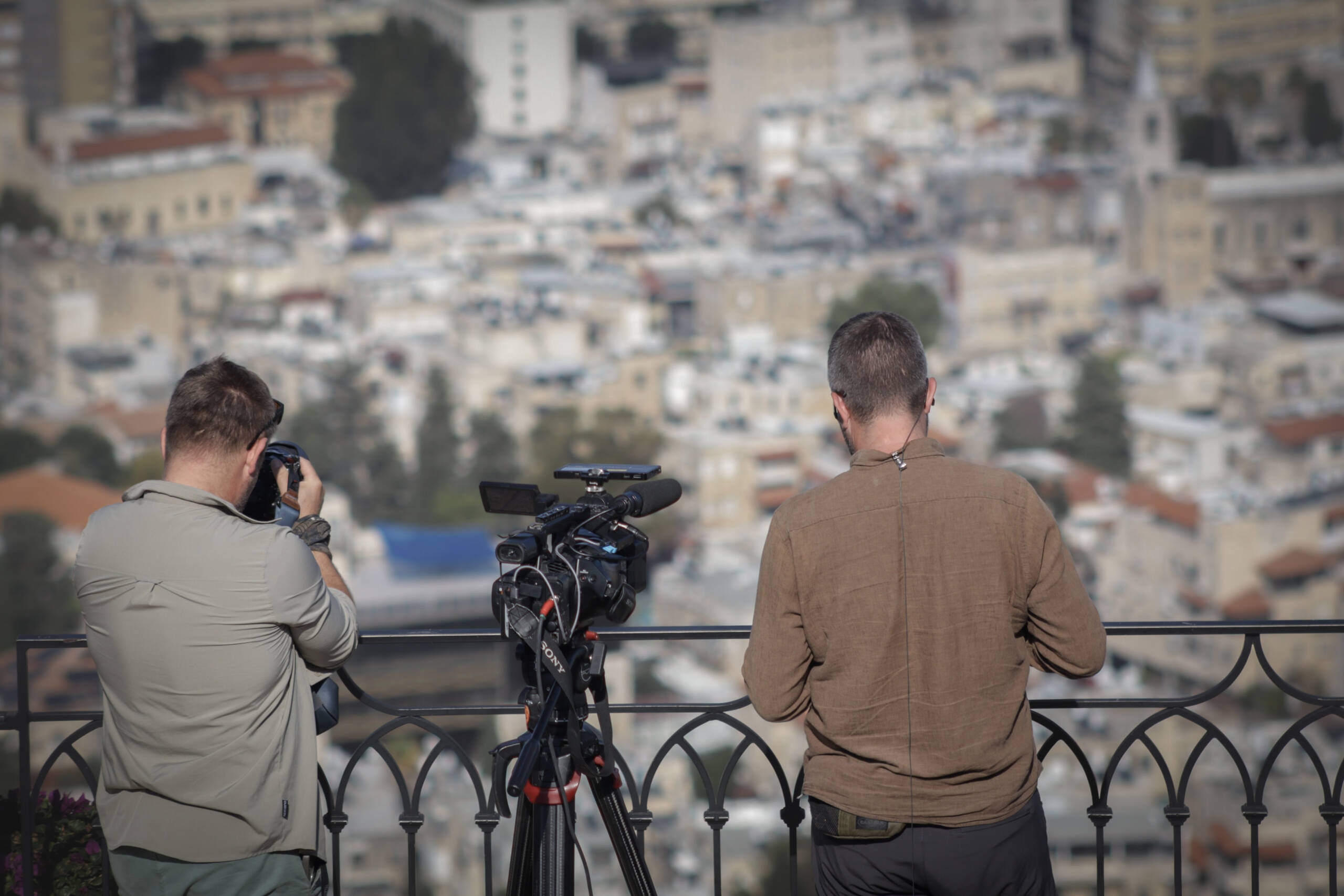
The centrepiece sits on a heavy fluid-head tripod behind an ornate iron railing: a professional video body with an external monitor, a shotgun mic up top, a phone clamped above the screen, and enough audio cabling to discourage any passer-by from asking for a portrait. To the left, a crew member in an olive field shirt leans into a handheld camera, grabbing stills and secondary B-roll that will cut between the locked-off wides. To the right, the operator stands with his back to us in an earth-toned linen shirt, discreet comms in one ear, watching whatever is unfolding down in the streets.
That split is the whole method. One camera is nailed down and does not move, because a wide shot from height only works if it is rock steady and you can hold it for thirty seconds without a wobble. The second camera is free to roam, because every cut out of that wide needs somewhere to go. A tripod alone gives you a beautiful shot you cannot edit. A handheld alone gives you movement with no anchor. Together, two people cover a city the way a six-person unit would.
What makes the picture read as clearly as it does is the depth of field. The sea of terracotta roofs, pale stone facades, and distant arches falls away into soft texture, so the eye lands on the gear and the posture rather than the geography. That is a long lens wide open from a long way back, and it does something a wider framing could not: it turns a location shot into a portrait of the work. Shoot the same scene at 35mm and you get a city with two small figures in it. At 200mm or beyond, you get two people and a suggestion of a city.
It is worth noticing what the compression also hides. From this distance the background is unreadable, which is exactly why the frame survives being published anywhere. The subject is the craft, not the address.
The rest is patience. Get set before the light turns, keep the tripod camera rolling longer than feels necessary, shoot more cutaways than you think you need, and get off the balcony before the coffee runs out.
MediaForum.net:
- Micron $MU and SanDisk $SNDK Sold Off on a Weibo Post: Why I Think the Market Priced the Wrong Thing
- OSINT Digest: Palantir Contracts, RT Mirror Domains, AI Debt and Russia's Retreat From Syria
- AI Companies Are Paying Two Different Prices for the Same Books: License or Settlement
- Bessent Promises an Economic D-Day for Iran While Hormuz Runs at 20% of Normal Traffic
- Big Tech Will Spend About $700 Billion on AI Infrastructure in 2026. The Revenue Is Not Close.
- Carney Answers With Dollar-for-Dollar Tariffs on US Steel, Dairy and Electronics From September 8
- ChatGPT Referrals to Publishers Grew 200% and Still Account for Under 1% of Traffic
- Congress Is Drafting Bills With AI, and AI Is Bad at the Part That Matters
- Fed Minutes Show a Hiking Bias, and Traders Cut September Odds Anyway
- Google Referrals Fell 60% for Small Publishers and 22% for Large Ones, and That Gap Is the Point
- Indiana Enters a Second Week Without Power While the Wildfire Story Moves On
- Nike Trades at 2014 Prices as On and Hoka Take the Ground It Used to Own
- Nvidia Is Financing $105 Billion of an OpenAI Data Center It Will Also Supply