Four Tripods Planted, Three Cameras Handheld: When the Legs Actually Earn Their Weight
Count the frame. Four sets of legs planted in the dirt, and most of the people standing behind them are holding their cameras in their hands anyway. Nobody is doing anything wrong. That is just what a workshop looks like in the ninety percent of the day that isn’t the shot.
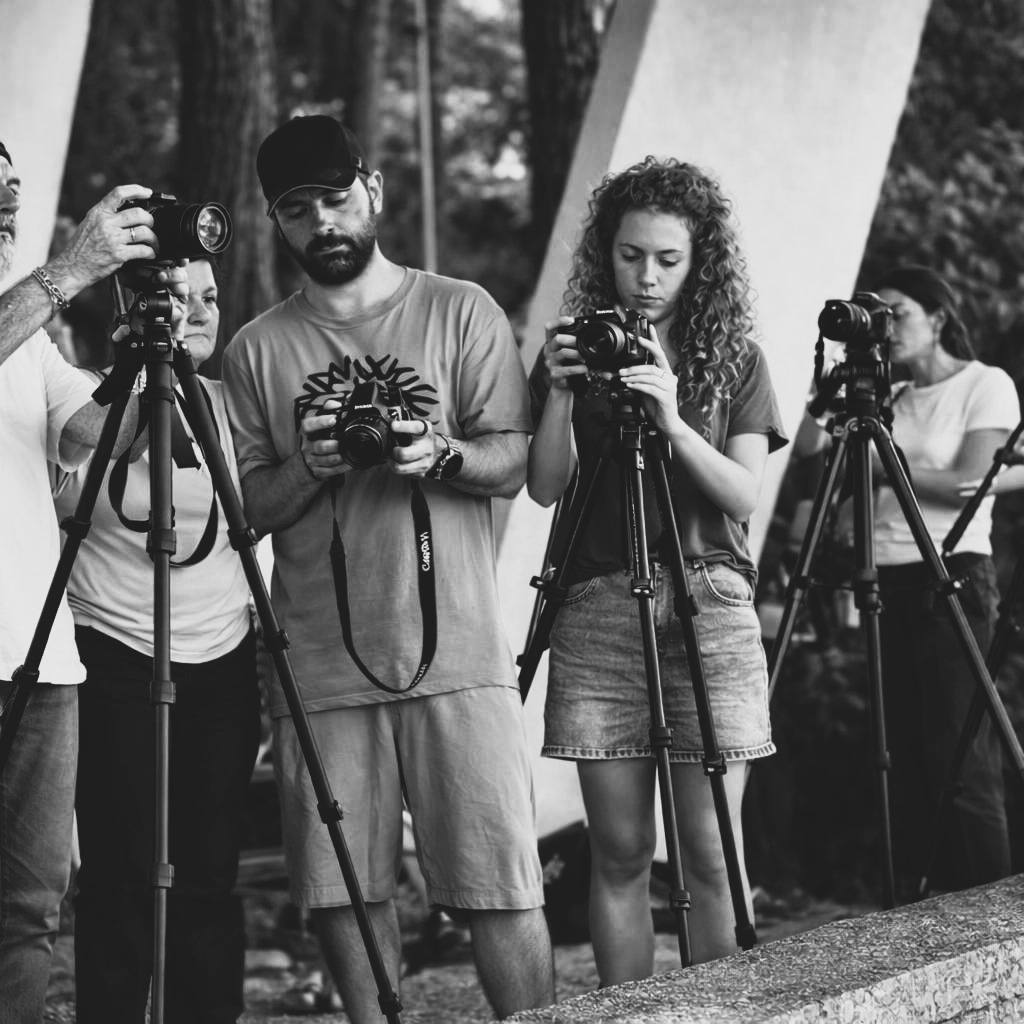
The tripod is the most bought and least used piece of equipment in the hobby. It gets carried because the packing list said so, and because there is a lingering sense that serious photography happens on sticks. Most of the time the sticks sit there while you work handheld, and that is the correct call.
The threshold has moved
The old reciprocal rule said keep the shutter above one over the focal length. On a 100mm lens, 1/100. That rule was written for film bodies with no stabilization and it has not aged well.
A modern stabilized body buys you four to five stops. On the same 100mm, careful technique gets you usable frames at 1/8 or slower. Brace against a wall, tuck your elbows, exhale, and it gets better still. The rule now is a starting point, not a limit, and you should know your own number rather than the internet’s. Shoot a bracket from 1/100 down to half a second, view at 100 percent, find where your hands stop being good enough. That number is yours and it changes with fatigue, with caffeine, with how cold you are.
Below that number, the tripod is not optional. Above it, the tripod is a bag of aluminium you carried up a hill.
What actually forces the legs
Four situations, and they have nothing to do with looking serious.
Exposures past half a second. Water, cloud movement, ND filter work, blue hour architecture. No amount of stabilization saves a two second exposure.
Repeatable framing. Focus stacks, exposure brackets you plan to blend by hand, panoramas with real overlap, anything where the frame has to sit still between clicks. Handheld brackets align fine in software until they don’t, and the failures come at the edges where you notice them last.
Long glass at distance. Stabilization corrects for shake, not for the amplification of a 400mm view. Wildlife shooters do not use gimbals for fun.
Base ISO discipline. If you want ISO 100 files out of a dim interior, the shutter has to go somewhere, and the somewhere is a tripod.
Everything else is preference.
Spend on the head, not the legs
Tripod marketing sells carbon fibre and leg-section counts. The head is what fails you.
A cheap ball head creeps. You compose, you lock it, you press the shutter, and the frame has sagged a few millimetres under the weight of the camera. On a wide landscape you might never notice. On a long exposure of a building, your verticals drift and the file is scrap. Creep is the single most common reason a tripod shot comes out worse than the handheld version.
The plate matters just as much. Proprietary plates lock you into one brand and cost more to replace when you lose one, which you will. Arca-Swiss is the de facto standard, it is cheap, and it lets you move between a ball head, an L-bracket, and a friend’s tripod without a conversation about adapters. Buy into Arca early and stop thinking about it.
If the budget is fixed, an adequate set of legs with a good head beats an excellent set of legs with the head that came bundled. Legs are a solved problem. Heads are not.
The cheap tripod problem
A tripod that flexes is worse than no tripod, because it gives you a false reading. You think the camera is locked down, so you drop the shutter to a second, and the whole rig is quietly oscillating in the wind. Handheld at 1/60 would have given you a sharper file.
Test yours. Set it up, lock everything, tap a leg, and watch the viewfinder. If the frame rings for more than a moment, you own a monopod with delusions. Weight helps, so hang your bag from the centre column hook, but only if the bag is touching the ground or hanging dead still. A bag swinging in wind is a pendulum bolted to your camera.
While you are there, keep the centre column down. Every centimetre of raised column undoes the stability the legs provide. Splay the legs wider instead and accept the lower working height. If you need the extra height often, you bought the wrong legs.
Two settings people forget
Electronic first curtain, or full electronic shutter if your sensor and subject allow it. Mechanical shutter shock is real at the one-eighth to one-second range, exactly the window where you have just committed to the tripod.
And a two second self-timer, always. Your finger on the shutter button is a vibration source. Two seconds costs you nothing and removes it entirely. Remote releases are fine, one more thing to lose, and the timer does the same job.
Carrying it anyway
None of this argues for leaving the tripod at home. The workshop in the photo is a case in point. Those legs are planted because the group is waiting for light, and when it comes there will be no time to set up. The tripod is the thing you deploy before you need it.
It also slows you down, which some days is the entire benefit. A tripod costs you a minute per composition. That minute is when you notice the branch in the corner.
Just be honest about which day you are having. Carrying it and not using it is fine. Using it because it is there, at a shutter speed your hands could have managed, is how you end up with a slightly soft file and no idea why.