The Art of Reportage Photography: The Few Lenses That Actually Earn Their Place
A man in a red shirt throws both hands toward the lens, mouth open mid-sentence, eyes locked on the camera. Behind him a Breton flag snaps against a hot blue sky and a crowd thins out across a stone square. Nothing in the frame is arranged. The photographer was close enough to touch him, wide enough to keep the flag and the architecture in the story, and present at the half-second before the gesture collapsed. That is reportage photography in one frame: proximity, context, and timing, with no second chance.
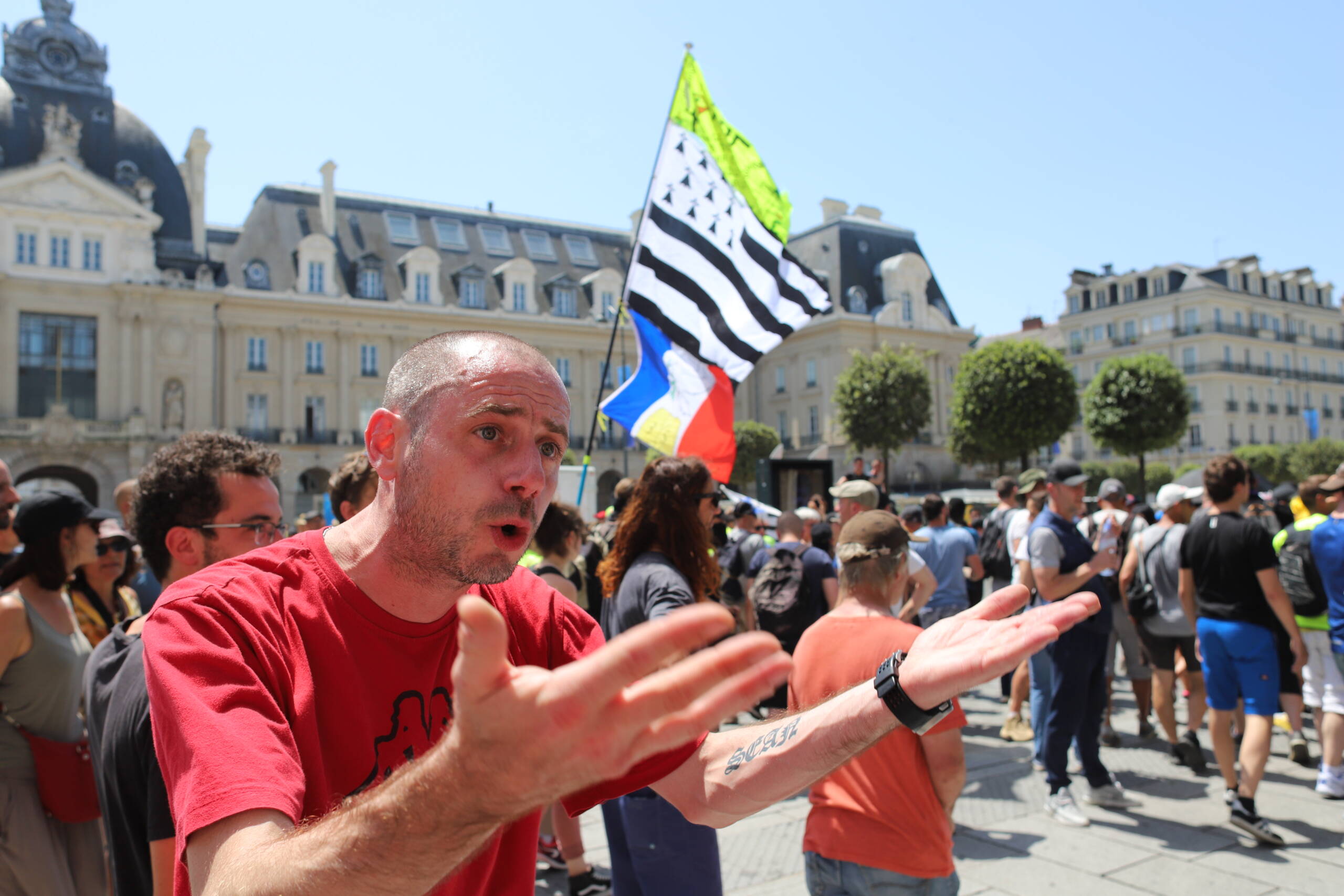
Reportage is not street photography’s prettier cousin and it is not photojournalism’s looser one. It is the discipline of recording a real event as it happens, in a way that holds up as both a record and a picture. The constraint is total: you cannot direct the subject, you cannot wait for better light to be installed, and you cannot reshoot. Everything that makes the image work has to be decided in the moment, which is exactly why the craft rewards a small, fixed, well-understood kit over a bag of options.
The craft is proximity, not zoom
The single most repeated piece of advice from working photojournalists is also the least technical: get closer. Robert Capa’s line about the picture not being good enough because you weren’t close enough has survived eighty years because it keeps being true. Closeness is not just about apparent size in the frame. It changes the relationship between you and the subject, it forces you to commit to a viewpoint, and it pulls the viewer into the event instead of leaving them watching from across the street.
This is why the wide-to-normal range dominates reportage and the telephoto sits in the bag. A long lens lets you stay back, and staying back is usually the enemy. The frame at the top of this piece only works because the camera is inside the man’s space, close enough that his hands break the plane and his expression carries the whole image. A 200mm shot of the same scene from forty feet away would be a different, weaker photograph: a man gesturing, rather than a man gesturing at you.
Anticipation beats reaction
Good reportage looks like luck and is mostly the opposite. The photographer reads the situation a beat ahead, pre-focuses on where the action will land, and presses at the peak rather than after it. That depends on knowing your gear so well that the camera disappears. You cannot anticipate a moment if half your attention is on which focal length to switch to. A fixed lens you have used for a thousand frames lets you frame in your head before you raise the camera, because you already know what 35mm will see from where you are standing.
Light, presence, and not being the story
Reportage lives in the light it is given. You learn to use harsh midday sun, backlight, and deep shade as they come, because the event will not pause. The other half of the job is social: being present without becoming the subject. A small, quiet camera and an unintimidating lens change how people behave in front of you. A 305-gram prime invites a candid frame in a way that a white telephoto barrel never will. The gear that disappears physically also disappears socially.
Best lenses for reportage photography
For Canon RF shooters, the working kit narrows to a handful of lenses, each with a clear reason to be on the camera.
35mm — the default. Thirty-five millimeters is the classic reportage focal length, and most photojournalists who carry one lens carry this one. It places a subject inside their environment rather than isolating them, with a near-neutral perspective that reads as natural to the eye and almost no distortion. On RF mount, the RF 35mm f/1.8 Macro IS STM is the obvious pick: small, light, discreet, fast enough for low light, and with close-focus capability that earns its keep on a feature shoot. EF shooters adapting older glass have the EF 35mm f/1.4L II, which remains a reference-grade reportage lens.
50mm — the second eye. When 35mm pulls in too much environment, a 50mm gives a tighter, slightly compressed, very natural frame for picking a single subject out of a scene. The RF 50mm f/1.8 STM is the cheap, tiny, genuinely good entry point; the RF 50mm f/1.2L USM and the newer RF 50mm f/1.4L VCM are the professional versions, with the f/1.2 rendering backgrounds beautifully and the f/1.4 VCM adding a hybrid stills-and-video design. Many reportage shooters run nothing but a 35 and a 50.
28mm — the pocket option. The RF 28mm f/2.8 STM pancake is the lens that makes an R8 nearly invisible. At 120 grams and 25mm long, it sits between 24 and 35, gives a true wide-angle character without going extreme, and is sharp across the frame even wide open. For discreet, all-day shooting where the priority is simply always having the camera ready, it is hard to beat.
135mm — the long eye. Reportage rewards getting close, but there are moments when close is impossible or unwise: a police line at a demonstration, a barrier at an event, a stage, a tense situation where stepping in would change or endanger the scene. This is where a fast telephoto earns its place, and 135mm is the classic reportage long lens. It does two things a wide cannot. It compresses — stacking foreground, subject, and background into layers that read as a single charged moment, the kind of frame where a protester, a riot shield, and a building all sit on top of one another. And it isolates — lifting one face out of a crowd at f/1.8 with the chaos dissolved into clean separation behind it. On RF mount, the RF 135mm f/1.8L IS USM is the tool: explicitly built as the successor to the legendary EF 135mm f/2L USM, with weather sealing, fast and silent Nano USM autofocus, and image stabilisation that reaches roughly 8 stops paired with an R8’s IBIS — which makes it genuinely usable handheld in the low light of an evening event or a dim hall. Its black barrel also disappears far better than a white super-telephoto. EF shooters still swear by the EF 135mm f/2L USM, which adapts cleanly and costs a fraction on the used market.
The f/2.8 zoom — the insurance policy. When a single assignment demands range and there is no time to switch primes, the RF 24-70mm f/2.8L IS USM is the workhorse, covering wide-to-short-tele at constant aperture with image quality close to the primes. The RF 28-70mm f/2L USM goes further, effectively folding a 28, a 35, and a 50 into one body at the cost of significant weight and price. A zoom buys flexibility; it sacrifices the discipline that primes impose.
Where the long end stops. A 135mm earns its keep because it still feels like a decision about access and emphasis. Push much past it — into 200mm and beyond — and most reportage starts to look like surveillance rather than presence. Carry the long lens for the shot you cannot get any other way, not as a substitute for walking closer.
A note for crop-sensor bodies
On an APS-C body like the R100, the 1.6x crop changes everything. The RF 28mm f/2.8 becomes a 45mm-equivalent normal lens, and the RF 50mm becomes an 80mm short telephoto that is too tight for crowded streets. To get the classic 35mm reportage field of view on a crop body, reach for something nearer 22-24mm — the RF 24mm f/1.8 Macro IS STM lands close to a 38mm-equivalent and makes a strong, compact one-lens setup. The crop also turns the 135mm into a roughly 216mm-equivalent reach, which is a real advantage when you need to pull a subject out of a distant crowd, though it pushes the lens firmly into tight-isolation territory.
The lens is a working method, not a spec sheet
The real lesson under all of this is that in reportage the lens is not a tool you select per shot; it is a way of seeing that you commit to before the day starts. Pick a 35mm and you have decided to work close and keep the context. Pick a 50mm and you have decided to isolate and compress a little. Pick a 135mm and you have decided to stand back, compress hard, and lift one moment cleanly out of the noise. The best photographers can tell you why they are holding a given lens before they ever raise the camera. If you cannot answer that question, you are reacting to events instead of photographing them — and reportage is decided entirely in the half-second between the two.