Theatre Light Is a Trap: Metering, Shutter Speed and Silent Mode for Stage Photography
Four dancers in saturated blue and red robes on a lit wooden stage, with everything below the stage edge falling away into an almost black auditorium of heads. The costume is the brightest thing in the frame by a wide margin, and it is the thing the camera’s meter will get wrong.
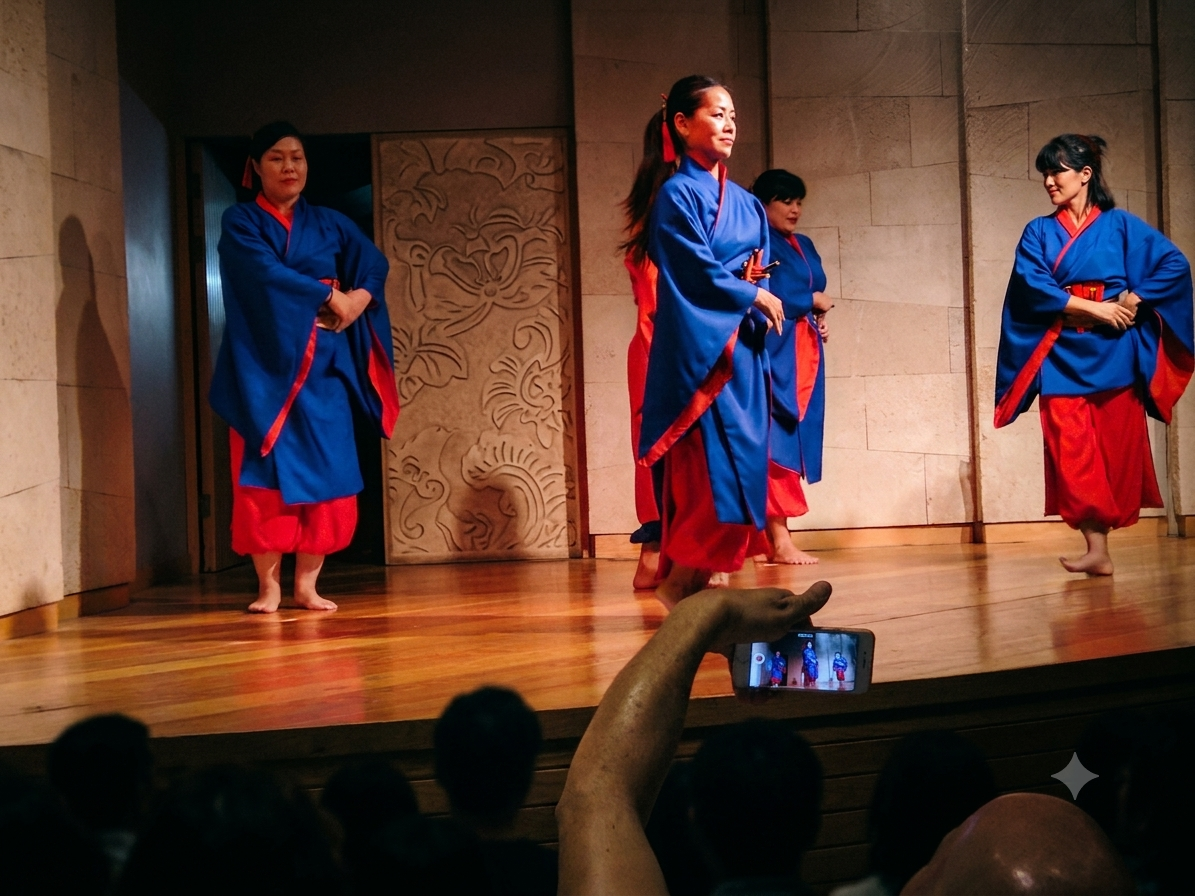
Stage lighting looks generous. There is a lit subject, there is contrast, there is colour. Every part of that is a problem in a different way, and the problems compound: the meter reads the wrong thing, the shutter speed you need is faster than the light supports, and the shutter mode that keeps you welcome in the room introduces artefacts of its own. Work through them in order.
Meter the Costume, Not the Scene
Evaluative metering averages the frame. In a theatre the frame is mostly dark. The camera decides the scene is underexposed and lifts everything until the average looks reasonable, which means the lit costume goes two stops hot and the face under a top light clips entirely.
Switch to spot metering and put the spot on the brightest part of the costume, then dial in negative compensation from there. Or work fully manual, which is better: stage light for a given scene is constant, so once you have an exposure it holds until the lighting cue changes. Auto anything will swing on you every time a performer crosses a pool of light or the black background takes up more of the frame.
Manual also fixes the shot-to-shot consistency problem. A sequence exposed by an averaging meter comes back with every frame a third of a stop different, and you spend the edit matching them.
Red Clips Before Anything Else
The specific failure in a frame like this one is red channel clipping. Warm tungsten stage light is already heavy in red. Put a saturated red garment under it and the red channel saturates while the luminance histogram still looks comfortable, sitting nowhere near the right wall.
The result is a red that has gone flat and papery, with no fabric texture and hard edges where the fold detail should be. It is not recoverable, because there is nothing left in the channel to recover.
Two habits fix it. Set the histogram display to RGB rather than luminance, and read the red channel, not the combined curve. And expose about two thirds of a stop under what looks correct on the back of the camera, then lift in raw. You are trading a little noise in the black surround for fabric detail you cannot get back any other way. In a theatre the black surround is going to be crushed anyway.
If your body has zebras, set them to the red channel if that option exists. Watching the costume flash before you press is faster than checking histograms between frames.
Why 1/200 Is the Floor for Dance
The torso in traditional dance often moves slowly. The extremities do not. A sleeve, a fan, a hand turning at the wrist, a foot leaving the floor: these travel several times faster than the body, and they are usually the thing the composition is about.
At 1/60 you get a sharp face and a sleeve rendered as a coloured smear. At 1/125 the sleeve is soft and the hand edge is mushy. 1/200 is where fabric edges hold on most stage movement. Faster if the piece is energetic, and 1/400 is not excessive for anything with jumps or spins.
There is a way to buy the light back, and it is compositional rather than technical. Most classical dance forms are built on held positions. The movement resolves into a pose, the pose is held for a beat, and the next phrase starts. That beat is the frame. Shoot the arrival, not the transit. You get sharpness at a slower speed, and you get the shape the choreography was designed around instead of an accidental moment between two shapes.
Watching for those pauses through the first piece and shooting the second is a better use of an evening than firing continuously through both.
Silent Shutter Has a Price
A mechanical shutter in a quiet auditorium is not acceptable. Silent electronic shutter is the polite default, and on recent bodies it is genuinely usable. It has two costs that matter here.
Rolling shutter skew appears when the subject or the camera moves quickly across the frame. A dancer’s fan or a fast pan comes back leaning. On a slow readout sensor this is severe, on a stacked sensor it is close to gone. Know which one you have before you rely on it.
Banding is the bigger problem. Stage lighting is increasingly LED, and LED fixtures are dimmed by pulse width modulation, meaning they flicker at rates the eye cannot see and an electronic shutter absolutely can. You get horizontal bands of different brightness and colour across the frame, and they move between frames. Anti-flicker detection helps with mains frequency flicker but usually only works with the mechanical shutter, which is what you are trying not to use.
The practical compromise: shoot silent, check a frame at 100 percent early in the performance, and if you see banding, drop the shutter speed to a value that syncs better with the flicker rate or switch to mechanical during a loud musical passage. Tungsten fixtures, which this stage appears to be using, do not have this problem. Their filaments have thermal inertia and the output is effectively continuous.
Set White Balance and Leave It
Stage lighting is gelled, changes on cues, and mixes colour temperatures deliberately. Auto white balance will interpret each cue differently, so a sequence shot across one scene comes back with the costume shifting hue every few frames.
Pick a value manually, roughly matching the key light, and leave it alone for the whole performance. Shoot raw, correct in the edit if you want to, and get a consistent set. What you must not do is let the camera neutralise a designer’s warm wash into grey. The colour of the light is part of the work.
Where to Sit
Front row is the worst seat for photography. You shoot up into nostrils and lose the floor, and dance is a full body form that needs the feet.
Rows five to eight, slightly off centre, gets you a near level angle and enough distance for an 85 or a 135 to frame one or two figures cleanly. An aisle seat lets you lean without disturbing anyone. A short telephoto zoom is more useful than a prime here because you cannot move, but you pay a stop or more for the flexibility, which pushes you back into the ISO problem.
And accept the foreground. Heads and raised phones are part of what a live performance looks like from a seat. Shooting over them entirely is possible if you are high enough. Including one deliberately, sharp or soft, tells the viewer where the camera was and what the room was doing.
The stage is lit for the people in the seats, not for the sensor. Expose for what they were looking at.