Choosing the Shooting Angle at Events, A Giro Award Ceremony Lesson
When photographing a public event, the difficult decision is often not which camera setting to use but where to stand. A small movement to the left, a step backward or a change in camera height can alter the relationship between people, objects and background far more dramatically than another lens. This photograph from a Giro award ceremony is a useful example. Four presenters in black dresses stand side by side on a stage, their faces turned toward a gleaming spiral-shaped trophy. They hold folded turquoise, pink and purple branded umbrellas, while a tall pink event banner rises along the left edge. The entire scene is seen from a relatively low position, giving it the feeling of looking up at the ceremony rather than observing it from the audience at eye level.
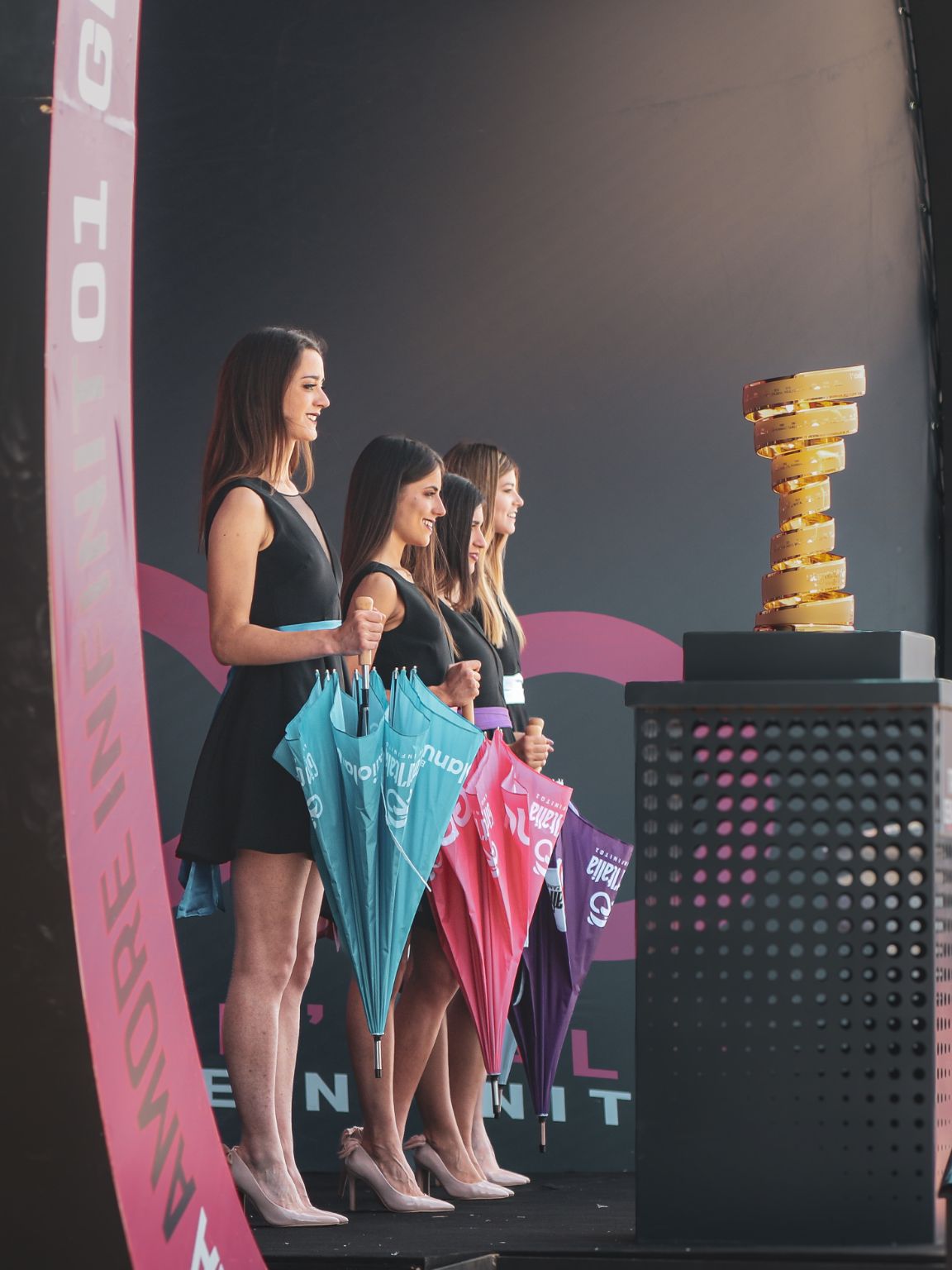
The original Giro award-ceremony photograph. Image hosted by MediaGallery.org.
There is a clear advantage to this viewpoint. The dark backdrop removes much of the visual clutter that usually surrounds an outdoor presentation, allowing the faces, the bright umbrellas and the metallic trophy to stand out. The low angle also emphasizes the height of the presenters and the unusual stacked shape of the award. The vertical format reinforces that upward movement: the left-hand banner, the line of standing figures and the trophy all become tall elements of the composition. The vivid umbrellas add color and a hint of the event’s branding without requiring the viewer to read every logo. It is not a conventional winner-holding-a-cup photograph, and that is part of its interest. It describes the ceremony’s visual setup, not merely its result.
But the same camera position brings complications. The perforated black equipment housing or stage fixture fills a large area in the lower-right foreground and blocks the base of the trophy. The umbrellas overlap the presenters’ bodies and legs, and the four faces sit close together in profile, making some people harder to distinguish. On the left, the event banner is cut off by the frame. There is also a large expanse of relatively empty dark background above the group. None of these details automatically ruins the image. In editorial photography, a little obstruction can communicate the reality of working at a crowded event. Still, they are reminders that a dramatic viewpoint is not always the cleanest viewpoint.
If the trophy and the people were the main news subjects, I would first try raising the camera slightly to reduce the bulk of that foreground fixture, then shift sideways until the award’s outline became more distinct. Even half a step can separate two overlapping faces or reveal an object hidden behind another. I would also shoot a wider horizontal frame showing the relationship between the award and the full stage, followed by a tighter vertical composition devoted to the presenters and the trophy. That sequence provides an editor with different visual answers: an establishing image for context, a cleaner ceremony photograph for the report, and a detail shot for emphasis. Of course, access restrictions and the short duration of award presentations may mean you get only seconds to make those decisions.
The lesson is to choose the angle according to the story you want the photograph to tell. A low position can make a podium or trophy appear imposing, but it also enlarges whatever happens to be nearest the lens. A higher viewpoint may clear the foreground and separate heads, yet lose some of the scale and theatrical character. Shooting straight on creates a tidy record; shooting from the side introduces depth, overlapping layers and sometimes a stronger sense of anticipation. Here, the profile arrangement and the presenters’ attention toward the trophy make the photograph feel like a moment just before or during the formal presentation. The direction of their gaze becomes part of the composition.
For event photographers, the best habit is to inspect the entire frame rather than concentrating only on faces. Check the corners, the stage furniture, the gaps between people, the height of the camera and the amount of empty space you are leaving above the subjects. Make the safe documentary frame first when possible, then experiment with more personal angles. A ceremony rarely waits for the photographer to solve every compositional problem. The strongest coverage comes from recognizing the trade-offs quickly and using them deliberately.