How to Cut Clutter Out of Ultra-Wide Photos at Trade Shows and Crowded Events
An ultra-wide lens does not create clutter. It just refuses to leave any out. Point a 15mm at a busy exhibition aisle and you get the interview you wanted plus four booths, two ceiling trusses, a tripod, a rolling case, six strangers with their backs turned, and a table of giveaway boxes. Everything in the room is now in the picture, at roughly equal visual weight, and the eye has nowhere to land.
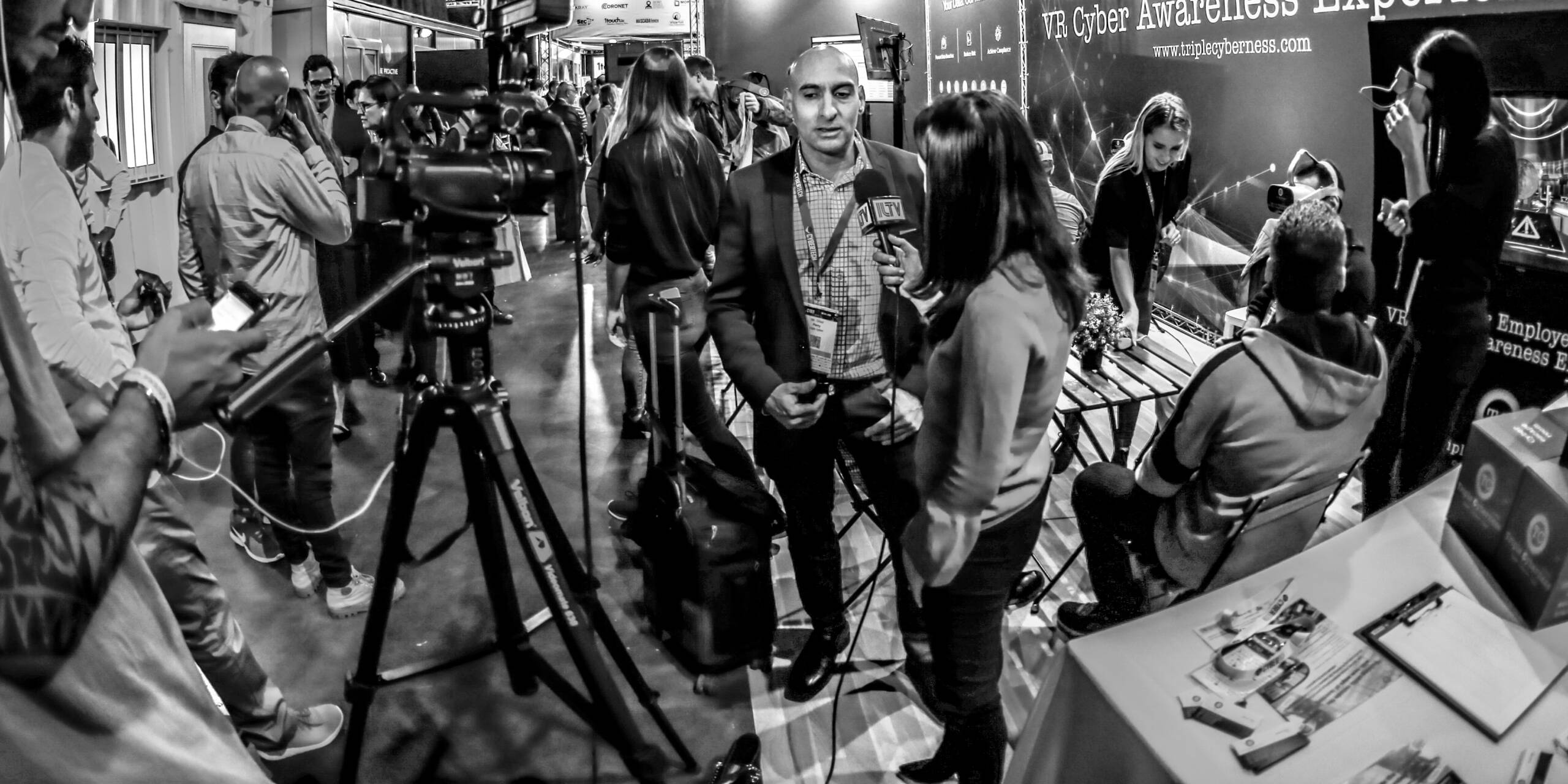
The fix is almost never a setting. It’s where you put your feet.
Proximity is the whole point of the lens
Ultra-wides exaggerate the scale difference between near and far. Something at half a metre looms; something at five metres shrinks to nothing. That’s the effect you’re paying for, and if you don’t use it, you’re just capturing a lot of room.
So get closer than feels comfortable, and get lower. Pick one thing to sit near the front of the frame and let it dominate. It can be a tripod leg, the shoulder of a camera operator, the corner of a table, a stack of product boxes. Once you commit to it, everything behind it drops into a supporting role and the depth does the organising work that composition can’t do on its own.
The failure mode is a frame where several objects sit at middle distance, all similar in size, none of them the anchor. That reads as debris. The same objects at 40cm read as structure.
Use the obstacles as a frame
At a show floor you cannot remove the clutter, so recruit it. Broadcast crews are the most useful furniture in the building: tripods make strong dark verticals, and the legs form a natural V you can shoot through. Truss uprights, banner stands, and doorway edges do the same job.
Move a step until one of those elements brackets your subject. The picture immediately reads as “seen from within the scrum” rather than “everything that happened to be there.”
The corners are where you lose
With barrel distortion, the edges of the frame stretch and pull in the junk you were not looking at. Ceiling structure and floor cabling collect there.
Two habits help. First, tilt down a few degrees; most show halls have nothing worth keeping above head height, and dropping the ceiling is free. Second, check the corners before you fire, not after. It takes half a second and it’s the single highest-return habit in wide-angle work.
If a frame is already shot, cropping to 16:9 will often rescue it, because in this kind of scene the competing material is usually stacked at the top and bottom rather than in the middle band.
Colour is clutter too, and monochrome removes it
Shape and object count are only half the problem. An exhibition hall is engineered to be visually loud: every booth is branded in a different palette, competing for the same attention you are, under a mix of daylight panels, tungsten spots, and coloured LED washes that no white balance setting will reconcile. A red banner three stands back will pull the eye harder than your subject’s face, no matter how well you’ve arranged the geometry.
Converting to black and white deletes that entire axis of competition in one move. Nothing is a different colour any more, so nothing can win on colour, and the viewer is left navigating by tone, shape, and depth — which are the things you actually controlled when you took the shot. The mixed lighting stops being a colour-cast problem and becomes a brightness problem, which is far easier to fix.
This is the strongest argument for shooting shows in monochrome, and it holds even when the frame is still busy. A cluttered black-and-white picture reads as atmosphere. The same picture in colour reads as a mess.
But monochrome needs tonal separation to work
Converting is not automatic improvement. A dense colour scene can collapse into one continuous field of mid-grey, where the red banner and the grey floor and the subject’s jacket all land within a few percent of each other. Nothing is separated any more, so the clutter gets worse rather than better.
Fight that at capture by placing your subject against the darkest surface available. Exhibition booths are full of black fabric walls, dark backdrops, and unlit gaps between stands. Put a face against one of those and it separates instantly. Then in post, burn down the surroundings and hold the brightness on the subject. The grey mush is a processing problem as much as a shooting one.
Wait, and shoot the gap
Show-floor density pulses. Aisles clear for two or three seconds at a time, sessions end and people surge, then it thins again.
Set your position, prefocus, and stand there. Most photographers walk while shooting and take whatever configuration the crowd happens to be in. Holding one good vantage point for thirty seconds gets you a version of the frame where the background is half as busy.
Correct the distortion
Straightening the verticals is not just a technical nicety. Curved buildings and leaning people add a layer of visual noise that the viewer registers as chaos without identifying why. Applying the lens profile and a bit of perspective correction cleans up a surprising amount of perceived clutter before you touch anything else.
The trade-off is a crop, so frame slightly loose if you know you’ll be correcting.
Consider not using the ultra-wide
The honest answer, often, is that 24mm or 28mm would have served better. Ultra-wide is a proximity tool. If you cannot physically get within a metre or so of your subject — and at a busy show you frequently can’t, because there’s a camera operator and a presenter and a booth rep in the way — then the extra angle of view is only buying you more background to manage.
A moderate wide lets you stand back a little, compresses the mess behind the subject, and keeps distortion off the faces at the edges. It also stops you from including the entire hall out of habit.
Reach for the widest lens when you have access to the front row. When you don’t, it works against you.