How Drones Are Becoming Ubiquitous in Wedding Photography
There is a small flying camera in the wedding photograph, and that is precisely what makes it interesting. We usually see the finished aerial image: the couple standing in a garden, the venue arranged beneath them, a winding driveway leading towards the reception. Here we see the machinery joining the occasion. Guests have gathered outside, some looking upward, while the drone hangs against the trees. Another member of the photographic team has arrived, apparently without needing a place at dinner.
“Ubiquitous” is a fair description of the impression drones now make in wedding imagery, although it would be a stretch to claim that every wedding uses one. Their growing familiarity is easier to explain than to measure. Aerial coverage fits the way weddings are presented: a mixture of intimate expressions, carefully chosen surroundings and short films that need to establish a setting quickly. The drone supplies a viewpoint that a photographer standing beside the guests simply cannot reach.
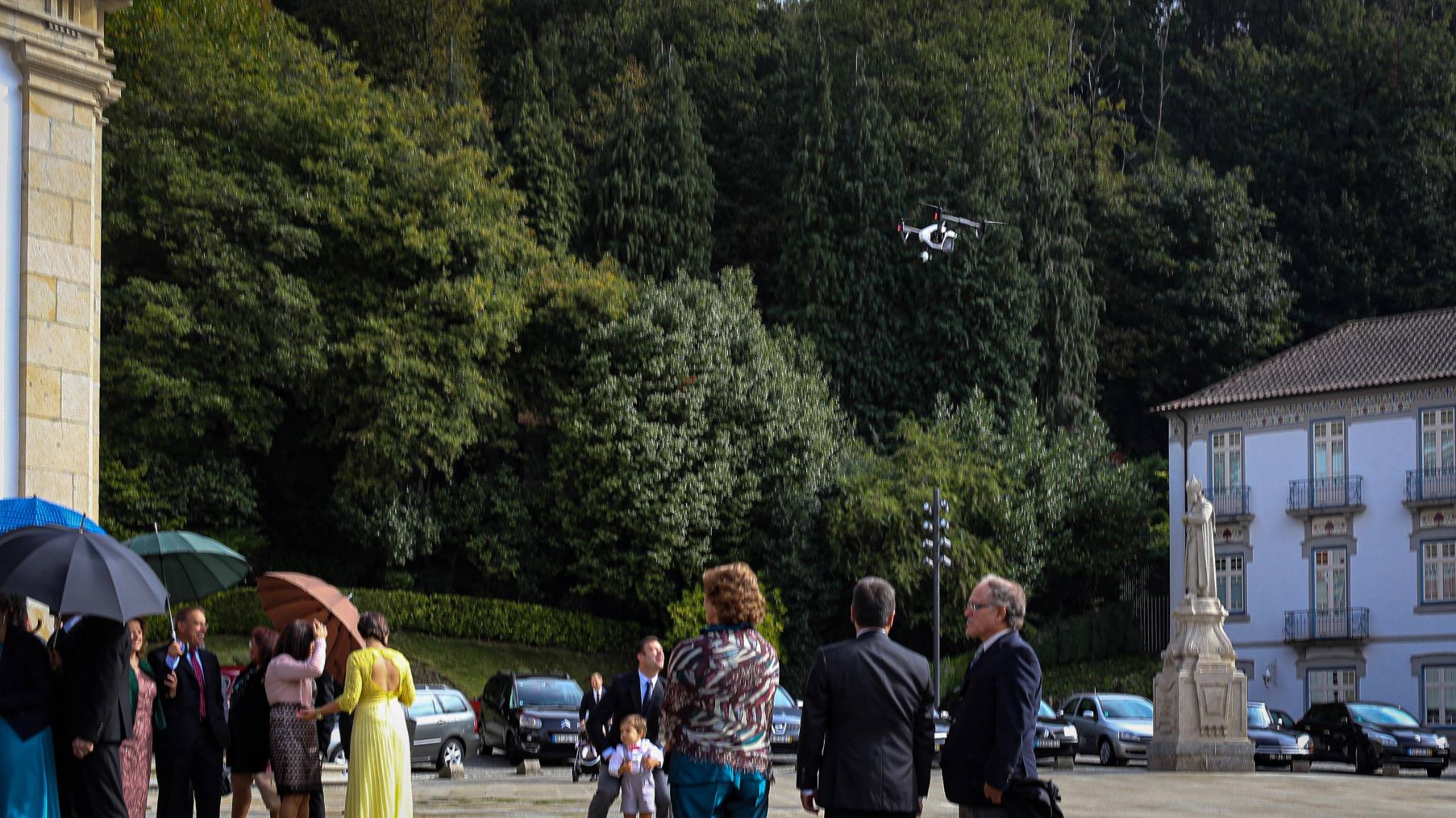
Photo: Pxef.com.
Look at how much is happening in this photograph. On the left, a pale stone facade rises out of the frame, its carved mouldings giving the gathering an architectural edge. Beneath it, blue, black, green and brown umbrellas overlap above guests in formal clothes. A woman in a bright yellow dress, with an open detail at the back, provides the strongest burst of colour among the dark jackets and softer pinks. Near the centre, a child in pale clothes stands beside an adult in a suit; closer to the camera, a patterned jacket and turquoise trousers add another patch of colour. To the right, two men in dark suits face towards the activity. Behind them are parked cars, a stone figure on a tall pedestal and a pale blue building with white window frames, narrow balconies and a tiled roof. Dense trees fill most of the background. Against that dark green wall, the light-coloured drone is easy to pick out, its arms extended and small camera suspended below. The frame brings together the familiar ingredients of a wedding gathering and a very contemporary observer.
That observer solves a particular photographic problem: how to show the scale of the place without losing the wedding inside it. A ground-level wide-angle photograph might show the facade and the guests, but the photographer has to work around bodies, cars and street furniture. From a suitable aerial viewpoint, the relationships become clearer. A courtyard acquires a shape. A garden becomes a pattern. The couple can appear within the landscape they chose for the occasion. For destination weddings especially, that sense of place can carry real emotional weight. People travelled to be there; showing where “there” was belongs in the story.
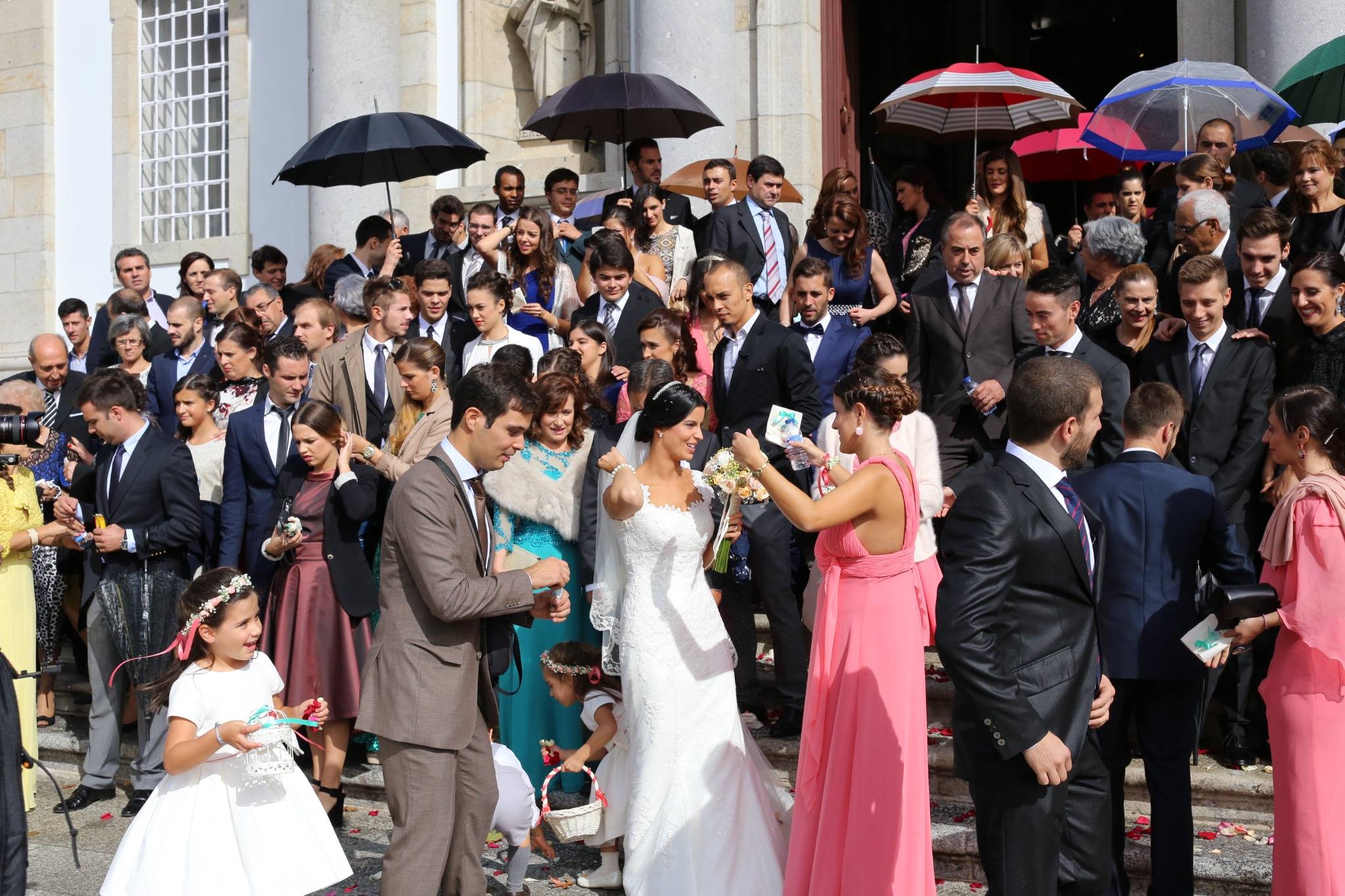
Photo: Pxef.com.
The second photograph makes the scale of the occasion much easier to understand. Dozens of guests fill the steps outside a broad, columned entrance, overlapping in rows that run right to the edges of the frame. Near the centre, the bride holds a pale bouquet against her white lace dress and veil, while a woman in a flowing coral-pink dress faces her with an arm raised. A man in a taupe suit occupies the foreground to the left; dark-suited guests crowd the right. Two flower girls in white dresses, floral headbands and bright ribbons bring the scene down to a child’s height, with a small basket resting near the bride. Above the gathering, black umbrellas mingle with red-and-white stripes and a transparent canopy edged in blue. Pale stone columns, a tall gridded window and the dark doorway hold the background together. It is a wonderfully busy scene, full of small exchanges, but from this position one guest’s shoulder can hide another guest’s face. Even the group itself continues beyond the photograph.
This is where the practical need for a drone becomes clear: the photographer needs a viewpoint from which the gathering can be understood as a whole. Stepping farther back may introduce more foreground without revealing the people behind the front rows; going wider can make the faces near the edges stretch while the people at the back remain obscured. An elevated, oblique view can separate those rows and show how the wedding party fills the entrance and surrounding space. A balcony or another suitable raised position could serve the same purpose, when available. A drone gives the team another way to reach that useful angle, subject to a suitable flight position and permissions. The aim is enough elevation to make the group readable while keeping the people recognisable. Beside the first photograph, this second frame explains why someone wanted a camera in the air in the first place.
Smaller aircraft and integrated cameras have also made aerial work easier to bring into an ordinary production. A wedding team can carry a drone alongside its other equipment, with stabilised capture and a live view that lets the operator judge a composition from the ground. That accessibility helps explain the appeal, but flying remains a separate skill. There is a considerable difference between getting an aircraft airborne and returning with a shot that belongs in an album. Good positioning, suitable light and a clear subject still decide whether the picture works. Height alone has never rescued a weak composition.
Wedding films have given drones an especially comfortable home. A brief aerial view can introduce the venue before the edit moves indoors to preparations, or provide a pause between an energetic reception sequence and a quieter portrait. Those images circulate as trailers and social clips, where a sweeping view communicates a setting almost immediately. Couples see that visual language and begin to expect some version of it in their own coverage. It is a plausible cycle of familiarity and demand, rather than evidence that an aerial shot is now compulsory. Personally, I would rather see one well-chosen view than the same orbit repeated around every available building.
Still photographs deserve their own planning. The best height for a moving reveal may leave a couple too small in a single frame. A strong aerial portrait needs readable figures, useful contrast between clothing and ground, and enough space around the subject to make the viewpoint worthwhile. A path, a clean lawn or a geometric terrace can give the composition structure. When the scene is full of parked cars, umbrellas and guests moving in different directions, a higher camera can simply record more clutter. The photograph here is valuable partly because it reminds us what the finished highlight reel leaves outside the frame: an actual event with people waiting, talking and getting on with the day.
There is also the question of manners. Rotor noise can intrude on vows, readings and conversations, and people looking up at an aircraft are no longer absorbed in the moment the ground photographer wanted to capture. Short, planned flights away from sensitive parts of the ceremony make more sense than keeping a drone present throughout. A dedicated operator can coordinate with the lead photographer while ground coverage continues. The kiss, the exchange of rings and a parent’s fleeting expression do not wait for someone to finish landing.
Permission and flight planning belong in that coordination too. Venue approval does not settle airspace restrictions, and wedding guests should never be treated as convenient obstacles to fly over. Rules depend on location and the operation. In the United States, commercial drone work generally falls under Part 107, and flights over people are subject to specific requirements; a small aircraft does not automatically make any route acceptable. The pilot needs to assess the site, the weather and the people nearby, with a workable plan for cancelling aerial coverage. This photograph alone cannot establish the aircraft’s distance from the guests or the permissions in place.
What makes drones likely to remain part of wedding photography is their ability to add a useful scale to the visual story. The ground camera records faces, gestures and relationships. A thoughtfully placed aerial camera can connect those people to a garden, a coastline or a building that mattered to them. As the equipment becomes more familiar, the interesting judgement shifts towards when to use it, and when to leave it packed. The wedding deserves the attention. The drone earns its place when the resulting photograph helps us remember it.