Shooting Through a Wet Train Window: Focus, Reflections, and the One Pass You Get
Lyon, 15 July 2018, early evening, a few hours after France won the World Cup final. The frame was taken from inside a carriage rolling into the station, through a window covered in water. Two women with tricolour paint on their cheeks and a flag rolled under an arm, a man in a cap on his phone, white bevelled tile, a notice about the Eurexpo access closure running to 31 August. Across all of it, a scatter of soft bright discs that are not confetti and not sensor dust. They are drops on the glass, sitting a couple of centimetres from the lens.
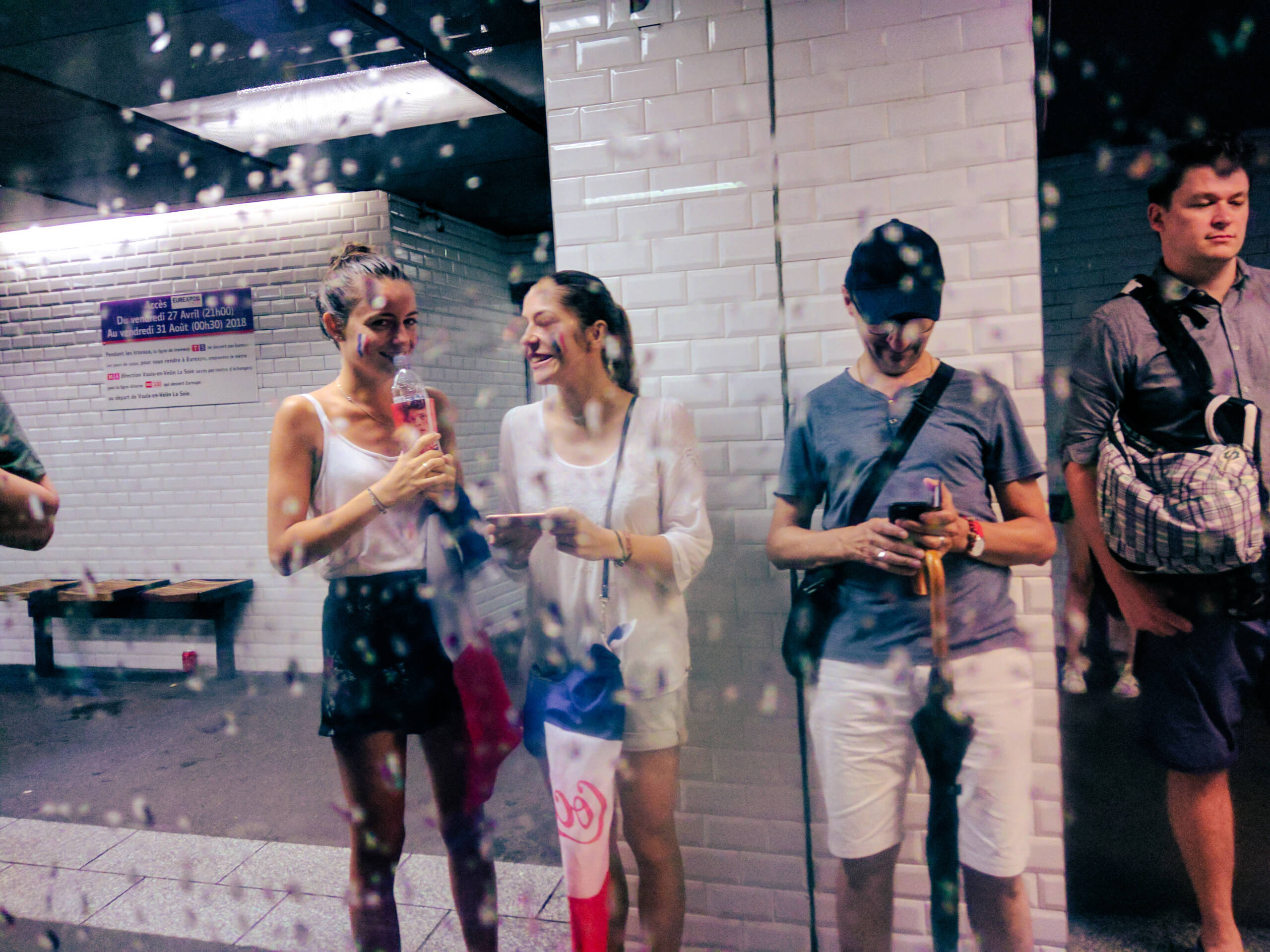
Shooting out of a train window is one of the few street situations where every variable is against you at once. The subject is outside, the camera is inside, the glass is dirty or wet, the carriage is lit, and the whole thing lasts about four seconds. Worth breaking down, because the same problem shows up on ferries, buses, cable cars and hotel windows.
Why the drops render that large
A drop on the glass is not blurred because it moved. It is blurred because it is close. The optics do not care what kind of camera you are holding. Focus at three metres and the near limit of acceptable sharpness sits somewhere around a metre, even on a phone with its tiny actual focal length and huge depth of field. A drop two centimetres away is not slightly outside that zone, it is two orders of magnitude outside it. It also sits at enormous magnification, so a bead of water a millimetre across paints a disc the size of somebody’s head.
The consequence is a choice you cannot avoid. You can focus on the drops or you can focus on the platform. There is no aperture on any camera that gets both. Pick the platform and accept the veil.
What the glass does to autofocus
Wet glass close to the lens gives an autofocus system exactly the kind of high contrast edge it is hunting for. Continuous AF will pump between the drops and the platform for as long as you hold the half press, and the train arrives before it settles.
Three fixes, in order of reliability. Tap a face, lock focus, keep the half press and recompose. Switch out of continuous AF into single shot, because tracking is the wrong tool when the thing entering the frame is not the subject. Best of all, on an adapted manual lens, set the distance by hand before the station comes into view and never let the camera vote at all. A cheap manual 35mm or 50mm on a crop body beats any tracking algorithm here for the simple reason that there is no algorithm.
Reflections, and getting rid of them
The carriage interior is lit and the window is a mirror. Look along the top of this frame and the ceiling panels of the train are printed across the glass. Two things reduce that. Put the front element as close to the window as you can without touching it, which cuts the angle at which interior light can bounce in. Shoot slightly off perpendicular, which throws the reflection of your own body and phone screen out of frame instead of straight back at you.
Never fire a flash. It lights the glass and the water and nothing else, and the platform disappears behind a wall of white.
Exposure and shutter
Metering is deceptive because the dark carriage fills the near field and the tiled platform is comparatively bright. Meter on a face, not on the scene, or the people come out underexposed against blown tile. Station light at this level lands around ISO 1600 and up on most bodies.
Shutter speed matters more than usual because the camera is on a decelerating train. Standing subjects are still moving relative to you. Below 1/125 the platform smears sideways while the drops stay put, which reads as a technical error rather than a decision. Faster is better and the ISO cost is worth it.
You get one pass
There is no second attempt. The train arrives, the doors open, and the composition you were building disappears into people boarding. Hold a burst from the moment the platform enters the window and sort it out later. In this frame the drops missed both women’s eyes, which is not skill, it is volume.
Leave them in afterwards. Clarity and dehaze go straight for the veil, and cloning the drops out removes the only evidence of where the camera was standing.
The window is the picture. The platform is what was behind it.