Shooting Wide Open at Night: Why a Fast Prime Beats a High ISO Body
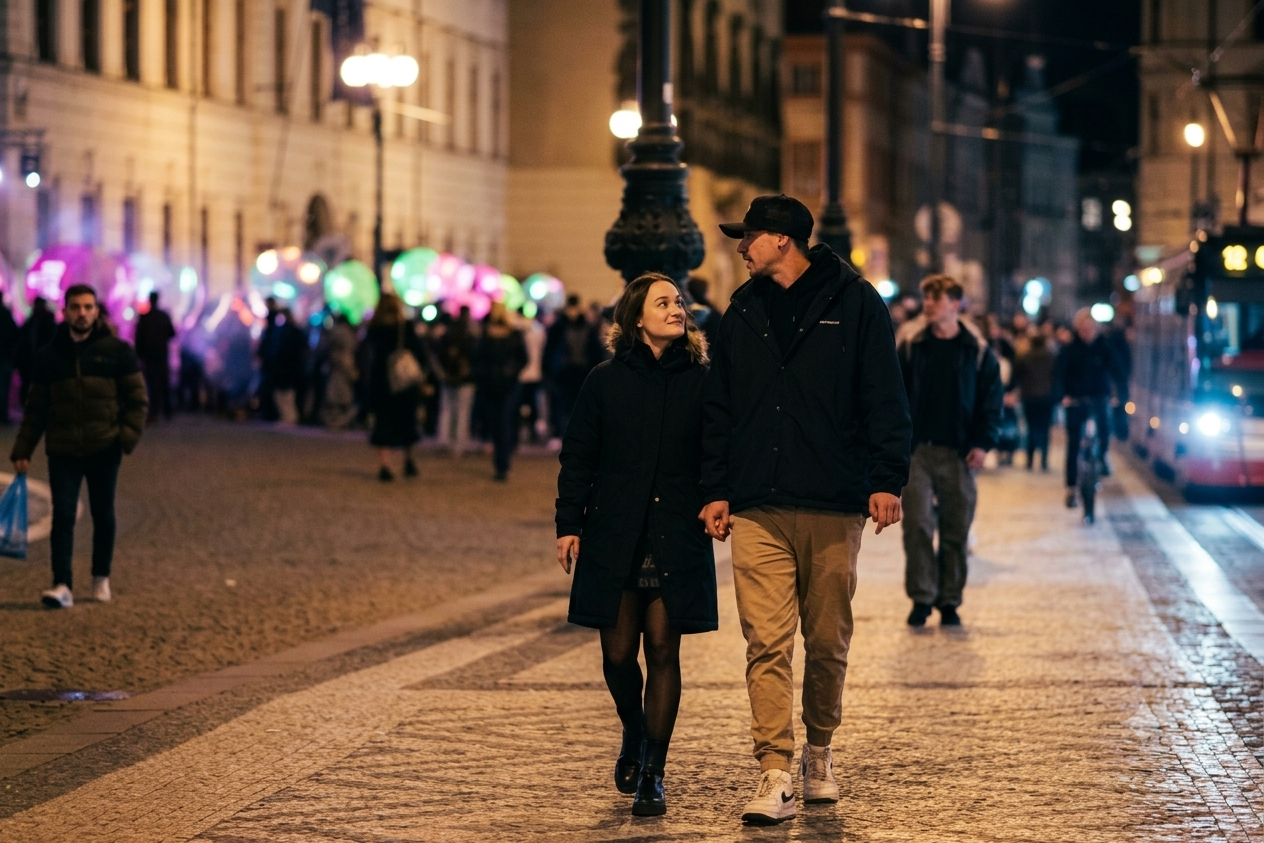
A couple walking down a cobbled city street after dark, sharp from the cap on his head to the stitching on her coat, with a crowd of thirty other people and a moving tram dissolved into soft colour behind them. Nothing in the background is legible. That is the point. The separation was not made in software, and it was not made by cranking the ISO.
The standard advice for night street work is to buy the body with the cleanest high ISO and shoot a modest zoom at f/4. That advice is backwards. A stop of ISO buys you one thing: light. A stop of aperture buys you two: light and separation. Only one of those is recoverable afterwards.
Noise Is a Solved Problem, Separation Is Not
Machine learning denoise has changed the maths. DxO PureRAW and the Lightroom denoise module will pull a clean file out of ISO 12800 on a decent full frame sensor and give you something that prints at A3 without apology. Call it two stops of free performance on any body made in the last decade. That means the difference between a class-leading sensor and an average one has narrowed to almost nothing for this kind of shooting.
Nothing has narrowed the optical gap. There is no slider that turns an f/4 background into an f/1.8 background. Depth of field is geometry. If the crowd behind your subject is rendered as recognisable faces and readable shop signs, you own that decision forever. The frame above works because the coloured installations forty metres back are reduced to overlapping discs of magenta and green, and the tram is a red smear with two headlights. At f/4 that background is a mess of competing detail and the couple stops being the subject.
Buy the aperture. Fix the noise later.
The Shutter Floor Is Higher Than You Think
The mistake that ruins most night street frames is not noise. It is shutter speed. People walk, and walking is not a slow motion. The torso moves at maybe 1.4 metres per second, the swinging hand and the trailing foot move at two or three times that.
At a working distance of ten to fifteen metres with a short telephoto, 1/250 is the floor for a walking subject. 1/320 is where hands and shoe edges stop smearing. Below 1/160 you are producing a frame where the face is sharp and the feet are not, which reads as a mistake rather than as motion.
In-body stabilisation does nothing for this. IBIS corrects your shake, not their movement. A five stop rating tempts you down to 1/30 and every frame comes back soft in the places that matter. Turn it on if you like, then ignore it and set the shutter by the subject.
Do the arithmetic backwards. 1/250 is the requirement. Street lighting at night is somewhere around EV 4 to 6 on a lit shopping street. At f/1.8 that lands you at ISO 3200 to 6400, which is fine. At f/4 the same shutter needs ISO 16000 to 25600, and now you are asking the denoise software to reconstruct skin tone rather than just clean it up.
Depth of Field at Street Distance Is Forgiving
The objection to shooting wide open is that you will miss focus. That objection comes from portrait shooters working at two metres, where f/1.8 gives you a couple of centimetres and the near eye is sharp while the far eye is not.
Street distances are different. An 85mm at f/1.8 focused at twelve metres holds roughly a metre and a half of acceptable sharpness. Two people walking side by side are both inside it. A 135mm at f/2 at the same distance is tighter but still gives you enough to cover a stride’s worth of forward movement between the half press and the frame.
That is the whole trick. Wide open is dangerous close in and generous at distance. Night street work happens at distance.
Focus Technique When the Face Is Small and Dark
Eye detection needs contrast and pixels. At fifteen metres a face occupies a small part of the frame and it is lit from above by a sodium lamp, which puts the eye sockets in shadow. The detection will grab it, lose it, grab the person behind, and hunt. Fighting the system frame by frame is how you miss the moment.
Two approaches that work:
Set a single small AF point, put it on the head, keep the shutter half pressed and let servo track while you wait for the subject to reach the pool of light you have already chosen. The AF only has to hold a lock it already has, which is far easier than acquiring one.
Or prefocus manually on the paving at the distance you want, switch to manual, and shoot when they arrive on that line. This is zone focusing with a fast lens, and it works better than its reputation because of the metre and a half you have to play with.
Back button focus makes both of these easier because it separates the decision to lock from the decision to fire.
Meter Manually or the Camera Will Fight You
Evaluative metering sees a mostly black frame and pushes the exposure up. The face blows, the lamps blow harder, and the whole thing goes flat. Then a bright shop window enters the edge of the frame two steps later and the camera swings the other way.
Set shutter and aperture yourself. Let ISO float on auto with somewhere between two thirds and a full stop of negative compensation dialled in. Now the exposure is anchored to the thing you care about, the file gets darker rather than noisier when the scene gets darker, and consecutive frames of the same subject match instead of stepping around by a stop.
Accept blown highlights on the light sources. A street lamp rendered as pure white is what a street lamp looks like. Protecting it costs you the face.
Mixed Light Is Information, Not a Problem
A night street is lit by three or four different sources at once: warm sodium or warm LED street lighting, cool white LED from shopfronts, and whatever colour the installations and signage are throwing. Auto white balance will average all of that and hand you a neutral, dead file, and it will pick a different average every frame.
Fix the white balance manually, roughly on the light falling on your subject. The subject reads correct and everything else keeps its colour cast. Warm faces against a cold magenta and green background is not an error to be corrected. It is the separation working a second time, by hue instead of by focus.
The Cheap Version of This Kit
None of the above requires expensive glass. The Canon EF 85mm f/1.8 and EF 100mm f/2 are decades old, sell used for very little, and adapt to RF bodies with no loss of function. Both are a full two and a bit stops faster than a kit zoom at the long end. On a crop body the 85 frames like a 136 and keeps its f/1.8, which is free reach for the cost of a slightly noisier sensor that the denoise pass will hide anyway.
The modern equivalents are sharper wide open and focus faster. They are not three times better, and at ISO 6400 with a moving subject you will not see the difference.
Where to Stand
Background blur is a distance ratio, not just an aperture setting. The further the background sits behind the subject, the larger the out of focus discs and the more complete the separation. Standing close to a wall of people gives you a busy grey mush. Standing so your subject is ten metres out and the crowd is another thirty behind them gives you the colour field in the frame above.
So pick the spot first. Find a pool of clean light with depth behind it, stand still, set everything, and wait for people to walk into it. Chasing subjects around a night street produces bad focus and worse backgrounds.
The couple did not know the picture was being taken. The lights behind them did all the work.