Shooting the Rialto Bridge at Night Without a Tripod
On paper this scene should not work. A floodlit white stone bridge sits against a sky with no light in it at all, the water throws back a dozen point sources at different colour temperatures, and the whole thing has to be held still by hand because you are standing on a floating pontoon with people moving past your shoulder.
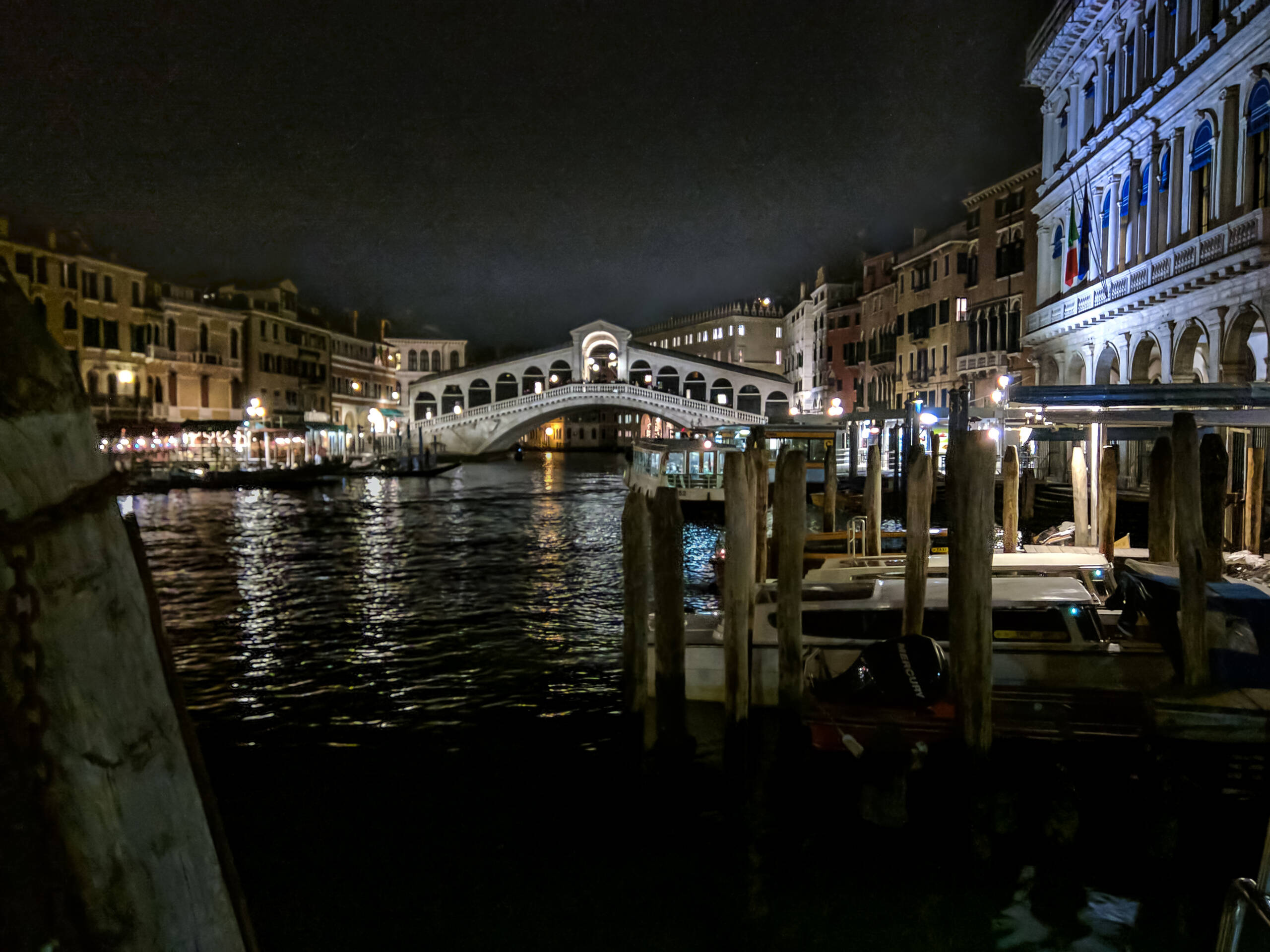
Start with why the tripod is not the answer here. The banks along this stretch are narrow, busy well past midnight, and the good vantage points are all working infrastructure: vaporetto stops, taxi pontoons, delivery moorings. Setting legs down in any of them puts you in someone’s way and gets you moved on. The pontoons also float, which means a long exposure records the swell of every passing hull whether your camera is bolted down or not. A tripod buys you nothing on a moving platform.
So brace instead. The mooring piles are the best support in the city: hardwood, roughly chest height, driven deep enough that they do not move. Press the camera body into the top of one, or wedge your elbows against a pontoon rail and breathe out before firing. That gets most people two to three usable stops below their normal handheld floor.
Meter for the bridge, not the scene. It is by far the brightest element and it is white, so any average metering will blow it into a featureless slab and you will not get it back. Expose so the stonework holds detail and let the sky and the far arcades fall away. The black in this frame is doing structural work. It hides the clutter along both banks and pushes the eye down the canal to the one lit object.
Autofocus will hunt. Contrast detection has nothing to lock onto in most of the frame, and phase detection struggles below a certain light level regardless of what the marketing says. Aim at a lamp, a lit window, or the edge of the bridge itself, lock, recompose. Manual focus at infinity is the fallback and it is usually close enough at these apertures.
Accept the noise. This frame was made with a phone sensor in 2017 and the grain in the sky is not subtle. Trying to clean it with heavy noise reduction produces the plastic smear that ruins more night photographs than grain ever has. Leave texture in it. Grain in a dark sky reads as film. Smeared grey reads as a mistake.
The white balance is a compromise you have to choose rather than solve. There are at least three light sources here: warm sodium along the banks, colder floodlighting on the bridge, and whatever the palazzo on the right is throwing out, which sits close to blue. Pick one and let the others drift. Neutralising all of them flattens the picture into something that looks like daylight, which is not what you came out at this hour to record.
One practical note on timing. The reflections need a little chop to break up into strands. Flat calm water gives you a mirror, which sounds better than it looks, because it doubles the frame and halves the interest.