Why a Fisheye Is the Natural Lens for Cathedral Interiors
Most of the arguments against fisheye lenses come from people shooting outdoors, where a bent horizon is an obvious mistake. Take one inside a domed church and the objection quietly disappears. There’s almost nothing in the room that’s supposed to be straight.
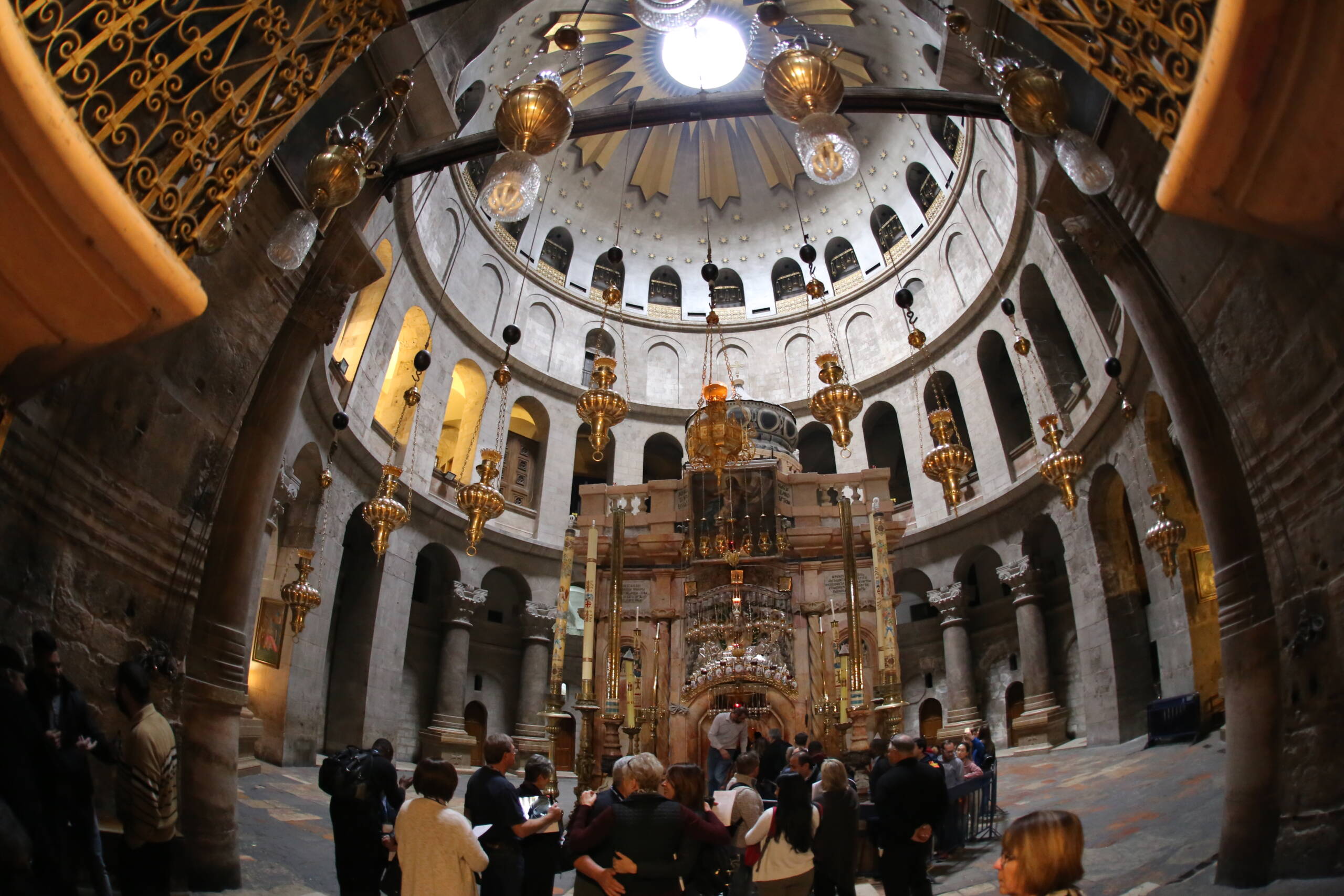
This is the Rotunda of the Church of the Holy Sepulchre in Jerusalem, the circular space built over the Aedicule, the marble kiosk that stands at the centre of the frame. The camera is low and roughly level, maybe fifteen metres back, handheld, in the middle of a crowd.
What the lens actually caught
Start at the top. The oculus is blown out, as it always is, and around it the ceiling opens into a starburst of gilded and blue-grey rays. Below that runs the drum, cream stone set with small gold stars, then a ring of narrow arched windows. A dark horizontal beam cuts across the upper third with brass lamps hanging off it on chains. In the top-left corner there’s a panel of gold scrollwork from a gallery front, curled almost into a half-circle by the projection, and under it a stone pier bows into the frame edge like something out of a Gaudí drawing. It isn’t bent in the building. It’s bent here.
The two tiers of arcades sweep round in a way you can feel. Lamps hang everywhere at different heights, gilt bodies, clear glass globes, dark spheres strung between them on the same chains. The Aedicule sits at the middle, tall painted candles at its corners, icons above the door, a cluster of gold lamps over the entrance, one man standing in the doorway small enough to give you the scale of it. Along the bottom edge, a tour group in winter coats, backs to the camera, one of them holding a printed sheet, a metal queue barrier at the right. Warm tungsten spots fight cold daylight from the oculus and neither wins.
The room is already curved
A rectilinear ultra-wide keeps straight lines straight, which sounds like a virtue until you point it up at a dome. The lines it’s protecting are the ones the architect drew as arcs, and to protect the few genuine verticals it stretches the corners, so the columns at the frame edge come out fat and the faces at the bottom come out wrong.
The fisheye trades that away. Nothing at the edge gets stretched, everything gets compressed evenly toward the rim, and the price is that straight lines bow. In a rotunda that price is close to zero. The arcade curves, the drum curves, the ring of lamps curves. Barrel distortion here reads as the shape of the building rather than as an error, and most people looking at the picture never work out what lens was on the camera.
You cannot back up
The other case for it is duller and more decisive. In a church you shoot from where you’re allowed to stand. There’s a queue, there’s a barrier, there’s a group of thirty people from Bari in front of you, and the interesting thing about the space is that the ceiling and the floor belong to the same picture. A 16mm rectilinear gets you the dome or the Aedicule. A fisheye gets you the dome, the Aedicule, both storeys of arcade and the crowd, from a spot you can actually occupy without anyone asking you to move.
Depth of field comes free at that focal length. Stop down to f/4 and the candles two metres away are as sharp as the oculus, so you can stop thinking about focus and start thinking about where the middle of the frame is pointed. It’s also forgiving of slow shutters. Handheld at 1/20 with a fisheye you get frames you’d throw away at 85mm, which matters in a building where tripods and flash are usually out of the question.
The rules it does impose
Two, and they’re strict.
Keep the camera level. Tilt it up and the whole dome slides to one edge, the floor line curls into a smile, and the picture starts to look like a mistake instead of a decision. Level and centred is what makes the bending read as architecture.
Keep people out of the extreme corners. The stretch at the rim is mild compared to a rectilinear, but it will still find a face and widen it. In this frame the crowd sits along the bottom edge and slightly in, where the compression flattens them into a band of dark coats and heads. They’re doing a job, giving the Aedicule its height, and none of them is close enough to the corner to be caricatured.
There’s a third habit worth picking up. Shoot the same scene twice, once with the fisheye and once with something conventional, because the fisheye frame is the one you’ll want and the conventional frame is the one you’ll be glad you have when someone asks for a picture of the Aedicule alone.
Defish it in software if you like. You’ll get a wider rectilinear image with soft, stretched corners and a lot less frame, and you’ll have spent an afternoon turning a picture of a round building into a picture of a slightly less round building.