Wet Paving at Night: A Handheld Street Frame of Two Runners and a Collie
Two runners, a dog on a leash, a row of bike hoops, a road full of headlights. Shot handheld from behind and slightly above, on a public plaza, with nothing on the subjects except the street lamps. The thing holding it together is the water on the ground.
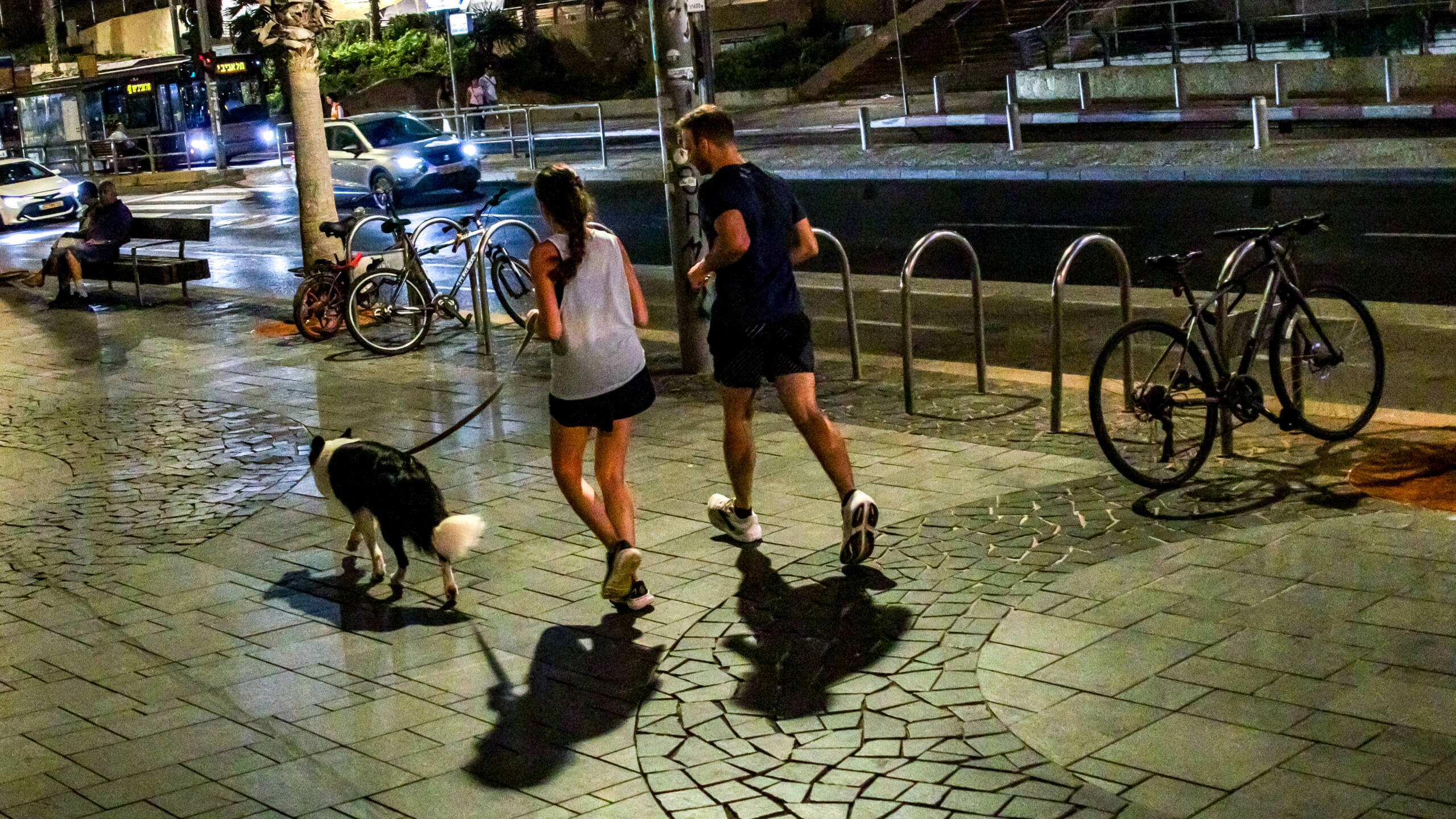
Before the technique, here’s the frame in full, written out the way I’d write it for a caption file or an archive record.
The frame, described
Night street scene, wet pavement, shot from behind at a slight elevation.
The main subjects. A woman and a man run away from the camera across a broad paved plaza. The woman is on the left in a loose white sleeveless tank and short black running shorts, her hair pulled into a long braided ponytail that falls between her shoulder blades. Her right arm is extended back and down, holding a thin leash that runs diagonally to a dog behind her. She’s mid-stride, right foot lifting, wearing pale cream sneakers with dark soles. The man is a step ahead and to the right, in a navy short-sleeve tee and dark shorts with faint vertical stripe detail, chunky white sneakers with heavy sculpted midsoles. His head is turned slightly left, catching light on his cheek and short fair hair, arms bent in a running position. Both cast long dark shadows forward and to the right across the stone.
The dog. A black-and-white border collie trots at the left edge of the frame, head lowered toward the ground, body in profile, white blaze on the muzzle and chest, white-tipped tail, white socks on the hind legs. The leash arcs up from its collar toward the woman’s hand.
Middle ground. A scarred metal pole covered in sticker residue rises between the two runners, cutting the frame vertically. To the right, a long row of chrome inverted-U bike hoops recedes toward the upper right, with a dark hybrid bicycle locked into the last one at the right edge and a second bike partially cropped beyond it. Two more bicycles lean against the racks behind the woman, one with a bright red seat clamp and a lock hanging from the frame.
Background. Across a road: a bus stop shelter and an articulated city bus with an orange LED destination sign in Hebrew, a white sedan with headlights burning at far left, a silver crossover mid-turn with a blue car behind it, all with lights flaring off the wet asphalt. A thick palm trunk anchors the left-center. A person sits alone on a slatted bench, legs crossed, looking down. Further back are pedestrians by a metal railing, low bollards, a zebra crossing, and a wide staircase climbing to a raised promenade on the right.
Light and surface. Everything sits under mixed streetlight — a greenish-yellow cast over the stone, cooler blue in the road area, a warm orange pool at the lower right corner. The paving is damp and reflective: rectangular slabs in the foreground opening into a circular crazy-paving mosaic under the runners’ feet, with headlight streaks and pole reflections smeared across the wet surface.
Water on the ground is a free light source
Dry paving at night eats light. It takes the fall from a street lamp and gives back almost nothing, so you get a black floor with two bright figures floating on it, and the shadows go to mud.
Wet paving does the opposite. It turns into a rough mirror, so every lamp in the plaza gets a second life as a smear on the stone, and the ground reads as a surface with tone in it rather than a hole. Look at the bottom half of this frame: there’s detail across all of it, and none of that detail came from a light I brought.
The practical rule is simple. Go out after it rains. Ten minutes of drizzle changes a location more than a stop and a half of extra aperture.
Shutter speed against a running subject
Both figures are mid-stride and both are readable. The feet aren’t frozen, and I didn’t want them frozen. Freezing a runner at night costs you a lot of ISO, and it also kills the thing you were photographing, which is people moving.
What matters is which part of the body has to be sharp. On a subject moving away from the camera, the torso and head shift slowly across the frame even when the legs are flying. So you expose for the torso being clean and let the shoes and the leash go soft. In practice that’s somewhere around 1/125 to 1/200 handheld, which is slow for a runner and fast enough for this geometry.
Cross the same runner left to right at the same distance and you’d need three or four times that.
The pole is the problem
There’s a scarred metal pole running straight up through the gap between the two figures. It stops the picture from turning into two people and a background.
It also nearly ruins it. Move a foot to the left when I pressed the shutter and it lands on the man’s shoulder. Move a foot right and it stacks on the woman’s head. At night, on the move, you don’t get to compose that carefully, so you shoot the sequence and pick the frame where the vertical falls into a gap.
Same thing with the bike hoops on the right. As a row they give the picture depth, a receding line that takes your eye back to the road. Individually they’re clutter, and if the runners had been three metres further right they’d be tangled in chrome.
Mixed colour temperature: fix some of it, keep the rest
Three light sources here, and they don’t agree. Green-yellow over the stone, cold blue over the road, warm orange in the bottom right corner.
The instinct is to neutralise all of it. Don’t. A single global white balance either turns the stone grey and the road corpse-blue, or warms the road and leaves the whole plaza looking like an old fluorescent office. Neither one looks like the place felt.
What I do instead: set white balance on the skin, because that’s what a viewer checks first. Then pull the green out of the paving with the HSL panel rather than the temperature slider, and leave the road and the corner alone. The colour clash is information. It tells you there are three different systems lighting this square, and that’s true.
Backs, not faces
Nobody in this frame is identifiable. The runners are going away, the dog is looking at the ground, the woman on the bench is looking down, and the figures near the railing are small and dark.
That’s not an accident and it isn’t only a legal comfort. A face at night, lit by a street lamp from above, is usually the worst part of the picture. Hard shadows in the eye sockets, shine on the forehead, a half-expression that reads as a grimace. Backs give you posture instead, and posture at full stride says more about what these two are doing than a face would.
The shadows do the rest. Both figures throw long dark shapes forward and right across the stone, and those shadows are the second subject.
Wait for rain. Shoot the ground.