Street Photography Dos and Don'ts: Shooting a Crowded Promenade With a Long Lens
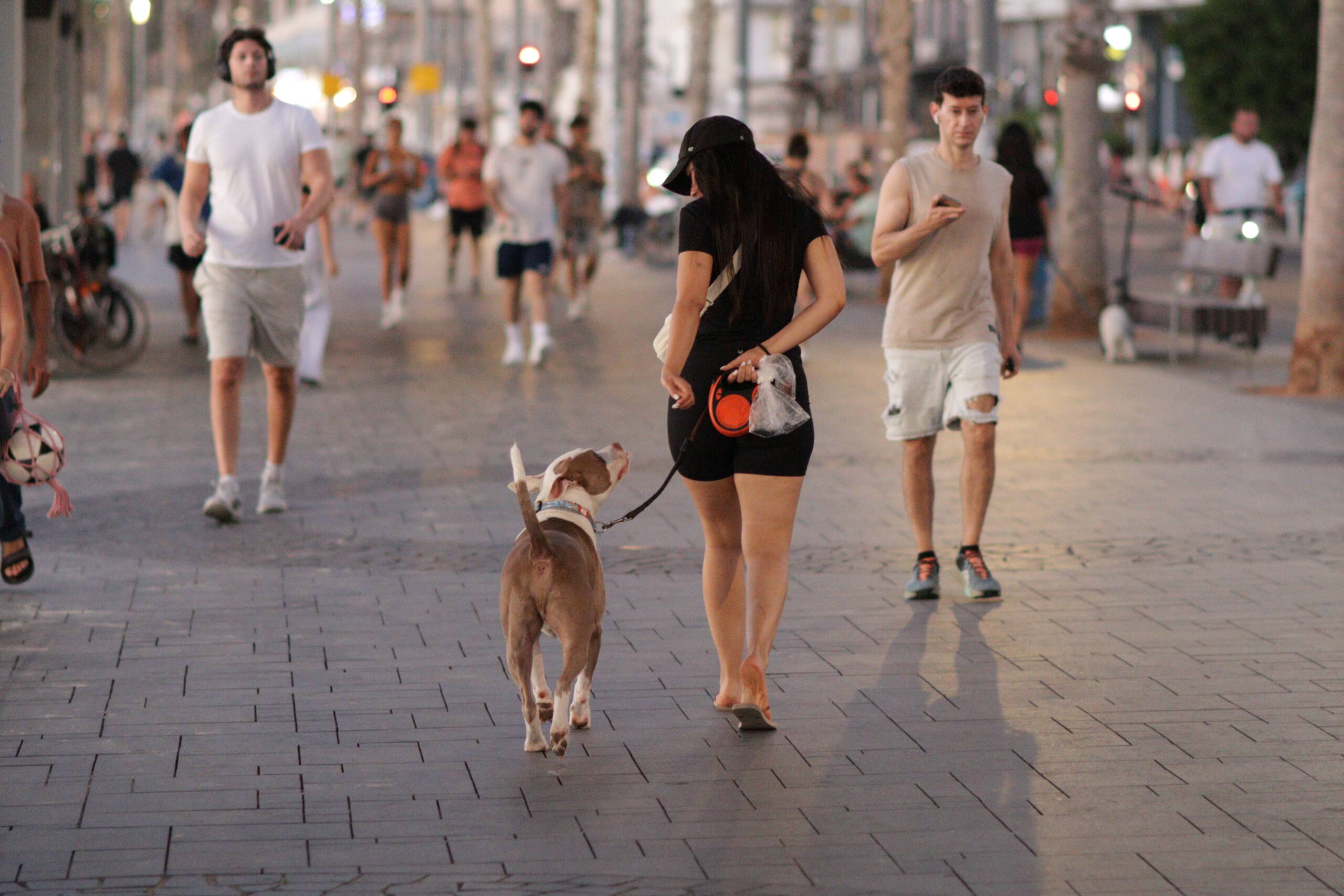
Most street photography advice assumes you’re standing close with a 35mm, waiting for someone to walk into a doorway of light. That’s one way to do it. The frame below is the other way: a short telephoto, wide open, shot down the length of a busy promenade at dusk, everyone moving, nobody posing, nobody aware.
The long-lens approach solves some problems and creates others. Here’s what it gets right, and where it goes wrong.
Do shoot from behind
Backs work. The woman here is the whole subject and you never see her face, which means the picture carries the moment without carrying a person’s identity. The dog does the storytelling instead: head turned up and back toward her, front paw off the ground, ears cocked. You get the relationship without the portrait.
This isn’t a cop-out for people too shy to shoot faces. It’s a different picture. A face pulls all attention to expression, and expression is a lottery at 1/250s. Take the face away and the reader starts looking at posture, at the gap between two walkers, at where the hands are. That’s usually where the story was anyway.
Don’t let ISO do the aperture’s job
Dusk on a lit street is a trap. Your meter sees warm sodium and thin blue sky, decides it’s brighter than it is, and you end up at f/5.6, ISO 6400, with a shutter too slow for a moving dog. Open the lens first. This frame is wide open on a fast short tele and the background dissolves into a wash of shopfront lights and out-of-focus walkers, which is the entire reason for shooting here at this hour. Stop down two clicks and it turns into a snapshot of a crowded street.
Then set the shutter for the subject, not for the lens. A person walking toward you at 200mm needs more than the old one-over-focal-length rule suggests. 1/400s and up if there’s a dog in the frame, because dogs move in four directions at once.
Do wait for the feet
Look at the dog’s legs. Both front paws are in the air, mid-bound, and the woman’s back foot has just left the ground. Nobody’s flat-footed. That’s not luck, it’s the third or fourth frame of a short burst, and the first two are in the bin.
Flat feet kill walking pictures. So does clipping them. If you crop the bottom edge above the ankles the whole figure looks like it’s sinking into the pavement. Frame with room underneath and cut later if you want to.
Don’t spray and hope
Short bursts, yes. Twenty-frame machine-gun runs, no. You’ll come home with 900 near-identical files, you won’t cull them properly, and the two good ones will get lost between the 898 mediocre ones. Three to five frames per gesture is enough if you’re actually watching what’s happening rather than watching the frame counter.
The related sin is chimping. Every second you spend looking at the back screen is a second the street is doing something you’re missing. Check exposure once when you arrive, then trust it and keep your eye up.
Do use the layers
The depth here is doing a lot of work. Foreground: a bit of empty paving and a slice of someone’s arm at the left edge. Middle: the subject, the dog, the man in the vest walking the opposite way. Behind them: a receding column of blurred pedestrians, bikes, scooters, palm trunks, and traffic lights going soft. A long lens stacks all that up and compresses it, so a street that feels merely busy in person reads as dense in the picture.
To get it you have to shoot along the street rather than across it. Stand at the edge, point down the length of the pavement, and let people come to you. Which brings us to the one that gets photographers into trouble.
Don’t plant yourself in the traffic flow
Standing dead centre on a busy promenade at golden hour makes you an obstacle, and people notice obstacles. Once they notice you they change how they walk, and the candid quality you came for evaporates. Work from the side. Lean on a railing, sit on a bench, put your back to a tree. You look like someone resting rather than someone hunting, and the street closes back over you within about thirty seconds.
Do think about publishing before you press the shutter
The rules on photographing people in public places vary by country, and the rules on publishing those photos vary more. A recognisable face in a commercial context is where most of the risk sits. Shooting from behind, at distance, with faces turned away or dissolved by shallow depth of field, keeps you clear of nearly all of it.
That’s a practical argument, though it isn’t the main one. The main one is that the picture is better this way. You’re photographing a moment on a street, not a stranger’s face, and once you stop needing the face you start seeing everything else in the frame.
Shoot the walk. Leave the identity out of it.