Robot Photo Booths at Events: What a Rolling Ring Light Can and Cannot Shoot
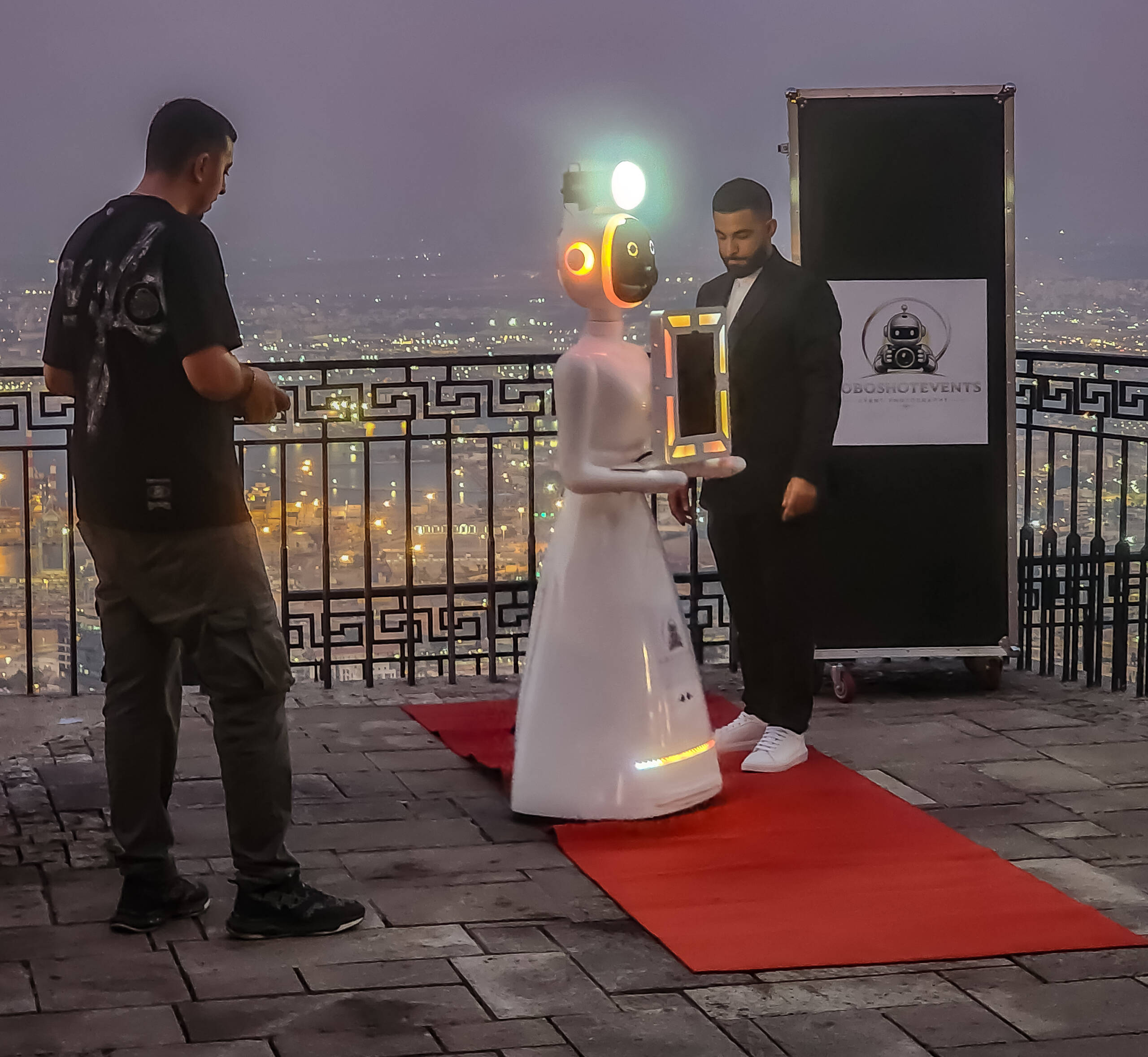
A white service robot in a moulded gown stands on a red carpet at a hilltop terrace, holding a lit screen out at chest height. A ring light glows amber around one eye socket, a small LED panel burns above its head, and the city behind it is deep into blue hour with the streetlights already on. Two men work the edges of the frame. One in a black tee is checking something in his hands, the other in a suit is watching the screen. The branded flight case behind them tells you the whole operation packs into a single box on wheels.
What the machine actually is
Strip the costume off and it’s a photo booth on a drivetrain. Fixed camera, fixed focal length, fixed working distance, continuous LED key light mounted at head height, touchscreen for the guest, wireless upload, usually a dye-sub printer in the base. The robot part is the marketing. The photography part is a small sensor behind a wide lens, about a metre and a half from the guest’s face, lit by a ring at roughly the same distance.
That geometry decides everything it produces. Wide lens close to a face means the nose grows and the ears shrink. Ring light on-axis means flat shadowless skin and a doughnut catchlight in each eye. Every frame it makes looks like every other frame it makes, which is the point. Consistency is the product.
Under the shell
The base is the expensive part. Two driven wheels with castors, a hub motor each, and a battery pack sitting low to keep the centre of gravity under the skirt. That skirt shape is not styling. It is ballast and it is a bumper. Anything tall and light falls over when a guest leans on it, and guests lean on it all night.
Navigation comes in two flavours and the brochures rarely tell you which one you are getting. The autonomous units carry a LIDAR puck or a depth camera, map the venue on arrival, and drive a set of waypoints while dodging legs. The rest are driven by a person on a phone, standing off to the side, looking like he is checking his messages. Look at the man in the black tee in this picture and draw your own conclusion. Either way there are ultrasonic sensors around the base and a bump strip, because the failure mode nobody forgives is rolling over a bride’s dress.
The camera is usually a compact mirrorless body or a dedicated module hidden behind the panel, running tethered to a small PC in the torso. The panel itself does three jobs: live view mirror, countdown, and advertising when nobody is standing in front of it. The lighting is a continuous LED ring around the lens plus whatever fill panel the maker bolted on top, colour balanced to daylight and dimmable but not aimable.
In the base, a dye-sub printer. Four by six in eight to fifteen seconds, a few hundred prints per ribbon, and a paper jam that requires kneeling on the floor in front of two hundred guests. Uploads go out over the venue wifi if it holds, over a 4G dongle if it doesn’t. Delivery is a QR code on the screen, or a text, or an email address typed on the panel by someone holding a drink.
Runtime is six to eight hours on a charge for the good ones, less if the printer is busy and the lights are at full. The flight case in the background of this frame is the whole system: robot, spare ribbon, charger, backdrop, and a laptop.
How a night with one actually runs
The crew arrives two hours early. They roll the unit out of the case, power it up, and walk it around the space so it maps the floor or so the operator learns where the steps are. They set the print template with the client’s logo and the date. They test the network, then test it again, because venue wifi at 19:00 and venue wifi at 22:00 are different networks.
Then it works the room. Attract mode on the screen, slow roll, stop when a guest steps in front. Tap, countdown, three or four frames, choose, print, scan, done. Thirty to forty seconds per group if the queue is behaving. A busy unit gets through several hundred guests in an evening and the crew’s real job is ribbon changes and keeping the carpet clear.
The lighting problem in this frame
Look at what the venue is offering. A city at blue hour, streetlights lit, sky still holding colour. That background sits two or three stops under the guest’s face once the LED is on it. A photographer solves this by dragging the shutter. Expose for the ambient at 1/15 or 1/8, let the light on the stand handle the subject, brace against the railing, accept a little smear in the crowd behind.
The robot can’t do that. It runs a fixed exposure tuned to make skin correct at a known distance, and it has to freeze a guest standing on a carpet rather than on a tripod. So the shutter goes up, the ambient falls away, and the skyline that is the entire reason this event is on a rooftop turns into black mush with a few orange dots in it.
You are paying for the view and the machine is throwing it out.
Why an organiser books one
Throughput first. It works the line without a queue master, guests approach it instead of being approached, and nobody stiffens up the way they do when a stranger with a big body and a 70-200 walks over. Kids go straight to it. The print lands in a hand inside thirty seconds and the file lands in a phone before the guest steps off the carpet. For a two hundred person event that wants everyone leaving with something, that is a real service, and it costs less than a second shooter.
It also doesn’t fall apart at hour four, which is exactly when human event coverage quietly does.
Then there is the part the photographer never sold anyone. Every print carries the client’s logo. Every upload goes through a branded gallery. Every email typed on that panel is a contact record, and every share is a post with the sponsor’s hashtag on it. A corporate client is not buying photographs. They are buying a few hundred pieces of branded content leaving the building in other people’s pockets.
What it’s really selling
The photographs are the second product. The first is the crowd around the machine.
A robot in a gown rolling across a red carpet generates more phone footage than it takes pictures. Guests film it. They film themselves next to it. They film their friends being surprised by it. That material is shot on their cameras, posted from their accounts, and carries no ad spend at all. The unit is a photo booth in the same way a claw machine is a toy dispenser. The interaction is the attraction.
This is why the costume matters more than the sensor. Nobody films a black box on a stand. Novelty has a shelf life and this particular novelty is aging, which is why the units keep getting more elaborate: gowns, mirrors, LED skirts, voices, name badges. The thing being sold is a moment of surprise, and surprise gets expensive to maintain.
What to check before you book one
The floor. This terrace is old stone paving with lipped joints, and a wheeled base with small castors hates lipped joints. Ask about thresholds, cables, gravel, grass, and any step at all.
The lift. It weighs as much as a person and it does not do stairs.
The light. Outdoors after dark it is fine because it brings its own key. Under strong mixed venue lighting it fights the room and loses. In full sun it is useless.
The network, the ribbon count, the battery, and who owns the guest data afterwards. That last one is a contract question, not a technical one, and it is the one clients forget to ask.
What it can’t do
It can’t anticipate. It can’t recompose. It can’t notice that the best picture of the night is the groom’s father alone at the railing with the city under him, and walk over and take it. It shoots when tapped, from where it is parked, at the framing it was born with.
The frame here makes the argument better than I can. The machine is on the carpet under a spotlight, and the actual photograph is the two men either side of it, the flight case, the fog sitting on the lights below. Nobody hired anyone to shoot that. It just happened while the robot was busy being the attraction.
Book the booth for the line. Keep a photographer for the night.