Sports Photography, What a Photographer at Work Teaches Us
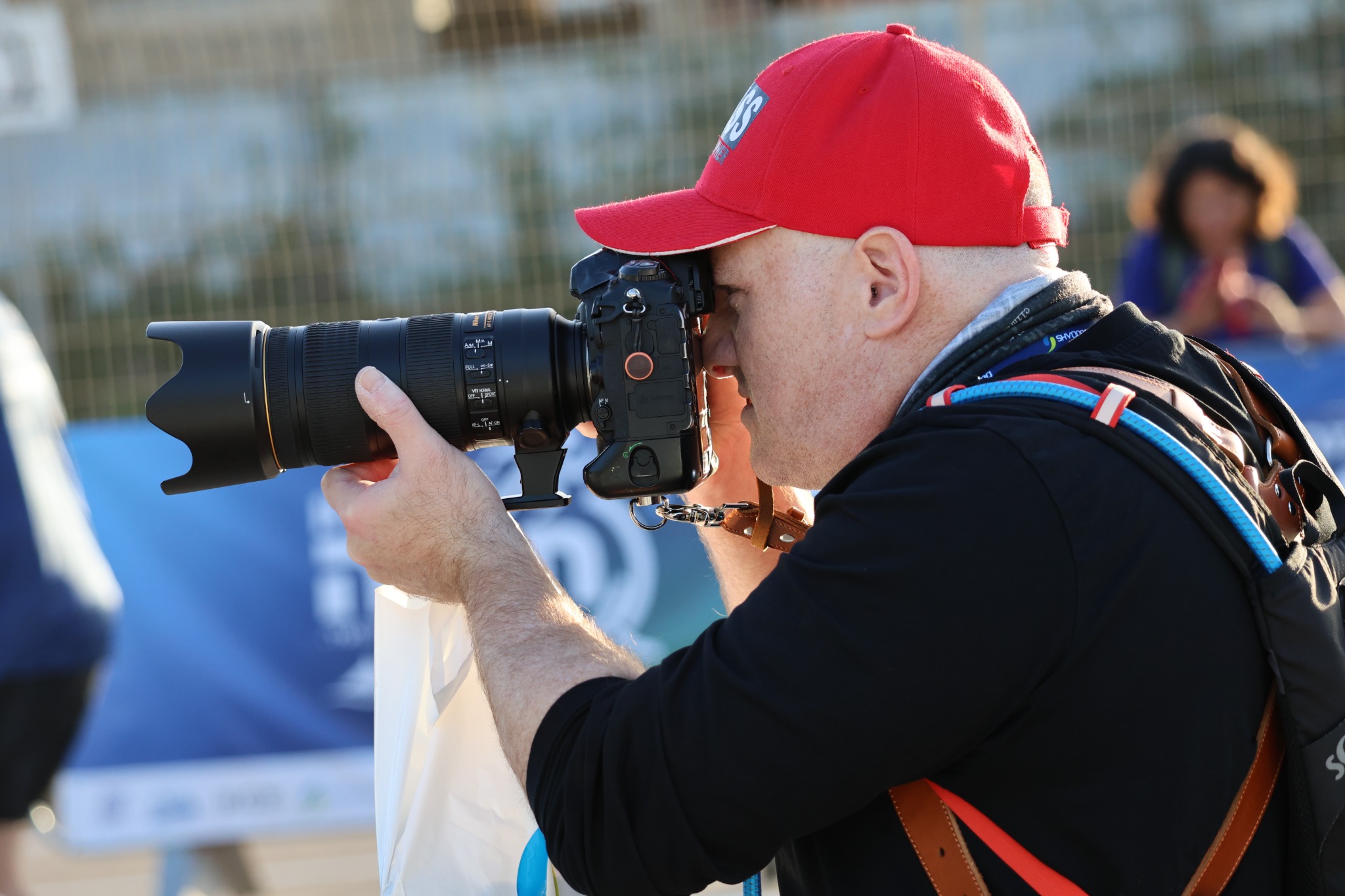
The best way to understand sports photography is sometimes to turn the camera away from the athletes and watch the people photographing them. Here, a photographer in a bright red baseball cap is working at the edge of an outdoor sporting event. He has pressed a large camera firmly to his eye and supports a substantial black zoom lens with his left hand. A broad petal-shaped hood extends toward the left edge of the photograph, and a tripod collar with a foot projects below the lens. The camera appears to have a deep vertical grip, the sort of body built to be held securely during long assignments.
Everything about his posture suggests concentration. His head is angled into the viewfinder, his shoulders are turned toward the action and his left elbow is bent to carry some of the lens weight. A backpack or harness sits across his back, crossed by leather and brightly colored straps. A translucent white bag hangs near his forearm. Behind him, a blue event barrier, wire fencing and a softly blurred spectator place the scene firmly in the working environment of a road race or other public competition. Strong side light catches the red cap, his face and forearm, while the background falls away.
Photograph hosted by Pixel Effects.
The first thing to notice is the left hand. A long zoom changes the balance of the camera, especially with a heavy hood and a tripod foot hanging beneath it. Supporting the lens under its barrel reduces the twisting force on the mount and makes it easier to follow movement smoothly. The right hand operates the shutter and controls while the left hand carries the front-heavy assembly. With a lighter lens, a photographer can get away with sloppy grip for a while. With a heavier one, shaky handling soon shows up in missed frames and tired muscles.
The second lesson is position. At a public sporting event, the best light and the best access do not always coincide. Fencing may block the course, spectators may step in front of the lens and the background can be full of signs and barriers. A sports photographer has to choose a place where the action is likely to happen, where subjects can be seen clearly and where working does not obstruct the competitors, officials or other spectators. Moving a few steps along the barrier can change the angle at which an athlete enters the frame, separate a head from a distracting background or place the sunlight on the right side of a face. There is often more value in those steps than in changing a camera setting.
This image also demonstrates the importance of looking beyond the subject. The photographer’s red cap draws the eye immediately, while the dark camera and lens form a strong horizontal line to the left. His arm leads diagonally back into the frame. The background spectator is out of focus, just recognizable enough to give context without competing for attention. The photographer who made this picture has used depth of field and timing to turn an ordinary working scene into a portrait of concentration. Sports photography can do the same with athletes: separate the subject clearly, but leave enough surroundings to explain where the action is taking place.
There is no single shutter speed for every sport, though 1/1000 second is a useful starting point for freezing runners in daylight. Faster action may need more; panning with a slower shutter can instead show speed through a streaked background. Continuous autofocus and a well-chosen tracking area help, but they cannot decide where the decisive action will occur. Watch the direction of movement, leave room in front of a runner or cyclist, and anticipate the next stride or turn rather than waiting until it has already happened. Short bursts are often more useful than holding down the shutter without a plan.
Comfort matters, too. A long race can mean hours of standing, turning and carrying gear in the sun. The straps in the photograph are a reminder that the camera system has to work on the photographer’s body as well as on a specifications sheet. Lenses should be secure when lowered, bags must stay out of the way, and the photographer should have enough freedom to move quickly without swinging equipment into anyone nearby. Even an expensive setup becomes a liability when its owner spends the day fighting its weight.
For readers who want the equipment side of this assignment, our companion article at PhotoVideoGear.com, Sports Photography Gear Guide, Cameras and Lenses for Race Day looks at camera bodies, telephoto choices, carrying systems and practical race-day preparation. The distinction is worth keeping: gear gives you reach and speed, while fieldcraft determines what you actually bring home. Our earlier piece on the decisive moment in sports photography approaches the same problem from the athlete’s side of the lens.
There is something revealing about this portrait of a photographer at work. We do not see the athlete he is aiming at, so we cannot judge whether he got the shot. What we can see is the preparation that makes a good frame possible: the supported lens, the close eye on the viewfinder, the working position near the course and the attention directed entirely outside the photograph. The decisive instant begins well before the shutter is pressed.